How to Run a Design Thinking Workshop: Stages, Timings and Traps
TL;DR
- A design thinking workshop moves through five stages: empathise, define, ideate, prototype, test. They are scaffolding, not a script.
- Half a day gets you one honest pass at one narrow problem. A full day buys a second round of prototyping, which is where the value actually sits.
- Tables of four to six, and ideas generated in silence before anyone speaks.
- End with a decision, an owner and a date. Otherwise the day was theatre.
A design thinking workshop is not a brainstorm with better stationery. It is a structured session that takes a group from a fuzzy problem to something they have built, tested on a real person, and decided to act on.
Run well, it is the most useful day a team has all quarter. Run badly, it produces a wall of sticky notes that nobody ever opens again. The gap is almost entirely facilitation: how the time is cut, how ideas are collected, and whether anything gets decided before people pick up their coats.
I have hosted and facilitated 800+ events. The energy in a room is a curve, and your agenda either respects it or fights it all day.
What are the five stages of a design thinking workshop?
Empathise, define, ideate, prototype and test. Those are the five modes in the Stanford d.school’s Design Thinking Bootleg, the card deck most workshop agendas are descended from.
Everyone cuts it differently.
| Model | Stages |
|---|---|
| Stanford d.school | Empathise, define, ideate, prototype, test |
| IDEO | Inspiration, ideation, implementation |
| Design Council | Discover, define, develop, deliver |
| Nielsen Norman Group | Empathise, define, ideate, prototype, test, implement |
IDEO sorts its own method cards into three phases and describes the whole thing as a human-centred approach to complex problems. The Design Council’s Double Diamond, drawn in 2003, gives a facilitator the most useful picture: two diamonds that each open out and then narrow, so divergent thinking and convergent thinking get separate slots instead of fighting each other in the same hour.
Nielsen Norman Group adds a sixth stage, implement, and calls it the part most often forgotten. It is also the stage that quietly disappears from most workshop agendas.
Treat the stages as scaffolding, not a recipe. A good workshop will send a table back to redefine its problem after the first test.
How long does each stage take in a half day?
Around three and a half hours of working time, and it only fits if you narrow the brief to one problem before anyone arrives.
| Time | Stage | Minutes |
|---|---|---|
| 09:00 | Welcome, brief, ground rules | 15 |
| 09:15 | Empathise: user interviews or insight review | 40 |
| 09:55 | Define: reframe into one problem statement per table | 25 |
| 10:20 | Break | 15 |
| 10:35 | Ideate: silent generation, then share and cluster | 40 |
| 11:15 | Prototype: build something crude | 45 |
| 12:00 | Test: swap tables, get reactions | 25 |
| 12:25 | Decide: vote, owner, next step | 20 |
Pre-work does the heavy lifting. If the group has to discover the problem from scratch on the day, drop ideation to 25 minutes and accept a rougher prototype.
A full day design thinking workshop agenda
A full day is not a half day with longer slots. The extra time buys a second loop, which is where ideas stop being clever and start being workable.
| Time | Stage |
|---|---|
| 09:00 | Brief, ground rules, warm-up |
| 09:30 | Empathise: interviews, field notes, insight wall |
| 10:45 | Define: problem statements, pick one per table |
| 11:15 | Ideate: silent generation, round-robin, cluster, vote |
| 12:15 | Lunch |
| 13:00 | Prototype round one: build on your feet |
| 14:00 | Test round one: swap tables |
| 14:30 | Refine: what changed, what to fix |
| 15:00 | Prototype round two and test |
| 16:00 | Decide: owners, dates, what happens Monday |
Note what sits after lunch. The midafternoon dip in performance described by Monk in 2005 is real and it is not fixed by coffee, so I put building and moving there and never a long presentation. The slump lands around 1:30pm, and a room that is standing up with scissors in its hands rides straight over it.
If the problem genuinely needs more than a day, you want a design sprint: a five-day process that maps on Monday, sketches on Tuesday, decides on Wednesday, prototypes on Thursday and tests with customers on Friday. The honest version of that commitment is to clear the schedule for the week.
What materials do you need?
Less than people expect, and almost none of it digital.
- Wall space you are allowed to stick things to. This is the real constraint in hotel rooms, so check it when you book.
- Square Post-its, one idea per note, and chunky Sharpies so writing is readable from two metres.
- A3 paper, scissors, tape, card, pipe cleaners, foil. Paper prototyping is the fastest and cheapest technique in the process.
- Dot stickers for voting, and a visible countdown timer that is not a phone.
- A camera for every wall before it comes down.
What is the right group size for a design thinking workshop?
Four to six people per table, and no more than six tables if you still want every group to report back before you lose the room.
Groups do generate more ideas than individuals working alone, but very large groups turn unwieldy fast. Six tables of five is thirty people and about forty minutes of report-back, which is as much as an afternoon will take.
Most published design thinking agendas were written for twelve people in a training room, not a hall.
Above thirty, run parallel rooms with a shared brief. Liberating structures and the World Cafe method scale further than a classic design thinking format, and a well-briefed breakout session can carry the empathise stage for a few hundred delegates.
Three facilitation traps that wreck the day
Jumping to solutions
Someone will arrive with the answer already written down, and by 09:20 the table is costing it up. As Jakob Nielsen has it, an elegant interface that solves the wrong problem still fails.
The fix is mechanical. Ban solution language for the first hour, put a flipchart sheet on the wall labelled “parking lot”, and write every premature answer on it. Nobody loses their idea, and the define stage survives.
The loudest voice
In an open discussion, people wait their turn, and while they wait they forget or soften what they had. That is production blocking, identified by Diehl and Stroebe as a major reason groups generate fewer ideas than the same people would alone.
So generate in silence first. Five minutes, one idea per Post-it, no talking. Then round-robin, one note each until the table is empty. Postponing judgment is the point of the ideate stage, and evaluation gets its own slot with the dot stickers.
Professional adults take part readily when the format removes any risk of looking foolish. Cringe, not reluctance, is what kills participation.
Prototyping too late
Most workshops over-run on ideation because talking is comfortable and building is not. Then prototyping gets ten minutes and testing gets skipped.
Hold a hard stop. Changing a design before anything is built is around 100 times cheaper than changing it afterwards, and the crude card version made at 2pm tells you which half of the idea was wrong.
How do you end with something decided?
Name a decider before lunch, vote with dots, then write the owner and the date on the wall where everyone can see them.
Jeanne Liedtka’s argument in Harvard Business Review is that design thinking earns its keep by working on the biases and behaviours that block innovation, not just by generating ideas. The last thirty minutes are where that happens or does not. Dot voting surfaces a preference, but a vote is not a decision until a named person owns the next step.
My closing sequence: three minutes per table to state the decision out loud, owner named, date named, and one line on what they will show at the next meeting. Then photograph the wall and circulate it the same afternoon, while people still remember what the notes meant.
Where a host earns the fee on a workshop day
Timekeeping, mostly. Someone has to call the hard stop on ideation while a table is still enjoying itself, and spot the group that has quietly given up. That is reading the room, and it separates a day that decides something from a day that discusses something.
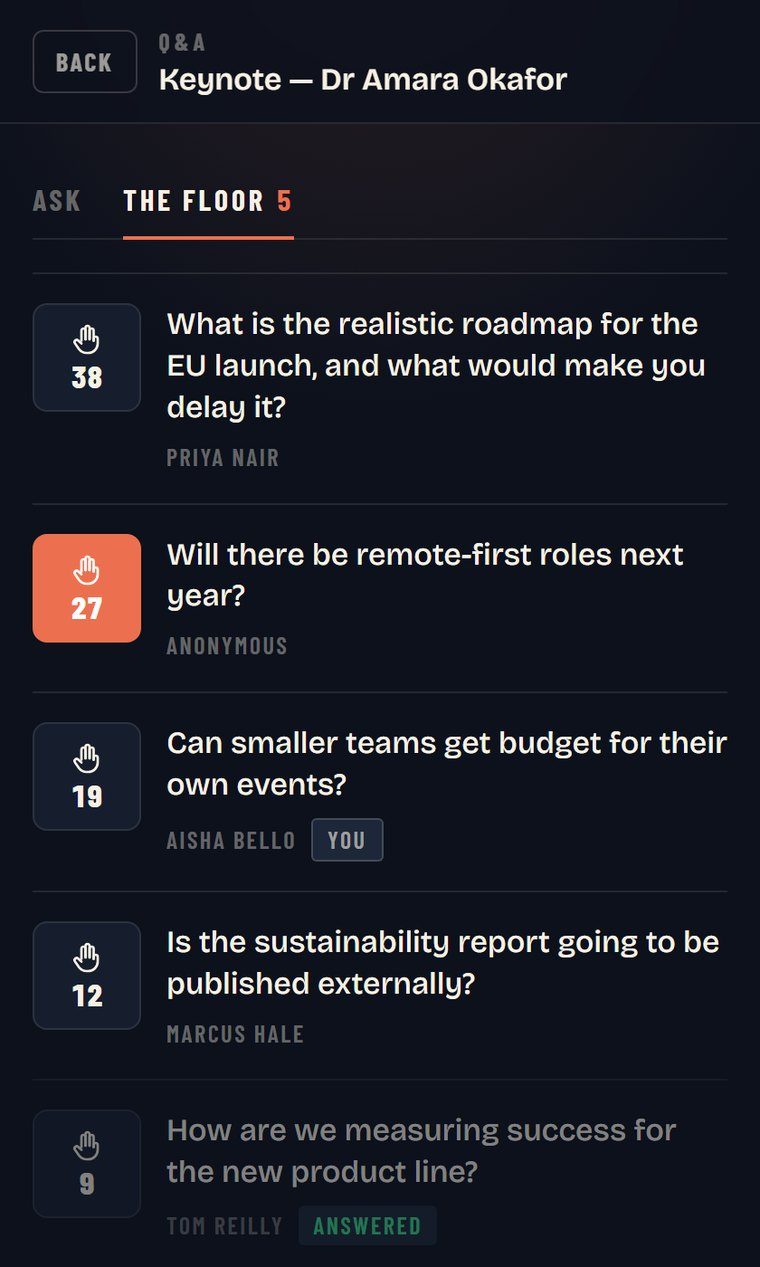
I work as a conference facilitator as well as a host and moderator. In larger rooms I gather input from every delegate through RoomReader, my own phone-based question and polling software, nothing to download. It turns the empathise stage from six loud voices into three hundred.
If you have a date and a problem, send the agenda and I will tell you whether it is a half day, a full day, or something that needs a sprint.
17:00Close
Send me your agenda. I’ll show you where the room comes alive.
A fixed price, a free planning call, and a reply within one working day.