This or That Questions for Meetings, Teams and Conferences

TL;DR
- This or that questions give people two options and one second to choose. That makes them the fastest icebreaker there is, and one of the few that works in a hall of hundreds.
- A show of hands distorts the answer because people follow the majority. Run the questions as a phone poll and everyone votes at once, privately, with the split on the big screen.
- Keep them work-safe: tea or coffee, camera on or off, Jaffa Cake cake or biscuit. Skip alcohol, politics, money and anything about dating.
- Aim them at the known dips in a conference day: the cold 9am open, the slump after lunch and the gap before networking.
This or that questions are the simplest icebreaker you can run: two options, pick one, move on. Tea or coffee. Email or call. Front row or back row. No speech, no sharing anything personal, and nobody has to stand up and introduce themselves. Below is a bank of work-safe this or that questions for adults, grouped by theme, plus how to run them in a room of 20 or 500.
What are this or that questions?
This or that questions are rapid either/or prompts where everyone picks one of two options, usually in a second or two. They are not a debate and nobody needs to explain their choice, which is why they work as an opener.
Two options is the point. Hick’s law, from 1952 research by William Hick and Ray Hyman, holds that decision time increases with the number and complexity of choices. Give a room two simple options and nobody stalls.
Fewer options also keep people in. In the famous jam study, shoppers who stopped at a display of 6 flavours were far more likely to buy than those who saw 24: nearly 30% against 3%. An icebreaker is not a jam stall, but the principle travels. Make taking part easy and more people do it.
Why do this or that questions work so well in a big room?
Because everyone can answer at the same time without being singled out. That matters more than the questions themselves.
Most organisers run them as a show of hands. I have hosted 800+ events, and I have seen organisers reach for that tired opener and then wonder why a big room stays flat. It also gets you the wrong answer. Harvard researchers found that a public show of hands misrepresents what a class actually thinks, because people herd towards the majority answer.
That is conformity at work. In Solomon Asch’s line experiments, around 75% of participants went along with an obviously wrong majority at least once. When people wrote their answers down privately instead, conformity fell to about 12.5%.
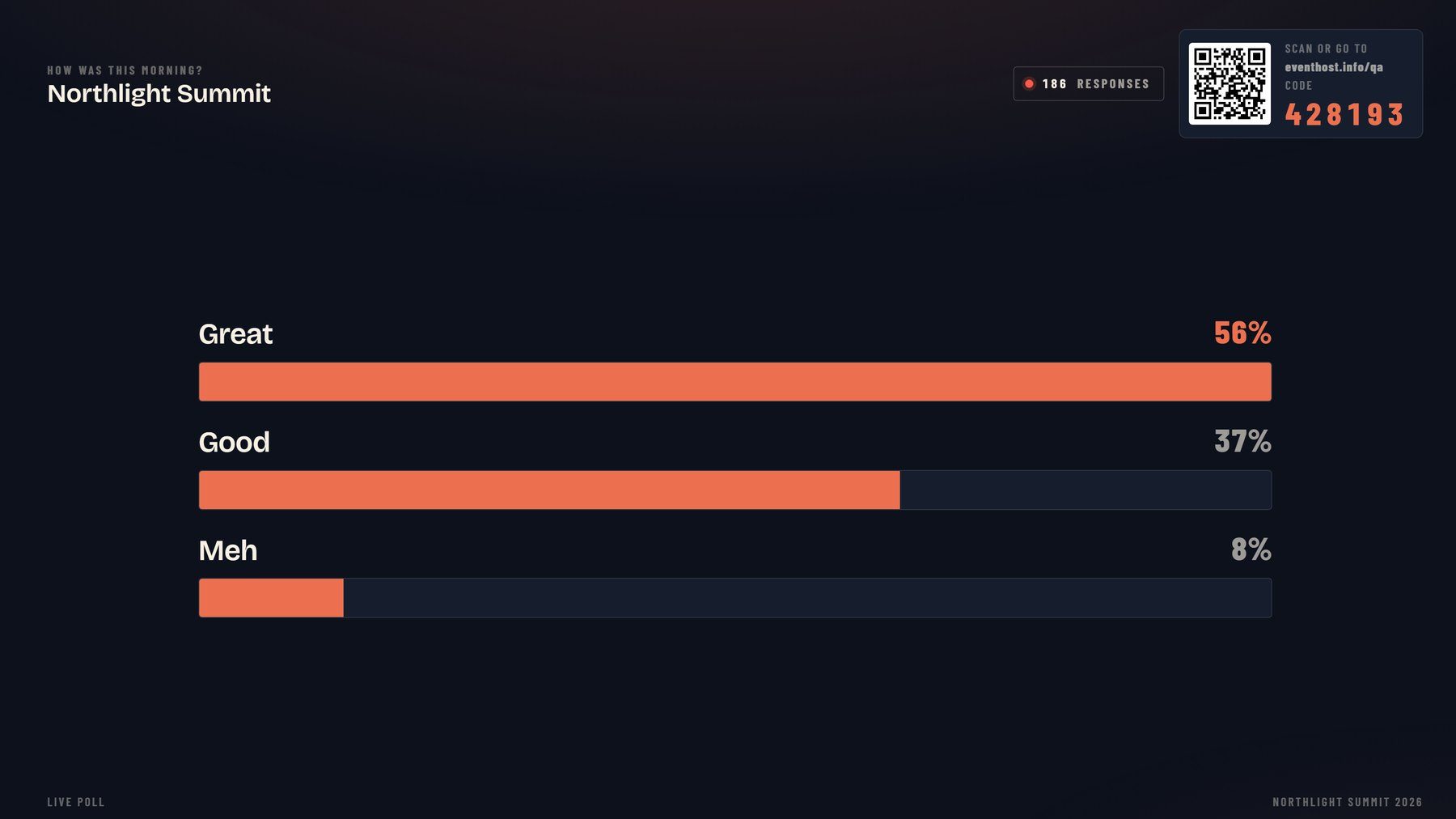
So the format that works at scale is a private vote with a public result. Everyone picks on their own phone, the split goes up on the screen, and the room reacts to itself. Run like that, it is an opener designed for a hall, not for twelve people in a training room.
Professional adults will happily take part if the format removes the risk of looking foolish. Cringe, not reluctance, is what kills participation.
Good this or that questions for work
Every question below passes three tests: anyone can answer it, nobody reveals anything personal, and it gives the person next to you something to talk about.
Working style
- Early start or late finish?
- Email or call?
- Plan everything or figure it out as you go?
- To-do list on paper or in an app?
- Big picture or fine detail?
- Headphones on or office buzz?
- Inbox zero or 4,000 unread?
- Slides or whiteboard?
- Deadline sprint or steady pace?
- Lead the project or be the expert in the room?
Meetings and office life
- Camera on or camera off?
- Stand-up meeting or sit-down meeting?
- Agenda in advance or see where it goes?
- Hot desk or your own desk?
- Reply-all or reply to sender?
- Monday morning meeting or Friday afternoon meeting?
- Lanyard or name sticker?
- Front row or back row?
Food and breaks
- Tea or coffee?
- Biscuit tin or fruit bowl?
- Meal deal or packed lunch?
- Sweet or savoury?
- Dunk or don’t dunk?
Travel and downtime
- Train or drive?
- Window seat or aisle?
- Beach or city break?
- Podcast or music on the commute?
- Book or film?
- Summer or winter?
For open-ended prompts that get people talking for longer, use a set of icebreaker questions instead. This or that is the quick-fire format; it does a different job.
Funny this or that questions that stay work-safe
The funniest this or that questions are the silly arguments people already have, not jokes at anyone’s expense. A national debate gets a laugh because half the room is wrong, and everyone knows it.
- Scone: rhymes with gone or rhymes with bone?
- Scone: jam first or cream first?
- Jaffa Cake: cake or biscuit?
- Pineapple on pizza: yes or absolutely not?
- Ketchup: fridge or cupboard?
- Milk in first or milk in last?
- Toilet roll: over or under?
- Socks with sandals: comfort or crime?
The scone ones come with real numbers you can reveal after the vote. YouGov found 51% of Britons rhyme scone with gone and 42% with bone, rising to 80% for gone in Scotland. The same poll found 61% put jam on first and 21% cream.
The Jaffa Cake has an official answer. A VAT tribunal decided it had enough cake characteristics to be zero-rated as a cake. The tribunal weighed the sponge, the texture and the fact that a stale one goes hard like a cake, while noting that size and packaging pointed towards biscuit. Read that out after the vote and watch the biscuit camp argue with HMRC.
The best this or that questions for a conference hall
In a hall, the best questions split the room near the middle, need no context and lead somewhere.
| Question | Why it works in a hall |
|---|---|
| Tea or coffee? | Everyone has an answer, and it warms up the voting habit |
| Scone: gone or bone? | Regional split, real data to reveal |
| Jaffa Cake: cake or biscuit? | A genuine argument with a legal verdict |
| Camera on or camera off? | Every hybrid team has an opinion |
| Early start or late finish? | Opens a useful conversation about how people work |
| Big picture or fine detail? | Useful for mixing tables before group work |
| Front row or back row? | Gets a laugh from a room that has just chosen its seats |
| Email or call? | Shows the room its own habits |
How do you run this or that questions as a live poll?
Put each question on the big screen, let every delegate vote on their phone, then reveal the split. It takes about a minute per question and works the same for 30 people or 300.
- Pick five to eight questions. Two options each, no more than three words per option.
- Open with the easiest. Have the first poll and the join code on screen while people sit down, so the room is voting before you start.
- Keep each one short. Close the vote quickly so the pace stays high.
- React to the result. The fun is in the split. Invite a volunteer from the losing side to defend themselves. Invite, never pick.
- Finish on the topic. Make the last question about the day ahead, so the opener leads into the agenda.
RoomReader is the software I built and bring to every conference I host. It runs multiple-choice polls on the big screen: delegates scan a QR code or type a six-digit code, and every delegate votes on their phone, nothing to download. It is included when I host. If you are comparing options for an event you are running yourself, the guide to live polling tools covers the category.
For a virtual meeting, Microsoft Teams has a built-in Polls feature that runs on Microsoft Forms. You can share the aggregated results with attendees, and choose whether names are recorded. More remote formats are in the guide to virtual icebreakers.
The no-tech version: this or that on your feet
No screen? Use the room. Call the question and point to two sides of the room, or use heads and tails: hands on head for one option, hands on hips for the other. It is loud and quick, and it gets people moving after a long sit.
Two cautions. Not everyone can stand or move easily, so always offer a seated version (raise a hand, hold up a phone torch). And because everyone can see who chose what, you lose the private vote. Keep the questions light.
This or that vs would you rather: which suits work?
This or that suits openers and big rooms; would you rather suits smaller groups with time to talk. The difference is the effort each one asks for.
This or that is two real, everyday options and a one-second answer. Would you rather is a hypothetical trade-off, and people want to explain their reasoning. That is great round a table of six, slower in a hall. A few work-safe would you rather questions for work:
- Would you rather never sit in another meeting or never send another email?
- Would you rather present to the board or write the board report?
- Would you rather have a four-day week with longer days, or five days that finish at 3pm?
- Would you rather have a perfect memory for names or for numbers?
- Would you rather fix the office printer forever or the Wi-Fi forever?
Which this or that questions should you avoid at work?
Avoid any question where one option excludes people, exposes something private or has a right answer the boss holds. If anyone in the room could feel awkward picking, cut it.
- Alcohol. “Pub or wine bar” or “red or white” leaves people out. The ONS found 20.4% of adults in Great Britain did not drink at all, the latest figure in that series.
- Politics, religion and money. Obvious, but they still slip in as “jokes”.
- Dating and couples questions. Fine at a party, wrong at work.
- Bodies, diets and fitness. “Gym or sofa” is not as harmless as it sounds.
- Loaded work topics. “Office or home” is a live issue: 28% of workers in Great Britain were hybrid working in early 2025. Use it only if the room is relaxed about it, never during a return-to-office row.
When should you use this or that icebreaker questions?
Use them at the moments when a room’s energy drops. The energy in a room is a curve, and I have watched it for twenty years: the cold open at 9am, the slump after lunch, the awkward gap before networking.
- The 9am open. Run the first poll while people find their seats. The room is participating before the first speaker is on.
- After lunch. Run a quick-fire round at around 1:30pm. The post-lunch dip can happen even when people have had no lunch, and a high-carbohydrate lunch makes it worse.
- Before networking. Use the last result as a starter: find someone who voted the other way and settle it.
Engagement is not a gimmick bolted on at the end. It is how you keep a room with you from the first minute. For more openers aimed at those exact moments, see the conference icebreakers page. And if you have a conference coming up and want the whole room with you from the opening poll, send the agenda.

17:00Close
Send me your agenda. I’ll show you where the room comes alive.
A fixed price, a free planning call, and a reply within one working day.