The Best Icebreaker Questions for Meetings and Conferences
TL;DR
- The best icebreaker questions for professional rooms are low-risk, quick to answer, and relevant to why people are there.
- Match the question to the moment: a light opener at 9am, a sharper prompt after lunch, a warmer one before networking.
- Keep it to one clear question, a time limit, and a format where nobody can look foolish for answering.
- Grouped question lists follow below: quick openers, team and work, fun, and deeper prompts, with honest notes on which land and which to skip.
- In a hall of hundreds, a question read aloud is not enough on its own. You need a way for everyone to answer, not just the three confident people near the front.
Most icebreaker questions were written for a training room of twelve, then copied onto lists for everyone else. They fail in a conference hall for a simple reason: a question that works when you can see every face falls flat when you are looking at two hundred of them. This guide gives you real, usable questions, grouped by purpose, plus the judgement about which ones land with professional adults and which quietly kill the room.
I have hosted more than 800 events and watched the energy in a room for twenty years. The pattern is always the same. Ask the wrong opener and the room folds its arms. Ask the right one, framed well, and people lean in before they have even noticed they are taking part.
What makes the best icebreaker questions work at scale?
The best icebreaker questions are low-risk, fast to answer, and clearly connected to why the room is together. Those three things matter more than how clever the question is.
Low-risk means nobody can be embarrassed by their answer. If a question can be answered wrong, or reveals something a person would rather keep private, half the room will simply opt out. Fast to answer means one sentence, not a story. And relevant means the question earns its place: it warms people up for the actual agenda rather than feeling like a detour.
Scale changes everything. In a small meeting you can go round the table. In a hall you cannot, so the question has to work as something people answer in pairs, on their phones, or by a quick physical signal. A brilliant question with no way for everyone to respond is just the host talking.
If you want the reasoning behind large-room openers in more depth, our conference icebreakers page sets out the formats built for a hall rather than a huddle.
Quick openers: icebreaker questions for meetings
Use quick openers when you have two minutes and need to warm the room without derailing the agenda. These are the safest icebreaker questions for meetings because they ask for almost nothing and give people an easy first word.
They suit the cold open, the top of a weekly team call, or the first session of a conference morning. Keep the answer to a single sentence and set a timer so nobody rambles.
| Question | Why it works | Time |
|---|---|---|
| What is one word for how your week is going? | One word removes the pressure to perform | 60 seconds |
| What is the last thing you got genuinely excited about? | Positive and personal without being private | 90 seconds |
| Coffee, tea, or neither, and how many so far today? | Light, universal, gets a laugh | 60 seconds |
| What are you hoping to take away from today? | Doubles as useful intent-setting | 90 seconds |
| What is one small win from this week? | Ends on a lift, easy for anyone to answer | 90 seconds |
For a recurring meeting, rotate these so the same three people are not always first to speak. The point of a quick opener is momentum, not depth. Get a voice from every corner, then move on.
Which good icebreaker questions suit team and work sessions?
Good icebreaker questions for team and work sessions connect to how people actually work, without turning into a performance review. They open a door to the real conversation you are about to have.
These belong in offsites, planning days, and kickoffs where the group already knows each other a little. The aim is to surface something useful: a working preference, a shared frustration, a small piece of context that makes the day run better.
- What part of your job would surprise people outside the team?
- What is one thing that makes a meeting genuinely worth your time?
- If we could stop doing one thing as a team, what would you nominate?
- What is a skill you have that we rarely use here?
- What does a good day at work look like for you right now?
The last two are quietly powerful because they hand you information you can act on. I have seen a planning day change direction because one person mentioned a skill nobody knew they had. A work-relevant opener is not filler: it can be the most productive ninety seconds of the session.
What are the most fun icebreaker questions?
The most fun icebreaker questions are the ones that give people permission to be a little playful without asking them to be a performer. Fun should lower the stakes, not raise them.
The trick with fun icebreaker questions is that they must still be safe to answer in front of colleagues and, at a conference, in front of strangers. A question is fun when the answer is easy and mildly revealing, not when it demands wit on the spot.
| Fun question | Why it lands |
|---|---|
| What is the most useless talent you have? | Everyone has one, and it is charming rather than boastful |
| What would the title of your autobiography be? | Creative but answerable in a few words |
| Teleport anywhere for lunch, where do you go? | Instant, universal, sparks side chat |
| What is a film or show you will always rewatch? | Common ground appears fast |
| What was your first ever job? | Nostalgic, humanising, safe |
Fun openers work best when the host answers first and sets the tone. If you give a slightly self-deprecating answer, the room understands the game is gentle, and participation climbs. That modelling is a big part of good audience engagement: show people the water is warm before you ask them to jump in.
Funny and weird icebreaker questions: a word of caution
Funny icebreaker questions and weird icebreaker questions can be excellent, but they carry the most risk, so handle them with care. The line between “playful” and “put on the spot” is thin, and professional adults feel it instantly.
Funny questions rely on the answer being funny, which puts pressure on the person answering. That is the trap. Better to use questions that are inherently amusing to hear rather than ones that demand a joke. Weird questions work when they are surreal but harmless, and fail when they get personal or gross.
Use these sparingly, and read the room first:
- Funny, safe: “What is the strangest food combination you genuinely enjoy?”
- Funny, safe: “What is a wildly overrated thing everyone seems to love?”
- Weird, safe: “If animals could talk, which would be the rudest?”
- Weird, safe: “You get one superpower but it is mildly useless. What is it?”
Avoid anything that pries (embarrassing stories, dating, family, money) or anything that only lands if the person is quick-witted. A senior audience will forgive a slightly dull opener. They will not forgive being made to look foolish in front of peers. When in doubt, choose warm over wacky.
Deeper questions that build real connection
Deeper questions belong later in a session, once the room has warmed up and trust has built a little. Opening cold with a deep question is the fastest way to make a room go quiet.
Save these for a workshop, a leadership offsite, a small breakout, or the reflective back half of a longer day. They ask people to share something with a little more weight, so the setting has to earn it.
- What is a piece of advice that genuinely changed how you work?
- Who had the biggest influence on your career, and what did they teach you?
- What is something you have changed your mind about in the last year?
- What does success look like for you beyond the obvious targets?
- What is a challenge you are working through that others here might recognise?
Deeper prompts work best in pairs or small groups, not broadcast to a full hall. Give people a partner and a couple of quiet minutes. The intimacy of a one-to-one conversation is what makes the honesty possible, and it protects anyone who would rather not share with the whole room.
How do you run an icebreaker so nobody cringes?
You run an icebreaker without cringe by removing every way a person could feel exposed, then giving clear, confident instructions. Cringe, not reluctance, is what kills participation.
Professional adults will happily take part when the format is safe. Here is what “safe” looks like in practice:
- Ask one question, not three. Clarity beats cleverness.
- Set a time limit out loud. “You have sixty seconds with the person next to you.”
- Give people an out. Pairs and small groups mean nobody is performing solo.
- Answer first yourself, briefly, to model the tone.
- Never force a shy person to speak to the whole room. Invite, never single out.
- Know when to stop. The moment energy peaks, move on.
The host carries the risk so the room does not. If you deliver the setup with a flat, apologetic tone, people mirror it. Deliver it as if it is obviously going to be good, and they follow. Confidence in the framing does more work than the question itself.
Which icebreaker questions should you avoid?
Avoid any icebreaker questions that can embarrass, exclude, or expose someone in front of colleagues. If an honest answer could cost a person status or privacy, cut it.
The usual offenders:
- Anything that assumes a lifestyle: partners, children, home ownership, holidays abroad.
- “Two truths and a lie” with a large group of strangers. It is slow and it stalls.
- Questions that reward the quickest wit, which sideline everyone else.
- Anything that can be answered “wrong”, such as trivia with no stakes or context.
- Overly personal prompts about money, health, dating, or family.
- Long questions that need a story, when you have set aside two minutes.
A useful test: would a quiet, senior person in the third row be comfortable answering this in one sentence? If not, it is the wrong question for that moment. Save the braver prompts for smaller, more trusting settings.
How do these openers scale to a conference hall?
These openers scale to a conference hall only when every delegate has a way to answer, not just the confident few near the front. A question read from the stage to two hundred people, with no response mechanism, reaches almost nobody.
In a large room you have three realistic options. Pair people with the person beside them, which is simple but limited. Use physical signals, such as “stand up if”, which works for broad questions. Or give everyone a way to answer on their phone, so two hundred responses appear at once and the whole room sees itself thinking together.
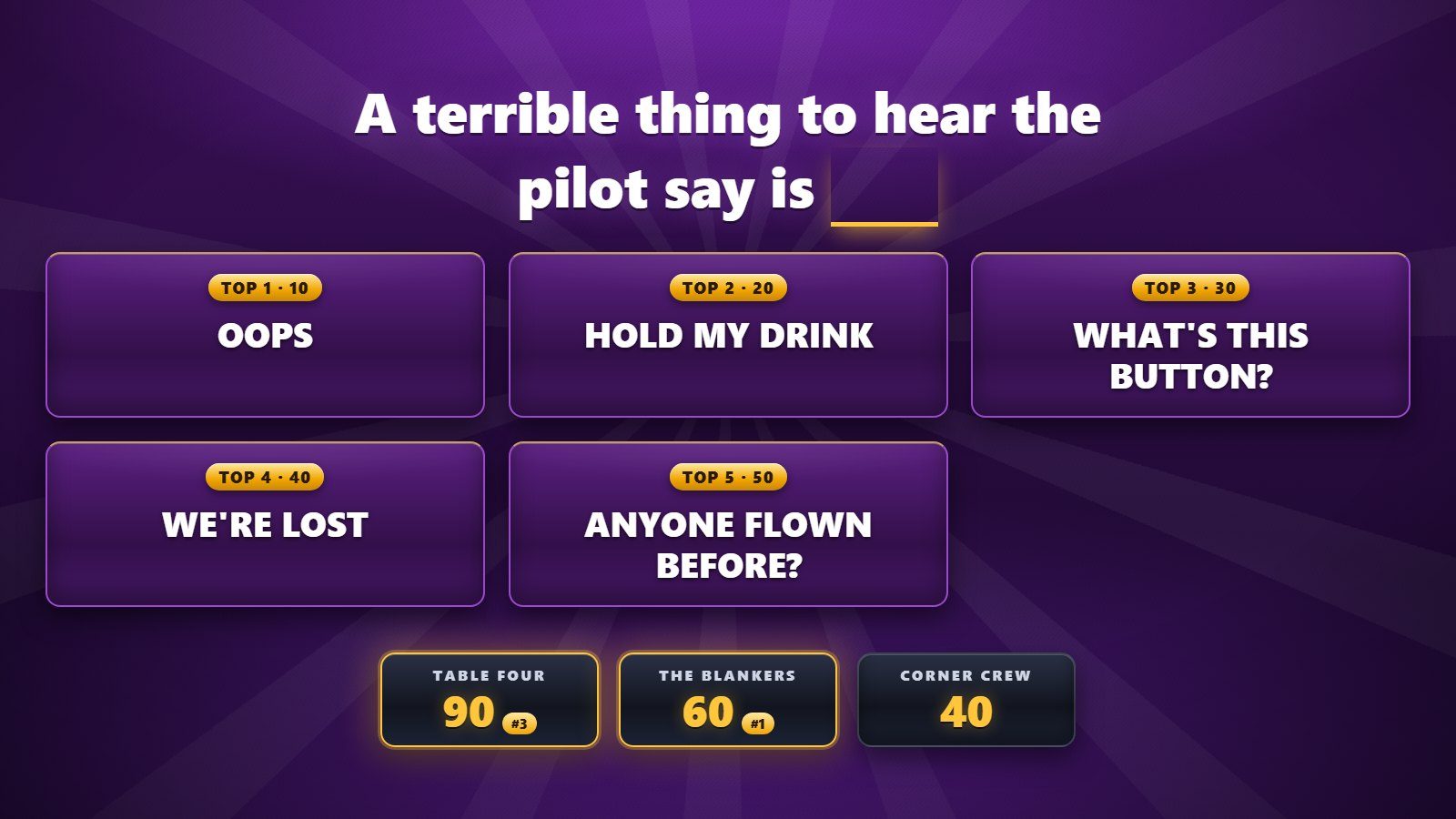
That last option is what I build my hosting around. Every delegate answers on their own phone with nothing to download, whether that is a live question through RoomReader or one of eight whole-room game show formats where the entire hall plays at the same time. A question becomes an opener the moment everyone can respond to it, not just react to it.
So use the question lists above, but choose your moment on the energy curve, and give the room a real way to answer. Get those two things right and even a hall of hundreds warms up in the first few minutes. That is the whole job of a good opener: keep the room with you from the start.

17:00Close
Send me your agenda. I’ll show you where the room comes alive.
A fixed price, a free planning call, and a reply within one working day.