Liberating Structures: Which Ones Work in a Conference Room
TL;DR
- Liberating Structures are 43 free, openly licensed facilitation patterns created by Henri Lipmanowicz and Keith McCandless.
- Five scale well to a conference hall: 1-2-4-All, Impromptu Networking, Creative Destruction (aka TRIZ), 25/10 Crowdsourcing and User Experience Fishbowl.
- Each one has a minimum group size, a room layout and a time box. Check all three against your venue before you put it on the agenda.
- Save Troika Consulting and the longer dialogue formats for breakouts and offsites, where people can move chairs and talk about personal challenges.
Liberating Structures promise to involve everyone in the room, not just the confident few at the front. But if you are running a hall of 300 in fixed rows, most guides will not help you: they are written for a workshop of twenty. Here are the structures that survive the move to a conference room, with timings, set-up and the point where each one breaks.
What are Liberating Structures?
Liberating Structures are simple, step-by-step patterns for group conversation, each with a set invitation, group shape and time box. They were developed by Henri Lipmanowicz and Keith McCandless, who began testing rough prototypes in healthcare settings around 2001 before wider field tests in Latin America and the US.
Their 2014 book, The Surprising Power of Liberating Structures, set out 33 methods grounded in ten principles. The 2026 Liberating Structures Fieldbook by McCandless and Nancy White expanded the menu to 43.
They are free to use. The structures are published under a Creative Commons licence (CC BY-SA 4.0). The creators have dropped the old non-commercial clause, so a paid conference can use them with attribution, but they note that materials created before June 2026 may carry older terms. Check anything you download.
Why do Liberating Structures work in a big room?
They work because they stop people queuing to speak. In a hall of 200, a one-hour open discussion gives each delegate 18 seconds if everyone talks. In practice it is worse: the same few voices fill the hour.
The research on brainstorming points the same way. In a 1987 paper, Diehl and Stroebe listed 22 experiments comparing brainstorming groups with individuals working alone; 18 found the individuals’ pooled ideas outnumbered the groups’. Their own experiments pinned most of the loss on production blocking: people waiting their turn to speak lose ideas. Many Liberating Structures open with silent writing, then pairs or small groups, so everyone works at once.
They also remove the cringe. Professional adults will happily take part if the format removes the risk of looking foolish, and nobody is on the spot during a minute of silent writing.
I have hosted 800+ events. Most interactive formats fail at scale because they were designed for twelve people in a training room, not for a hall. Liberating Structures are one of the few families that still work in a big room, if you pick the right ones.
Which Liberating Structures work in a conference room?
Five work reliably with large audiences, each suited to a different moment in the day.
| Structure | Time | Minimum group | Room needs | Best slot |
|---|---|---|---|---|
| 1-2-4-All | About 15 min | 4 | Works in rows | After a keynote |
| Impromptu Networking | 20 to 25 min | 4 | Standing space | Opening, pre-networking |
| Creative Destruction (TRIZ) | 50 to 55 min | No minimum | Groups of 4 to 7 | Post-lunch |
| 25/10 Crowdsourcing | 20 to 25 min | 15 | No chairs or tables | Closing session |
| User Experience Fishbowl | 35 to 70 min | 15 | Inner circle, microphones | In place of a panel |
If your panels tend to become four mini-keynotes, look hard at User Experience Fishbowl. Three to seven people who have tackled a shared challenge talk to each other in an inner circle while everyone else listens, under two rules: no speeches, and talk to each other, not to the audience. Small groups then write questions for them. It is a panel with the presenting stripped out.
How do you run 1-2-4-All with a whole hall?
Run it exactly as written. Change only the final step. 1-2-4-All asks one question, then moves people through four stages:
- Alone: one minute of silent reflection and writing.
- Pairs: two minutes building on each other’s ideas.
- Fours: pairs merge into quartets for five minutes to refine the ideas and keep the distinct ones distinct.
- All: about seven minutes where a few people share something everyone should hear.
The first three stages scale to any size. The fourth is the bottleneck: thirty quartets cannot all report back, which is why the page asks for a few voices, not every group.

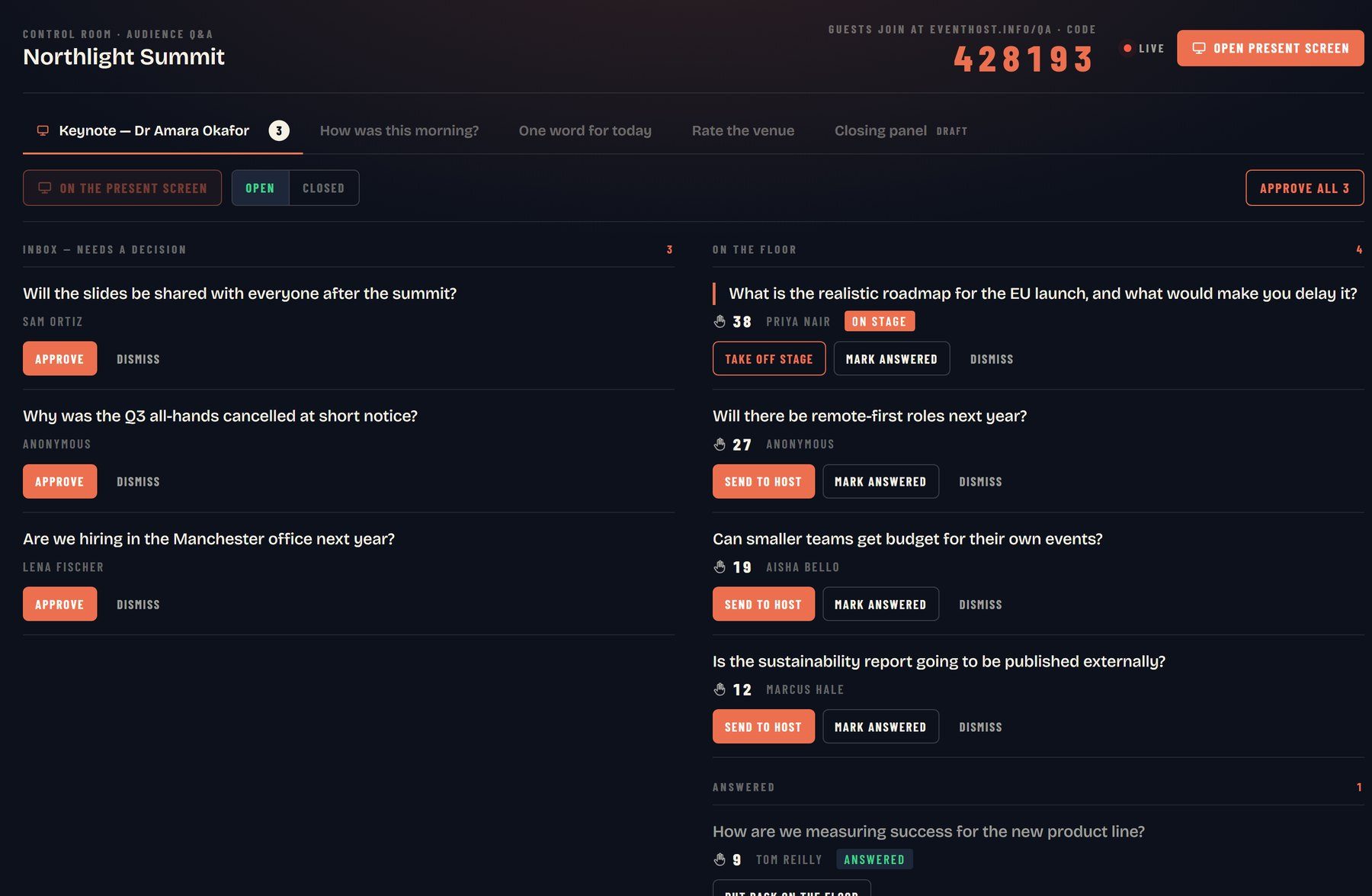
In rows, pairs form easily and fours mean turning to the row behind. The page also offers 1-3-All, which skips pairs for trios, but warns that one person can dominate a trio more easily. A phone-based tool helps here. With RoomReader, the live Q&A software I built and include with hosting, each group can send its best idea from a phone, so the host reads out patterns instead of picking three hands.
Impromptu Networking: the opener that beats a round of introductions
Impromptu Networking takes 20 to 25 minutes and replaces long introductions. Everyone silently considers two questions: what big challenge do you bring to this gathering, and what do you hope to get from and give to this group? Then they pair with someone from a different team or function and swap answers for four to five minutes. Three rounds, new partner each time.
It needs open space to stand and move, so it suits a foyer or cabaret layout better than theatre seating. The instructions are firm about one thing: resist cutting it to one or two rounds.
The energy in a room is a curve, and the awkward gap before networking is one of its low points. Impromptu Networking is aimed squarely at that moment. For more options at that scale, see these large-group icebreakers.
What is TRIZ in Liberating Structures?
TRIZ is the structure where groups design the worst possible result, then admit which of those behaviours they already do. The 2026 menu lists it as Creative Destruction (aka TRIZ), and the name nods to a Russian engineering approach to problem solving.
It runs for 50 to 55 minutes in groups of four to seven:
- List alone everything you could do to achieve the worst result (3 min).
- Combine lists in your group (10 min).
- Mark everything you currently do that resembles the list (10 min).
- Decide what to stop and the first step to stop it (10 min), then share with the whole room.
Two of its warnings matter at a conference. Groups must name things to stop doing, not new things to start, and in large groups you should watch for premature agreement. It is meant to be done in a spirit of serious fun, which is why I would put it in the post-lunch slot, alongside other conference energisers.
25/10 Crowdsourcing: a closing session with a countdown
25/10 Crowdsourcing finds a room’s ten best ideas in about 20 to 25 minutes. Everyone writes their boldest idea and its first step on an index card. People mill around swapping cards unread, stop on a signal and score the card in their hand from 1 to 5. After five rounds each card has a score out of 25, and the host counts down from “Who has a 25?” until the top ten are read out.
It needs at least 15 people and open space with no chairs or tables, and the creators do not recommend it online. In a theatre-style hall, that means the foyer or a cleared area. The countdown is the best part: it has the tension of a results reveal, and the room picks the winners.
What about Open Space in Liberating Structures?
Open Space Technology was number 25 on the original Liberating Structures menu, but it is not one of the 43 on the 2026 menu. The archived page credits it to Harrison Owen and describes a format where participants build the agenda themselves and are free to move between sessions, from 90 minutes up to three days.
The same page notes that unconferences and BarCamps are forms of Open Space. It is a whole event design, not a session format.
Which Liberating Structures are harder in a conference room?
The ones that need private conversation, movable chairs or a long time box are harder. Troika Consulting is the clearest example. It runs in trios of chairs with no tables, and the “client” turns their back while two colleagues discuss their challenge. Excellent peer coaching, but it belongs in a breakout or offsite, not row 14 of a plenary.
Some structures travel better than they look. 15% Solutions asks what each person can do now without extra permission or resources, then has groups of two or three coach each other, all in 25 to 30 minutes. That works with neighbours in a row and makes a strong close.
The test for any structure is the same three questions: does the minimum group fit, can people form the groups without moving furniture, and does the time box fit the slot?
A sample conference day built from Liberating Structures
Here is how the shortlist might fit a one-day internal conference:
| Time | Moment | Structure |
|---|---|---|
| 09:00 | Cold open | Impromptu Networking |
| 10:15 | After the keynote | 1-2-4-All on “What will you use from this?” |
| 11:30 | In place of a panel | User Experience Fishbowl |
| 13:45 | Post-lunch slump | Creative Destruction (TRIZ) |
| 16:00 | Close | 25/10 Crowdsourcing or 15% Solutions |
What, So What, Now What (known as W3) makes a good debrief for any of these: what happened, what it means, and what you do next, in 20 to 40 minutes.
Two things decide whether a Liberating Structures workshop at a conference lands. One is precise timing: the 1-2-4-All page tells the host to stick to the clock and not over-help the groups. The other is the person running it. Reading a hall and bringing 300 people back to plenary on time is what conference facilitation means.
People sometimes file Liberating Structures under facilitation games. They are conversation patterns that happen to be playful. If the room needs energy rather than ideas, a game is the better tool, and I run eight whole-room conference games where every delegate plays on their phone, nothing to download. One wakes the room; the other puts it to work. For more ways to involve a whole audience, see these participation techniques.
Pick two or three, time them to the energy curve, and they help keep the whole room with you. Whichever you choose, credit Lipmanowicz and McCandless, and point delegates to liberatingstructures.com so they can use the structures back at work.

17:00Close
Send me your agenda. I’ll show you where the room comes alive.
A fixed price, a free planning call, and a reply within one working day.