Audience Participation Techniques for Nervous Rooms
TL;DR
- Professional adults hold back not because they are reluctant, but because taking part in front of peers feels socially risky. Lower the risk and they play.
- The fear of looking foolish is overblown. People notice your small stumbles far less than you imagine.
- Make participation opt-in, keep it anonymous where you can, and start with a tiny ask before a bigger one.
- Phone-based participation beats a show of hands because it hides who said what and lets everyone answer at once.
- Design the room so that taking part feels safer than sitting in silence.
A flat room is rarely a room that does not care. More often it is a room full of professional adults quietly doing the maths on social risk, and deciding that silence is the safer bet. Audience participation is not about forcing hands into the air. It is about making it feel lower risk to take part than to sit still. Get that right and a nervous room will play along. Get it wrong and you spend the whole session pulling teeth.
This is a psychology problem before it is a technique problem. So it is worth understanding what your delegates are actually weighing up before we get to the tools that lower the stakes.
Why do professional adults hold back from audience participation?
They hold back because taking part in front of peers carries a real social cost, and most people decide it is not worth paying. The room is full of colleagues, managers and clients. Answering a question, volunteering an opinion or standing up all put your reputation on the line in front of exactly the people whose opinion you care about most.
Part of this fear is real, and part of it is a trick your brain plays. Psychologists describe one part of it as the spotlight effect: we badly overestimate how much other people notice what we do. In the original studies, people who wore an embarrassing t-shirt guessed that about half the room would remember it. In fact only around a quarter did.
Scale that up to a conference hall. The imagined audience for your small mistake is roughly twice the size of the real one. Nobody is watching as closely as the nervous delegate believes. But that delegate does not know it, so they keep their hand down.
Reluctance or cringe: what really kills participation?
It is almost never reluctance. It is cringe. I have watched rooms for more than twenty years, and professional adults will happily take part when the format removes the risk of looking foolish. Cringe, not reluctance, is what kills participation.
Forced fun is the fastest way to lose a room of adults. Childish games, put-you-on-the-spot volunteering and openers clearly designed for twelve people in a training room all read as embarrassing to a hall of hundreds. The delegates are not refusing to engage. They are refusing to be embarrassed, which is a very different thing.
So the job is not to persuade a reluctant room. The job is to design asks that a sensible adult can say yes to without feeling silly.
How do you remove the risk of looking foolish?
You strip the social cost out of every ask, one factor at a time. Four levers do most of the work, and you can pull them in almost any format.
- Make it opt-in. Never single out an individual who has not volunteered. A cold pointer at one person tells everyone else to brace, not to relax.
- Let it be anonymous. If nobody can see who gave which answer, the risk of judgement drops close to zero.
- Start small. A one-tap answer or a single word is a much easier first step than a spoken opinion in front of the room.
- Let everyone answer at once. When the whole hall responds together, no single person is exposed, and the quiet majority get cover to join in.
Pull two or three of these levers together and even a cautious room will move. This is the backbone of good audience engagement: not louder prompts, but lower stakes.
Audience participation techniques for a nervous room
Here are the audience participation techniques I lean on when a room is likely to freeze, ordered roughly from lowest risk to highest. Work up the list, not down it.
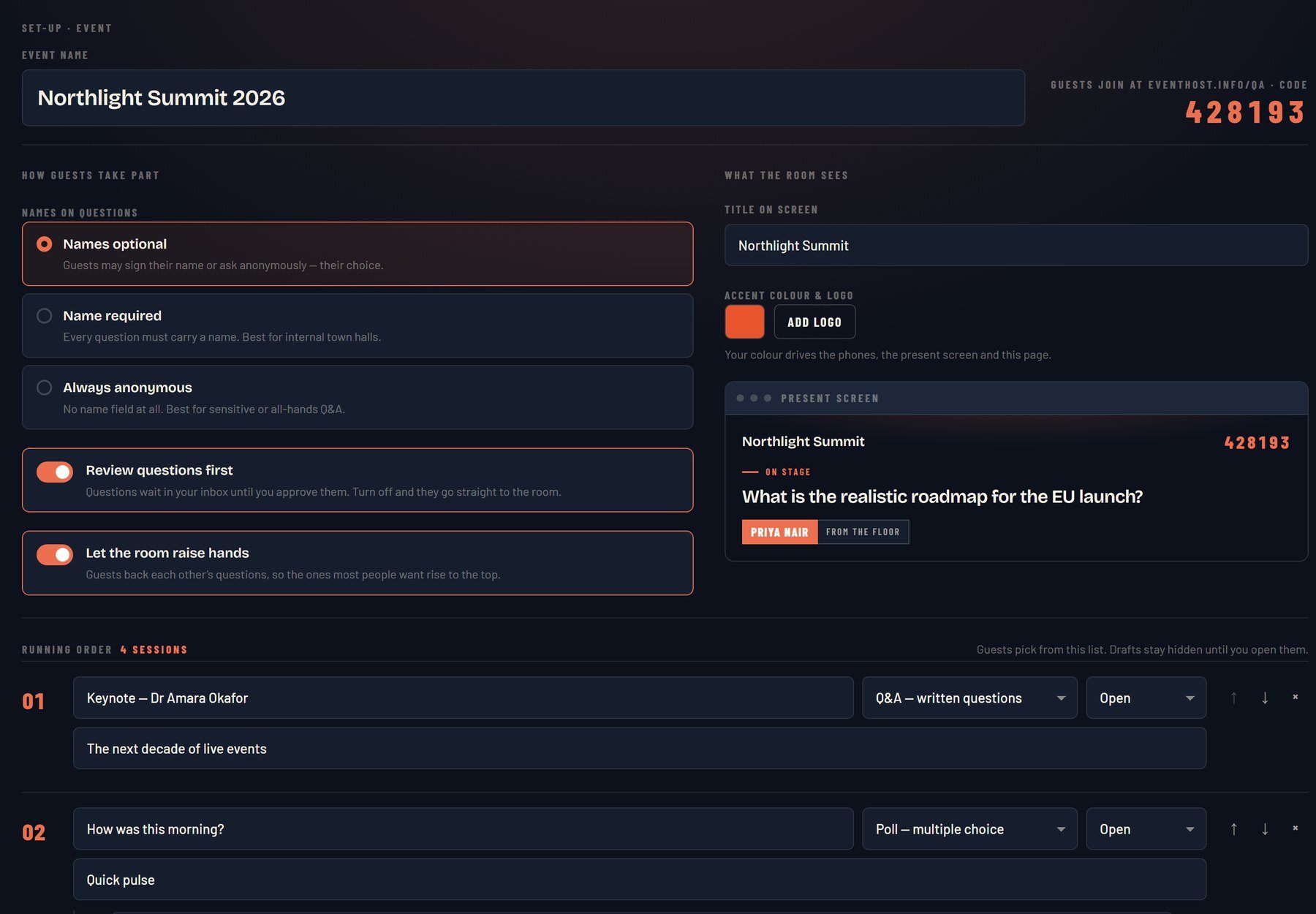
- Anonymous questions on phones. Delegates type a question or a comment from their seat. No hand goes up, no name is attached, and the shy half of the room finally gets a voice. My live Q&A software, RoomReader, is built for exactly this: it runs in the phone browser with nothing to download, and it comes with the booking when I host.
- One-word or word-cloud answers. Ask everyone to send a single word. It is fast, it is anonymous, and a wall of words on the big screen makes the room feel like it moved together.
- This-or-that votes. A binary choice, or a quick ranking, exposes nobody. People will happily press a button when they would never say the same thing out loud.
- A small ask before a big one. Get the room to tap one easy answer first. Once everyone has taken part once, the next, slightly braver ask feels normal rather than frightening.
- Turn to a small group first. A quiet word with three people nearby is far safer than the whole hall. It also warms up voices before anyone speaks to the room.
- A whole-room game everyone plays at once. This is where the risk almost disappears. In my game show formats, every delegate plays on their own phone at the same time, so taking part is the default and sitting out is the odd choice.
Notice the pattern. The tools people usually reach for, a show of hands or a spoken volunteer, sit at the risky end. The formats that actually move a nervous room hide the individual inside the crowd.
Does anonymity really make people braver?
Yes, within limits. When answers cannot be traced back to a name, the biggest brake on participation comes off, because the fear of being judged by colleagues no longer applies. This is why a phone-based approach usually beats a show of hands: the hands reveal who you are, the phone does not.
But anonymity on its own is not enough. A polling app added to the agenda often gets ignored, because a bar chart on a screen is not, by itself, a reason to look up. People need a reason to engage as well as permission to. That means asks that are genuinely interesting, tied to the moment, and quick to answer.
The strongest results come from combining the two: no attribution, plus a question worth answering. Take away the risk and give them a reason, and the room leans in.
Start small: the first ask sets the tone
The first thing you ask a room to do trains it for everything that follows. If your opening ask is low risk and everyone succeeds at it, the second ask is easier, and the third easier still. If your opening ask is a cold “who wants to volunteer”, you have taught the room that participation means exposure, and you will not get it back easily.
This is why the energy in a room is a curve, and why the early asks matter so much. A cold 9am open, the slump after lunch and the awkward gap before networking are all moments where a well-judged, low-risk prompt pays off. The right professional conference icebreakers are simply the first small ask, designed so an adult can say yes without a flicker of cringe.
Build from there. Once a nervous room has taken part once and nothing bad happened, it stops being a nervous room. From that point, participation is no longer something you have to drag out of people. It is just how the session runs.
17:00Close
Send me your agenda. I’ll show you where the room comes alive.
A fixed price, a free planning call, and a reply within one working day.