World Cafe Method: How to Run It With a Large Group
TL;DR
- The World Café, created by Juanita Brown and David Isaacs in 1995, uses tables of four or five, three or more rounds of about 20 minutes with table changes, then a whole-room harvest.
- It scales to hundreds because every table talks at once. What gets hard in a big room is logistics: moves, noise, harvest.
- Plan one table per four or five delegates: 300 people means 60 to 75 tables.
- A fishbowl gives a few people the floor. A World Café gives everyone a voice at once.
- Never let 60 tables report back one by one. Collect themes and play back the patterns.
The World Café (often written World Cafe) is one of the few facilitation techniques designed for a hall, not for twelve people in a training room. Run well, the World Cafe method gets 200 people working on one question at once, then shows them what they think together. Run badly, it is 50 tables of polite chat and an hour of report-backs.
What is the World Cafe method?
It is a structured conversation: small groups talk at café-style tables, swap tables between rounds so ideas travel across the room, then share what emerged with everyone. The World Café Community Foundation calls it a flexible format for hosting large group dialogue, built from five parts: the setting, a welcome, small-group rounds, a question for each round, and the harvest.
It began by accident. In 1995, two dozen participants meeting at Brown and Isaacs’s home in Mill Valley, California, had a large-circle dialogue rained off. They broke into small table conversations, wrote on paper tablecloths and switched tables now and then. Seven design principles grew out of that morning.
What are the seven World Café design principles?
Clarify the context, create hospitable space, explore questions that matter, encourage everyone’s contribution, connect diverse perspectives, listen together for patterns and insights, and share collective discoveries. The official design principles page presents them as one integrated set.
The fourth principle lets people take part simply by listening. That matters with professional adults: they will happily join in if the format removes the risk of looking foolish, and nobody at a World Café has to address the hall.
How do you run the World Cafe method step by step?
Welcome the room, run three rounds with table moves between them, then harvest as a whole group. The official quick reference guide, Café To Go, sets out the basics:
- Seat four or five per table. Fewer than four lacks diversity, the guide says; more than five limits interaction.
- Show the question on screen or on a card at each table, and explain the etiquette before round one.
- Run at least three rounds of about 20 minutes. People write and doodle key ideas on the paper as they talk.
- Move. One person may stay as table host while the others travel, carrying ideas with them.
- Harvest in a whole-room conversation about patterns and possibilities for action.
The question does the heavy lifting. The guide recommends open questions that invite discovery rather than advocacy, tested on a few participants first. “What would make your first month here feel easy?” will carry three rounds. “Is onboarding working?” will not.
Does the World Cafe method work with 300 people?
Yes. Every table talks at once, so more tables means more conversations, not more waiting. Café To Go calls a World Café always intimate, even at very large numbers.
Lyn Carson describes designing one for over 200 people in the University of Sydney’s Great Hall for the Sydney Festival. She seated six to eight per table, while noting that other organisers prefer four or five.
At scale, the strain is physical. Gamestorming warns that a hospitable environment may not be easy in typical conference spaces, so plan the room first:
| Delegates | Tables of 4 | Tables of 5 |
|---|---|---|
| 50 | 13 | 10 |
| 100 | 25 | 20 |
| 200 | 50 | 40 |
| 300 | 75 | 60 |
Venue rounds are often set for more than five, so remove chairs. For 300, you need a cabaret-style ballroom with clear walkways, because the whole room stands up every 20 minutes.
Then plan the sound. The World Café materials checklist includes handheld microphones and a bell or chime to signal timing. Carson used walking music for each move and asked people to spread out rather than move as a block.
Timings: a 90-minute and a 60-minute version
The official pattern is three or more 20-minute rounds. Carson ran six to eight 15-minute rounds in about two hours. North Dakota State University’s extension guide uses rounds of 10 to 15 minutes, which helps on a tight agenda.
| Stage | 90 minutes | 60 minutes |
|---|---|---|
| Welcome and question | 10 | 5 |
| Three rounds | 3 x 20 | 3 x 12 |
| Two moves | 2 x 3 | 2 x 3 |
| Harvest | 14 | 13 |
Protect the harvest. It gets squeezed when the morning overruns, yet it is what turns good conversations into something usable.
What does a table host do in a World Café?
The table host stays put when everyone else moves, welcomes the newcomers and briefly shares the last round’s key insights so the new group can build on them.
Café To Go is clear that there are no facilitators in a World Café, only hosts, and that everyone at the table hosts themselves and each other. It warns that inexperienced hosts can overstep, says to pick a new host at the end of each round, and lets you skip table hosts altogether.
Carson took a different line at scale: a permanent host per table, chosen as the person in the brightest clothing so the job did not default to the most confident person. Her hosts kept brief notes and made space for quieter voices. MIT researchers found that groups where one person dominated were less collectively intelligent than groups with evenly shared turns.
How do you harvest ideas from 50 tables?
Collect themes, not reports. Café To Go suggests a graphic recorder drawing the ideas on a wall, a gallery tour of the tablecloths during a break, or sticky notes with one insight each, clustered by theme.
Carson’s Sydney event went digital: a Theme Team typed and grouped each table’s notes on networked laptops, and the patterns went up on screen almost immediately after the final round.
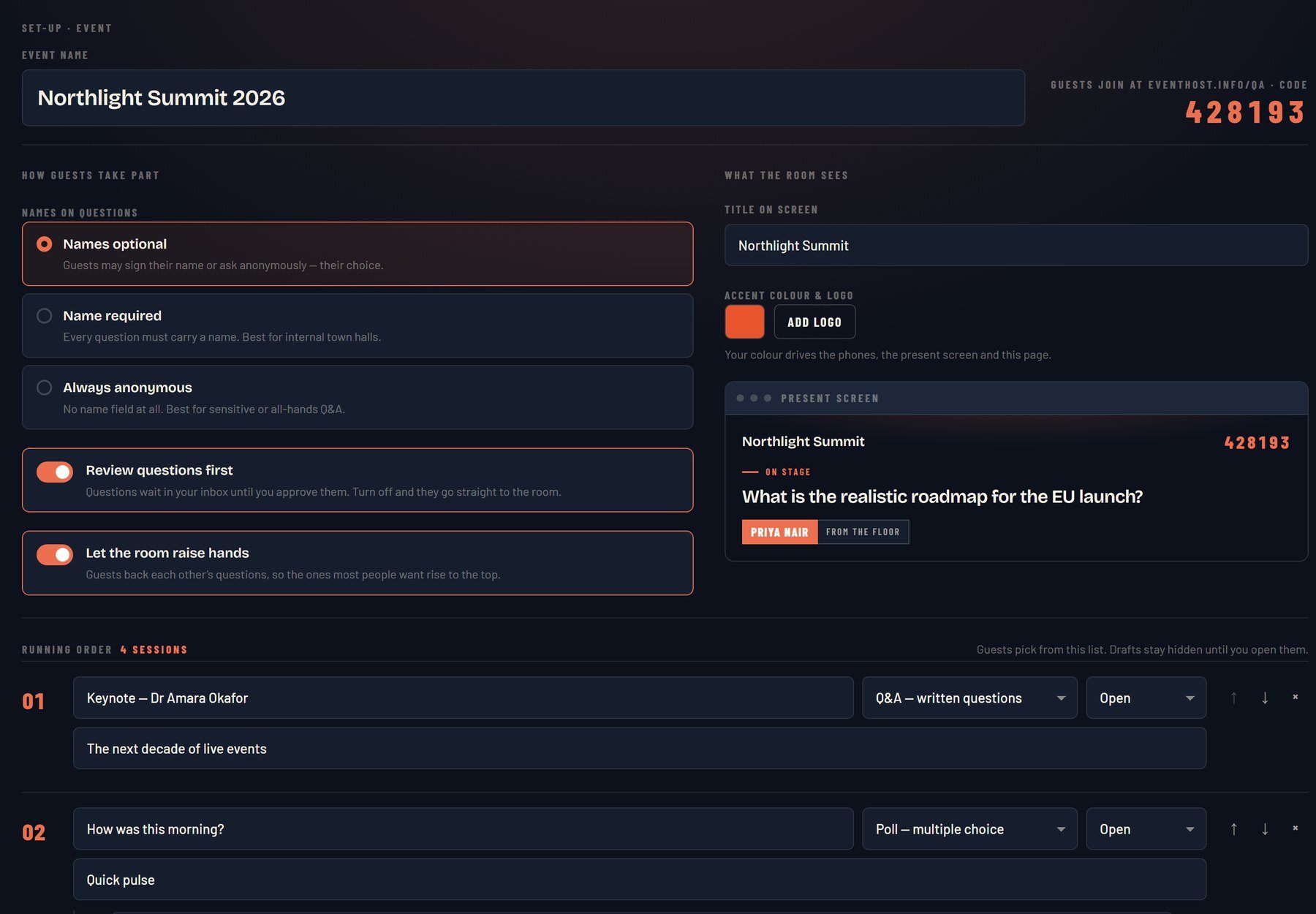
A phone does the same job without the volunteers. With RoomReader, the live Q&A software I built and include with hosting, each table sends its strongest idea from a phone, so the host reads out patterns instead of picking three hands.
World Cafe vs fishbowl: which should you use?
Use a World Café when you want everyone’s thinking. Use a fishbowl when a few people have experience the whole room should hear.
In the Liberating Structures User Experience Fishbowl, three to seven people sit in an inner circle with microphones under two rules: no speeches, and talk to each other, not to the audience. Outer-circle groups then draft questions for them. An open fishbowl keeps one chair empty: an observer can take the seat, and someone inside then leaves.
| World Café | Fishbowl | |
|---|---|---|
| Who talks | Everyone, at once | A few at a time |
| Best for | Ideas from the whole room | Learning from direct experience |
| Replaces | An open plenary | A panel |
If your panels become four mini-keynotes, try a fishbowl. These panel discussion questions work in either format.
Where large World Cafés go wrong
- A closed question. If it has a right answer, the room finds it in round one and rounds two and three run dry.
- The report-back marathon. Fifty tables at two minutes each, and the room has gone.
- Moving in blocks. Nothing cross-pollinates.
- No way to stop the room. No microphone, no chime, and 300 people miss the next question.
- Expecting a decision. Café To Go says good questions need not imply immediate action steps. If you need a decision by 4pm, follow the café with a prioritisation session.
The method also has its critics: Carson cites concerns that it can conceal structural inequalities. If the chief executive joins a table, that conversation changes, so decide in advance where senior leaders sit.
Running a World Café at a conference
The energy in a room is a curve, and I have watched it for twenty years: the cold open at 9am, the slump after lunch, the awkward gap before networking. A World Café needs people with something to say, so it works best after a keynote or panel (Carson opened hers with one). Warm a cold room up first with large-group icebreakers, and after lunch, a short conference energiser first will help.
The official method page says the process is simple to learn, but numbers and question crafting can make an experienced host worthwhile. With 300, someone has to brief the table hosts, hold the clock, move the room and turn the harvest into something delegates recognise. That is conference facilitation. I have hosted 800+ events, and the formats that work at that scale were designed for a hall, not for twelve people in a training room.
And credit the creators. The method is shared under a Creative Commons licence, and the foundation asks you to acknowledge it and link to theworldcafe.com when you use the name, which is trademarked in the US.
For more ways to involve a whole audience, see these participation techniques. If you want a host who keeps the whole room with you from the first table move to the last insight, send the agenda or check availability at hello@conferencehost.uk.

17:00Close
Send me your agenda. I’ll show you where the room comes alive.
A fixed price, a free planning call, and a reply within one working day.