Networking Games for Conferences That Get a Cold Room Talking
TL;DR
- Networking games work when they hand people a reason to start talking and a reason to stop. Timing and group size matter more than the game.
- Keep talking groups to four or fewer. Past that, somebody goes quiet.
- Rough timings: speed networking three to five minutes a partner, table rotations fifteen to twenty, problem swaps thirty.
- Run it from the stage: one instruction at a time, said twice, with a visible clock and a named finish.
- The delegates who hate networking need a job, not a conversation.
Networking games have a poor reputation and most have earned it. The failures are party tricks borrowed from a training room of twelve, dropped into a hall of two hundred where nobody can hear the instruction and nobody wants to stand up first.
The ones that work do something narrower. They remove the two hardest moments in a room of strangers: starting, and getting away.
What are networking games, and when do they work?
Networking games are structured conversations: a prompt, a time limit and a rule about who talks to whom. That third part separates them from a drinks reception, where people reliably find the colleague they arrived with.
They are not warm-up icebreakers. An icebreaker loosens a room before a session; group icebreakers do that job. A networking game aims elsewhere: delegates meeting each other, not the room meeting the speaker.
In Hilton’s Why We Gather survey of 3,150 adults in the UK, US and India, 49% said meeting new people and bonding with their team would be their main reason for attending work events in 2026.
The energy in a room is a curve, and I have watched it for twenty years across 800-plus events. Three slots suit a networking game: the first twenty minutes of day one, the dead half hour after lunch, and the awkward gap before the drinks.
Speed networking: how long should each round be?
Three to five minutes per partner. Shorter and nobody gets past job titles; longer and the room flags before everyone has rotated.
The Royal Geographical Society runs a 100-minute version at its annual conference: a five-minute introduction from the chair, an hour in which delegates find new partners every five minutes, thirty minutes of deeper conversation with whoever they want, then a five-minute close. That final half hour is the bit most organisers leave out, and where the business happens.
Short versions work too. A 2016 session at Virginia Commonwealth University put 21 researchers on tables of three with three minutes each, ran about thirty minutes, and 53% strongly agreed that they had met a potential collaborator.
What goes wrong: two long rows of pairs look tidy and sound terrible, because every voice competes with the one beside it. Scattered tables of three or four are easier to leave.
Table rotations: how do you move 200 people without chaos?
Number the tables, keep one person seated at each, move everybody else. The World Café method sets the table at four chairs optimally and no more than five, across three or more twenty-minute rounds.
That seated person is the whole trick. They hold the thread of what the last group said, so round two starts mid-conversation rather than at the beginning.
Rotate the host every third round so nobody is stuck.
Twenty minutes suits a question worth chewing on. Drop to fifteen if the room is tired, and never run four rounds without a break.
Keep groups small. Dunbar, Duncan and Nettle found an upper limit of about four people in one spontaneous conversation. Seat six and you have not made a bigger conversation, you have made two.
Question cards: what should be on them?
One question per card, and make it a real one. The cards that die ask for a fun fact about yourself, which is a performance request dressed as a question.
Go deeper than feels comfortable. Kardas, Kumar and Epley found that strangers given deeper questions expected awkwardness and were wrong: the conversation was less awkward, warmer and more enjoyable than predicted, and the mispredictions were largest for exactly the deep topics people avoid.
Escalate rather than opening at full depth. The Berkeley version of Arthur Aron’s closeness procedure splits 36 questions into three sets of twelve across 45 minutes, each more probing than the last. You will not run that at a conference, but the shape transfers: start with the work, then the choice, then the person.
Four cards is enough for a table: what brought you here, what are you stuck on, what have you changed your mind about, who should I talk to.
Problem swaps: the format senior rooms take seriously
Directors and partners will not play a game. They will accept free consultancy, which is what a problem swap is.
Troika Consulting runs in trios over roughly thirty to thirty-five minutes. The client describes their challenge in one to two minutes. The other two ask clarifying questions for another one to two minutes, then talk about it for four to five minutes while the client turns away and listens. The client says what was useful, and the roles rotate.
The turning-away step sounds odd and does the heavy lifting. People are franker when the person they are advising is not watching their face.
For a bigger room, Wise Crowds scales it: a central group of three or four works one problem for about twenty minutes while satellite groups of two or three run the same conversation at their tables. Where each format earns its slot sits in my guide to liberating structures.
Human bingo, scavenger hunts and the phone version
Card mixers are the lightest option and the easiest to get wrong. Human bingo has its own guide here, including the squares to leave off.
The honest limitation: a paper card makes people hunt for an answer, not a conversation. It suits twenty minutes before lunch, not a session you rely on.
When a room is genuinely cold I would rather run something everybody plays at once. Two of the eight conference games I run suit it, Scavenger Hunt and Category Clues, and every delegate plays on their own phone with nothing to download. That keeps the whole room with you. A table that has just competed together has something to talk about at the drinks.
How does the host run networking games from the stage?
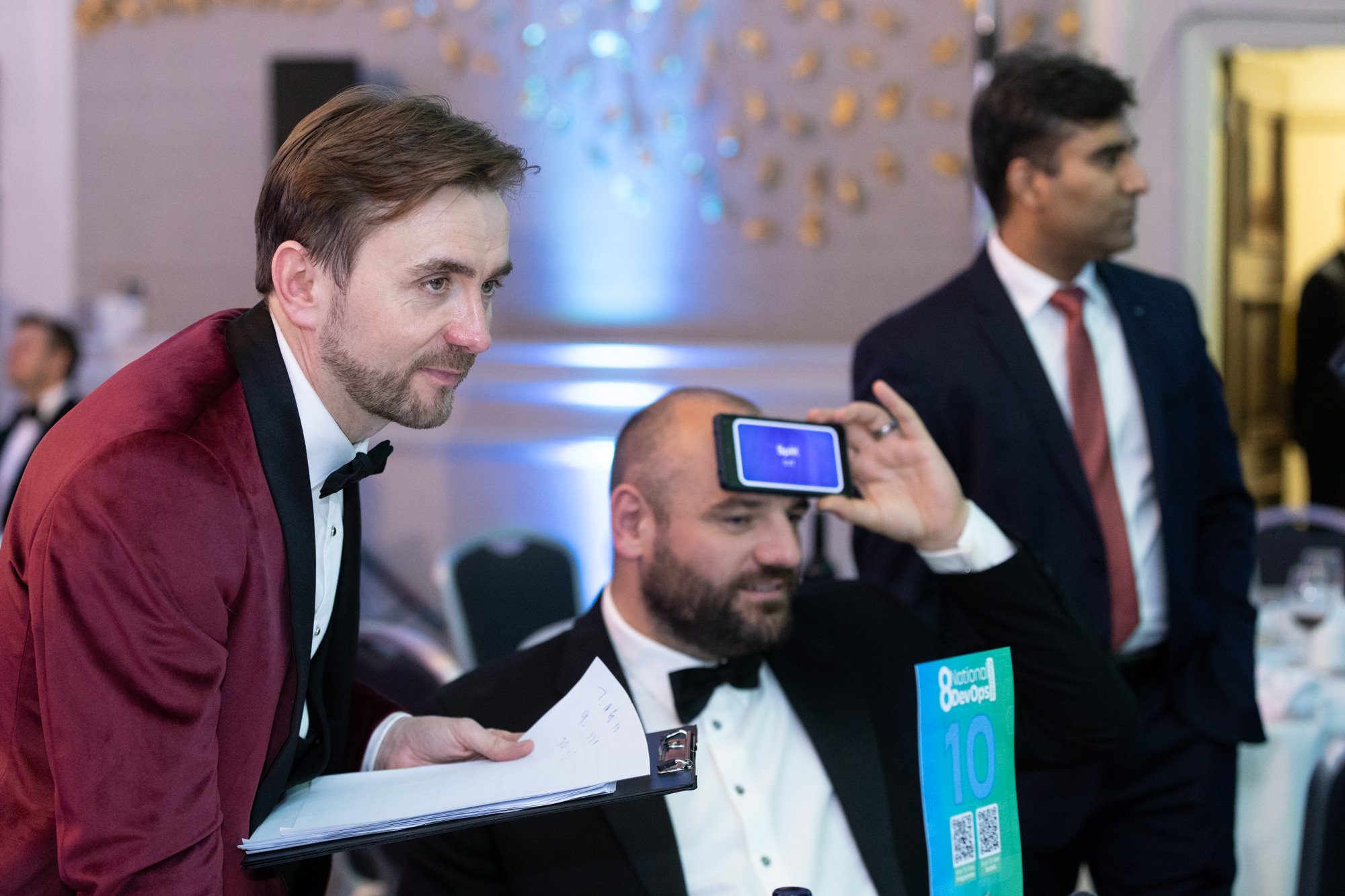
One instruction at a time, said twice, then a visible countdown. Most networking games fail in the thirty seconds before they start.
The running order from the stage:
- Name the point out loud: “you will leave with three names and one useful introduction”.
- Give the move before the task: stand up, find someone you have not met, then you get the question.
- Say the question twice and put it on the screen.
- Start a clock the room can see.
- Call the change hard. A countdown from five, not a polite suggestion.
- Harvest two or three answers before handing the agenda back.
Watch the room, not the clock. If a format has died, say so and move on.
I use RoomReader, my own phone-based live Q&A, for the harvest: reading three real answers off the screen tells the room this was not filler. Reluctance is not what kills participation. Cringe is.
What do you do about the people who hate networking?
Give them a job. A role removes the risk of looking foolish, and that risk, not shyness, stops professional adults taking part.
Not a small minority: in the same Hilton survey, 38% said they would rather spend free time at a work event recharging alone than join in.
What helps:
- Make it short and finite. “Twelve minutes, three conversations, then we move on” is a promise someone can agree to.
- Hand out the question card. A prop means nobody has to invent an opening line.
- Keep trios in play. Pairs give you nowhere to hide; a third person lets someone listen for a minute. Impromptu Networking uses pairs or trios across three rounds of four to five minutes and opens with three minutes of silent reflection, a gift to anyone who thinks before speaking.
- Allow the exit. Open Space has a law of mobility: people move when they are no longer learning or contributing. Say from the stage that stepping out is fine and more of them stay in.
For the delegate side, my networking tips guide covers joining a group, leaving one and following up.
Networking games at a glance
| Format | Time | Group size | Best slot |
|---|---|---|---|
| Speed networking | 3 to 5 min per partner | 3 to 4 per table | Day one morning |
| Table rotation | 15 to 20 min per round | 4, max 5 | Post-lunch |
| Question cards | 10 to 20 min | 3 to 4 | Any seated session |
| Problem swap | 30 to 35 min | Trios | Senior or peer groups |
| Card mixer | 15 to 20 min | Whole room | Pre-lunch, pre-drinks |
| Whole-room phone game | 10 to 25 min | Any size | Cold open, pre-drinks |
Pick one, give it a real slot in the agenda, and run it like a session, not an apology. If you want a second opinion on where it belongs, send me the agenda.


17:00Close
Send me your agenda. I’ll show you where the room comes alive.
A fixed price, a free planning call, and a reply within one working day.