Networking Tips for Conferences: How to Work the Room
TL;DR
- Nearly everyone at a mixer says they want to meet new people, and most still end up with the people they arrived with. Go in with a plan, not just good intentions.
- Ask questions, especially follow-ups. Research links them to being liked more, and the people you talk to already like you more than you think.
- Keep your elevator pitch to two sentences: who you are, what you do, what you are looking for.
- Follow up within a few days with one specific action. A contact who has gone quiet is still worth reconnecting with later.
- Organisers: unstructured networking leaves delegates to fend for themselves. Give every table a reason to talk before the drinks.
Most networking tips are written for job seekers at a careers fair. This guide is for the conference: the coffee queue at 8.45, the stand-up lunch, and the drinks reception where 300 strangers hold a glass and look at their phones. It covers what to do before, during and after, plus a section for organisers on the awkward gap before networking.
Why is conference networking harder than it looks?
Because good intentions do not survive the room. When Columbia researchers fitted about 100 executives at a business mixer with electronic name tags, 95% of guests said beforehand that their goal was to build new ties. They were still much more likely to spend time with the friends they already had.
People do care. Freeman research reported by BizBash found 58% of attendees said they were motivated by networking in 2024, up from 39% in 2021.
Part of the problem is how networking feels. A study that included lawyers at a large business law firm found that networking for professional gain can leave people feeling morally dirty, and those who felt it most networked less. If you have ever hovered by the coffee urn rather than walk up to a stranger, you know the feeling.
Networking tips for before the conference
Most of the work happens before you arrive.
- Read the attendee list. Pick three to five people you would like to meet. A Cell Press careers guide suggests emailing a few people a month ahead to ask for a chat in a break.
- Choose sessions with people in mind. A breakout with 40 people gives you more chances to talk than a keynote with 800.
- Split from your colleagues. Agree it in advance. The mixer study is the warning: people drift back to who they know.
- Prepare one line about yourself (more on that below) and three questions you actually want answered.
- Set a small goal. Three proper conversations beat 30 business cards.
How do you network at a conference without feeling awkward?
Start with what you share, and ask the other person about themselves. The National Careers Service gives the same advice for nerves: ask a question about the other person, which takes the pressure off you.
At a conference you share plenty: the session you just sat through, the queue, the speaker everyone is talking about. “What did you make of that panel?” works far better than a rehearsed introduction, because it is easy to answer.
Then keep asking. In Harvard research published in the Journal of Personality and Social Psychology, people who asked more questions, particularly follow-up questions, were liked more by the people they spoke to. Follow-ups work because they prove you were listening.
Two findings should calm your nerves. People consistently underestimate how much their conversation partners like them, which researchers call the liking gap. And Chicago commuters asked to talk to a stranger had a better journey than those who sat in silence, having underestimated others’ interest in connecting. The other person is usually relieved you spoke first.

What are good networking questions to ask at a conference?
Good networking questions are open, easy to answer and tied to the event. Save “so what do you do?” until the conversation has warmed up.
| Moment | Question | Why it works |
|---|---|---|
| Opening | “What brought you to this one?” | Everyone has an answer |
| After a session | “What did you make of that talk?” | Shared experience, no wrong answer |
| Follow-up | “How would that work in your team?” | Shows you listened |
| Going deeper | “What is taking up most of your time at the moment?” | Gets past the job title |
| Being useful | “Is there anyone here you are hoping to meet?” | Lets you make an introduction |
| Closing | “Can I send you that article we talked about?” | Sets up the follow-up |
Do not turn it into an interview. The same research summary warns that too many questions, or rude and repetitive ones, can backfire. For openers built for a room rather than a table of six, see these icebreaker questions.
How do you write an elevator pitch for a networking event?
Answer three questions in two sentences: who you are, what you do and what you are looking for. Lancaster University’s careers team builds the elevator pitch around exactly those three questions, and suggests ending with a clear next step.
The careers version can run to two minutes. At a conference, nobody wants two minutes. Aim for something you can say before the other person finishes a sip of coffee:
“I’m [name], and I run internal events for a logistics company. I’m here looking for ways to keep a 400-person conference awake after lunch.”
The last part matters most. It gives the other person a hook, and something they might be able to help with. Practise it out loud until it sounds like you talking, not like a script.
What are the best networking tips for introverts?
Plan fewer, deeper conversations, and build in breaks. You are far from alone in finding this hard: in Bizzabo’s 2025 survey of event professionals, attendees and sponsors, only 39% of attendees described themselves as outgoing and eager to engage at events.
- Book one-to-ones in advance. A coffee with one person is easier than breaking into a circle of five.
- Use the first minutes of a break. Before groups form, starting a conversation is easier.
- Take time out on purpose. The Cell Press guide recommends scheduling time alone each day. A walk at lunch is strategy, not avoidance.
- Go in with something to give. An introduction, an article, a useful contact. In the Kellogg research, people with more power felt less dirty about networking, possibly because they felt they had something to offer in return.
One more reason to relax: in the first liking gap study, the shyer the person, the bigger the gap. If you are quiet, you are probably making a better impression than you think.
How do you join and leave a group conversation?
Look for open groups, where people stand in a horseshoe with a gap, and wait for a natural pause before you speak. A tight, closed circle usually means a private conversation.
Leaving is the part most people dread, and it is simpler than it feels. Be honest and specific: “I want to catch the speaker before the next session. Good to meet you.” Better still, leave by introducing the person to someone else, so nobody is left standing alone.
What should you do after a business networking event?
Follow up within a few days, with one specific action. The National Careers Service puts it plainly: always follow up networking with an action. Send the article you mentioned, make the introduction you promised, or suggest a call with a date in it.
Sending a message is not enough on its own. In the Bizzabo survey, 92% of attendees said they had followed up with someone they met through an event app’s networking feature, but 34% said nothing ever came of it. So make sure your message gives the other person a reason to reply, such as the thing they asked for or a date for that call.
And if a contact goes quiet, do not write them off. In a study of executive MBA students, reconnecting with dormant ties (former contacts now out of touch) produced outcomes that compared favourably with those from current contacts.
For organisers: fixing the awkward gap before networking
The energy in a room is a curve, and I have watched it across 800+ events: the cold open at 9am, the slump after lunch, the awkward gap before networking. That last one is usually left to chance.
Only 53% of attendees in the Bizzabo survey said the events they attend include structured networking, and 21% of organisers named attendee social anxiety as something that holds people back. The mixer in the Columbia study had no chairs and almost no structure across 80 minutes, and guests stuck with who they knew. The researchers noted that the electronic name tags themselves gave guests a reason to start a conversation and acted as “a shield against rejection”.
Most icebreakers were designed for twelve people in a training room, not a hall. So give delegates that reason on purpose:
- Mix the tables in the session before networking, so people already know a few faces.
- Make introductions from the stage. Who is in the room, which sectors, who is looking for what.
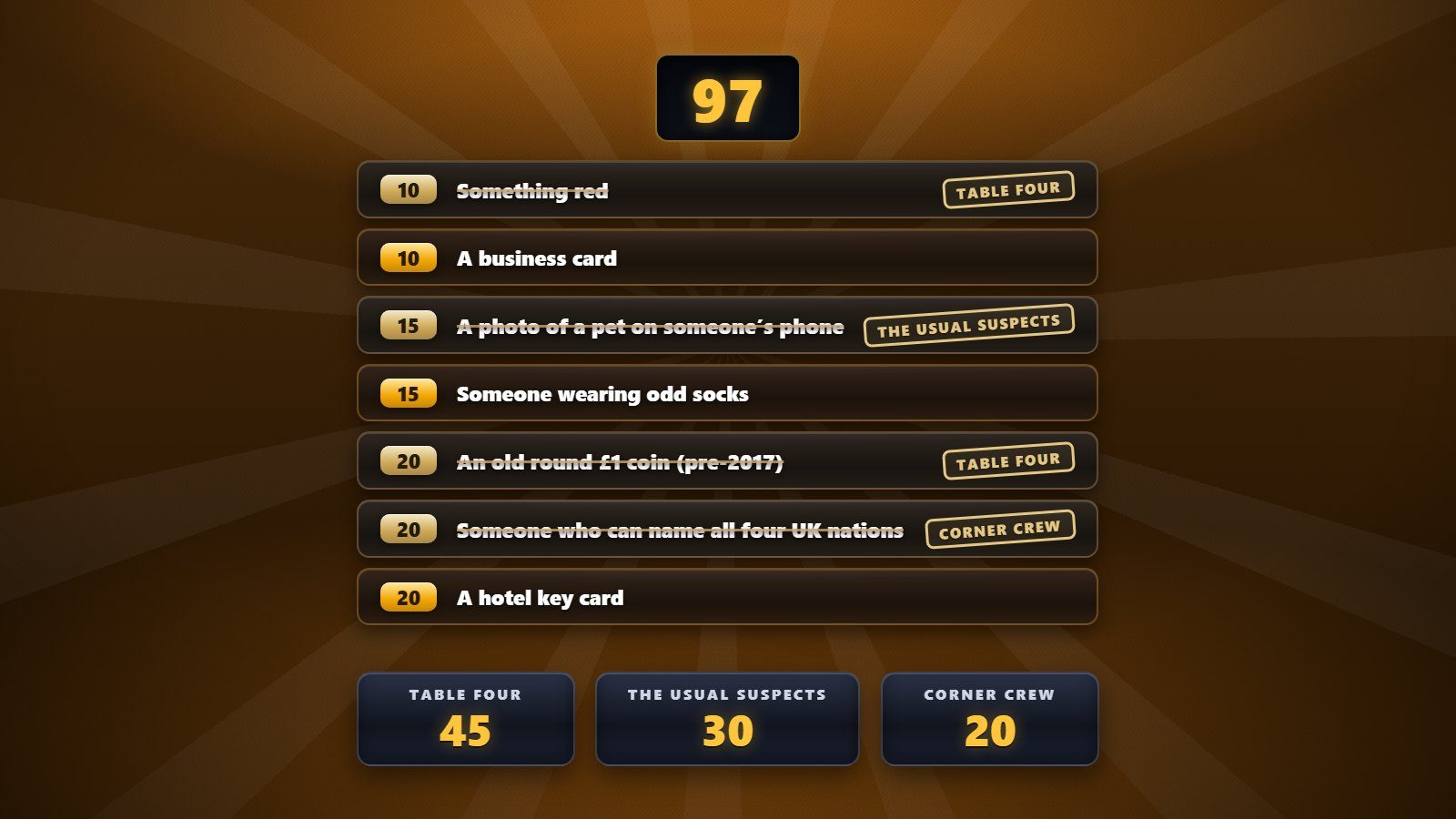
- Give every table an opening line. Networking fails because nobody has one. A short round of Category Clues or a Scavenger Hunt before the drinks gives every table something to talk about. Both are among the conference icebreakers I run, where every delegate plays on their phone, nothing to download.
The same thinking applies first thing. The guide on how to open a conference covers the first ten minutes, and the one on large group icebreakers explains why “turn to your neighbour” falls flat in a hall of hundreds.
Networking tips checklist
Before: read the attendee list, pick three to five people, book a coffee or two, and prepare your two-sentence pitch.
During: split from your colleagues, open with the shared moment, ask follow-up questions, and leave by making an introduction.
After: follow up within a few days with one specific action, and keep a note of who you met and what you promised.
If you are organising a conference and want a host who keeps the whole room with you, from the cold open to the networking gap, send the agenda or check availability at hello@conferencehost.uk.


17:00Close
Send me your agenda. I’ll show you where the room comes alive.
A fixed price, a free planning call, and a reply within one working day.