Two Truths and a Lie: Ideas, Examples and Good Lies for Work Events
TL;DR
- Each person says three statements about themselves, two true and one false. Everyone else guesses the lie, then the speaker reveals it.
- The best lie is boring and specific. The best truth is the one nobody would believe.
- Keep it light at work: nothing about health, money, relationships, religion or anything else people may not want to share.
- Played round the room it stalls past about 15 people. For a conference, a few volunteers submit sets in advance and the whole room votes on their phones.
Two truths and a lie is the icebreaker almost everyone has played. No kit, no prep, about a minute per person. It works because people choose what they reveal. Here is how to play it properly at work, a long list of work-safe examples, how to write a lie that fools the room, and how to scale it when the room holds 200 people instead of 12.
How do you play two truths and a lie?
Each player says three short statements about themselves. Two are true, one is false, in any order. Everyone else guesses which one is the lie, the player reveals the answer, and the turn passes on.
The rules that make it work in a meeting:
- Give people two minutes to think before anyone starts. Put on the spot, most people go blank.
- Statements are one sentence each. No stories until the reveal.
- The group votes together, by show of hands or on their phones, so nobody is guessing alone.
- After the reveal, allow one follow-up question about the surprising truth. That is where the conversation starts.
- Anyone can pass. No explanation needed.
Allow about a minute per person, including the vote. Eight people take roughly ten minutes.
Why does two truths and a lie work as an icebreaker?
It is a safe way to share something personal. Each player decides exactly what goes on the table. Everyone else has a reason to listen, because they have to guess.
The research backs this up. A meta-analysis by Collins and Miller found that people who disclose more tend to be liked more, and that people come to like those they have disclosed to. This game does that at speed, with facts small enough to be safe.
Yale psychologists also found a liking gap: after a first conversation, people underestimate how much the other person liked them. The colleague dreading their turn will go down better than they think.
The follow-up question is the part most groups skip. One study of live conversations found that asking follow-up questions is particularly likely to make a partner like you more. Build one into the reveal.
Two truths and a lie examples for work
Treat these two truths and a lie ideas as prompts. Pick ones that are true for you, then twist one into a lie. Every one is safe to say in front of your manager.
Career and first jobs
- My first job was in a fish and chip shop.
- I once sent an email to the whole company by mistake.
- I have worked in three different countries.
- I applied for this job on my phone, on a train.
- I have had a job interview in a car park.
- My first payslip was under £50.
- I have never had a desk of my own.
- I once worked a summer at a theme park.
Skills and hobbies
- I can solve a Rubik’s cube.
- I play in a brass band.
- I have run a marathon.
- I have a black belt in judo.
- I once baked a cake for 200 people.
- I taught myself to juggle from online videos.
- I can type faster than I can talk.
- I grow my own vegetables.
Travel and places
- I have never been on a plane.
- I have stood on top of Ben Nevis.
- I once missed a flight by going to the wrong terminal.
- I have lived on a boat.
- I learned to drive in another country.
- I have been to every continent except one.
Habits and quirks
- I have never drunk a cup of tea.
- I eat the same lunch every working day.
- I have never seen a Star Wars film.
- I keep the same alarm time at weekends.
- I can’t whistle.
Brushes with fame
- I was an extra in a TV drama.
- I was in the local paper when I was seven.
- I once shared a lift with a Premier League footballer.
What makes a good lie for two truths and a lie?
A good lie is ordinary, specific and the same length as your truths. Forget the poker face. The job is to make the lie the most believable thing you say.
People are poor lie detectors to start with. Across studies of more than 24,000 people, Bella DePaulo reports average accuracy of 54 percent, barely better than the 50% you would get by guessing. The cues people rely on, such as nerves, are real but weak. So the room will judge your statements on plausibility, not on your face.
That gives you four rules:
- Make the lie dull. “I have a black belt in judo” gets suspicion. “I eat the same lunch every day” does not.
- Make a truth outrageous. Your strangest true fact does the heavy lifting.
- Add one detail to the lie. “I learned to drive in Spain” beats “I learned to drive abroad”.
- Prepare for follow-ups. Liars in one Portsmouth study gave fewer details than truth tellers when asked unexpected questions. Know what you would say if someone asks who taught you.
A strong set might be: “I have never been on a plane. I was an extra in a TV drama. I grow my own vegetables.” If the plane line is the true one, most rooms will pick it as the lie.
Funny truth and lie ideas that stay work-safe
Funny two truths and a lie ideas land best when the joke is on you. Keep them a little absurd and over in one sentence:
- I once locked myself out of a hotel room in a towel.
- I have fallen asleep in a cinema during an action film.
- I was once mistaken for a member of staff in a supermarket and helped the customer anyway.
- I have waved back at someone who was waving at the person behind me.
- I failed my driving test for driving too slowly.
Avoid jokes that need a colleague’s name, a drink-fuelled backstory or a punchline you would not repeat to a client.
What should you keep out of it at work?
Anything a colleague might not want known, or might feel pressure to match. At work, the safe line is hobbies, travel, skills, first jobs and harmless quirks.
Leave out health, money, relationships, family plans and anything touching the protected characteristics in the Equality Act, such as religion, pregnancy or sexual orientation. A lie about any of those can land badly, and a truth can be more than someone meant to share.
Cringe is the real risk. A YouGov poll found 60% of Britons who had done a team building exercise found it embarrassing or cringe-worthy. After 800+ events, my view is simple: professional adults will happily take part if the format removes the risk of looking foolish. Cringe, not reluctance, is what kills participation.
Acas also notes that some neurodivergent staff may find certain social activities uncomfortable, and advises asking rather than assuming. The right to pass is not optional.
How do you spot the lie and win?
If your group allows one question before the vote, make it one nobody would expect, then listen for detail. Truths come with detail ready. Lies usually do not.
Ask about the edges, not the headline. “Who was in the TV drama?” is expected. “What did they feed the extras?” is not. That is the kind of question the Portsmouth study found exposes thin answers.
Do not trust your gut on body language. Science News reported that experienced judges showed no lie-spotting advantage over inexperienced ones. Your finance director is no better at this than the graduate intake. That is half the fun.
Does two truths and a lie work with a large group?
Not in its usual form. At a minute each, 200 people would take more than three hours. Even 15 people means a quarter of an hour of listening, and that is about where it stalls.
Most icebreakers fail at scale because they were designed for twelve people in a training room. A conference needs formats designed for a hall. To keep two truths and a lie in a big room, change who speaks and who plays:
| Version | How it runs | Time | Best for |
|---|---|---|---|
| Table rounds | Tables of 6 to 8 play among themselves | 10 min | Workshops, cabaret seating |
| Spotlight volunteers | 3 to 5 people submit sets in advance; the whole room votes | 2 min each | Conferences, kickoffs |
| Panel opener | Each panellist submits a set; the audience votes before the first question | 5 min | Panel sessions |
| Leadership edition | The senior team submits sets about themselves | 10 min | Town halls, internal conferences |
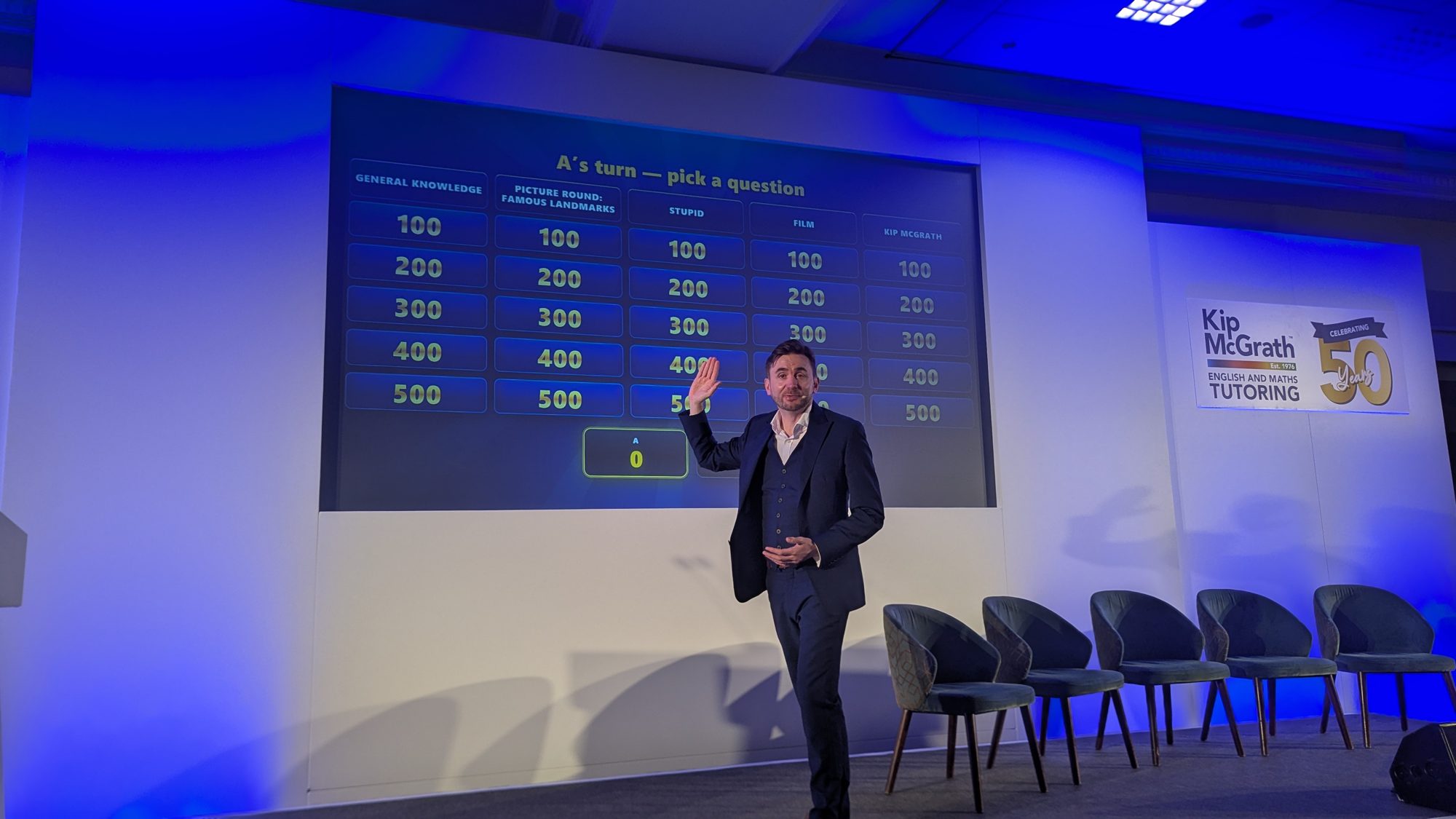
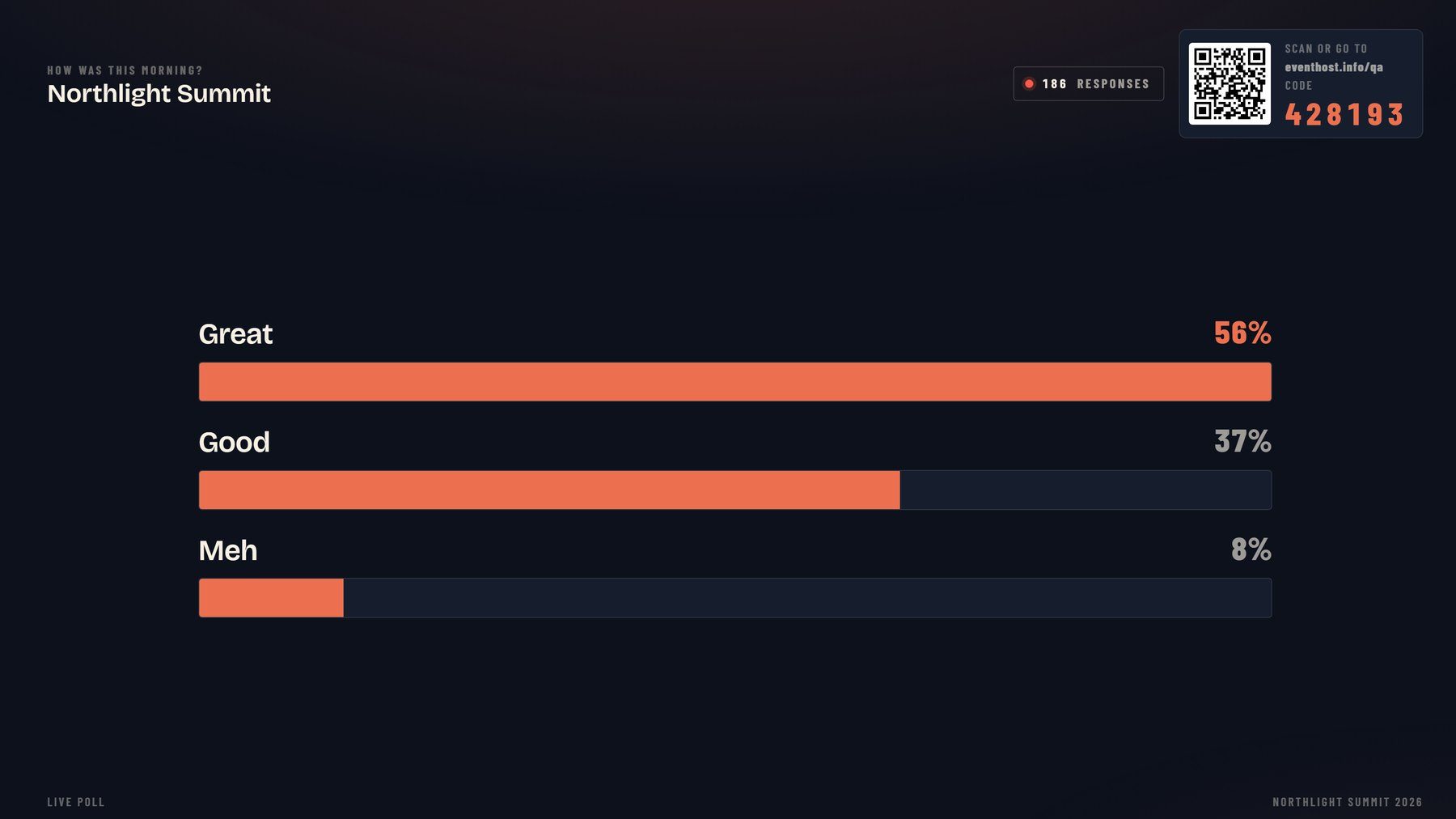
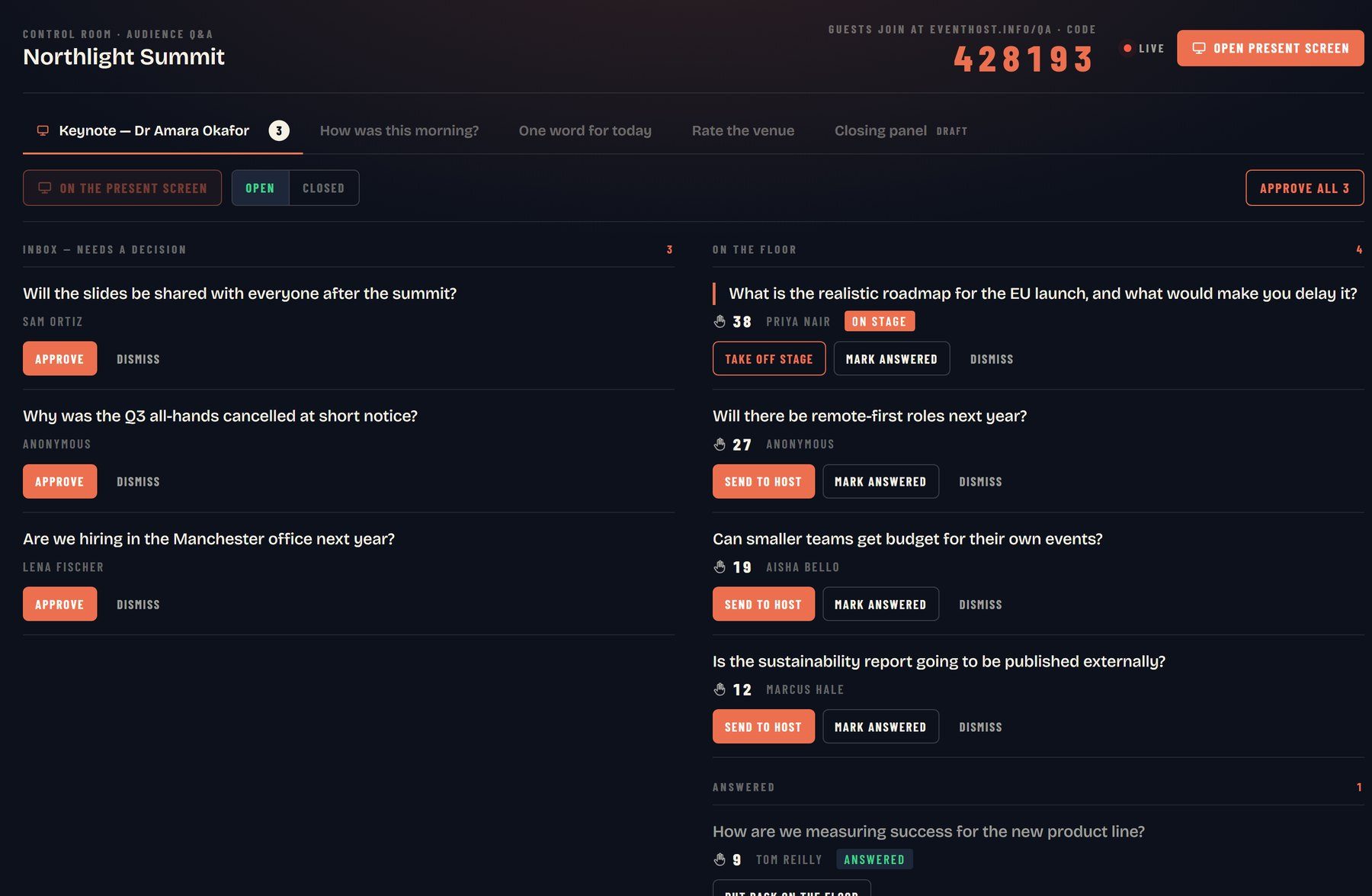
The spotlight version is the one that scales. The host reads each set aloud, every delegate votes, and the result goes up on screen before the reveal. Any audience response tool can run the vote. When I host, it can run on RoomReader, my own audience response software, included with hosting. Every delegate votes on their phone, nothing to download.
For more formats that work past 20 people, see the guide to large group icebreakers.
When should you run it in a conference day?
Run it in the morning or just before networking. Never use it to fix the post-lunch slump: it is a quiet, listening game, and a sleepy room needs something louder.
The energy in a room is a curve, and I have watched it for twenty years: the cold open at 9am, the slump after lunch, the awkward gap before networking. Each needs a different opener. Two truths and a lie suits the first and third: it gives strangers something to talk about.
The slump is a different problem. A review of the post-lunch dip found it can occur even when people have had no lunch. That slot wants a whole-room game with noise and competition, like the conference icebreakers I run on delegates’ phones.
Variations on the truth and lie format
Once a group knows the classic, these keep it fresh:
- Three truths and a lie. Four statements: harder to guess, a little slower. Best for small teams who already know each other.
- Company edition. The host writes three statements about the organisation’s history or numbers; tables guess the false one. Good for inductions.
- Two lies and a truth. Flip it, and the group hunts for the one true fact.
- Virtual version. Post statements in the chat, vote with a poll, reveal on camera. More ideas in the virtual icebreakers guide.
For openers that need no sharing at all, try the icebreaker games or a list of icebreaker questions.
Making it land on the day
Brief people the day before so they arrive with a set ready. Go first yourself, with a self-deprecating set, so everyone knows the tone. Keep the reveal quick. Let the follow-up question do the work.
Planning a conference, kickoff or internal event and want a host who keeps the whole room with you from the first minute? Send the agenda or check availability at hello@conferencehost.uk.


17:00Close
Send me your agenda. I’ll show you where the room comes alive.
A fixed price, a free planning call, and a reply within one working day.