Group Icebreakers for Small and Medium Gatherings
TL;DR
- This guide covers group icebreakers for small and medium gatherings, roughly 5 to 40 people. For a hall of hundreds, see the large groups guide instead.
- Match the opener to the size band. What works with eight people around a table will stall with thirty in rows.
- Keep it short: five minutes for a small group, ten at most for a medium one.
- The killer is cringe, not reluctance. Professional adults join in happily when the format removes the risk of looking foolish.
- Give every icebreaker a purpose: warm the room, mix the tables, or set up the session that follows.
Group icebreakers earn their place when they warm a room quickly and give people a genuine reason to talk. This guide is for small and medium gatherings, roughly 5 to 40 people: a workshop, a team offsite, a board awayday, a training cohort. If you are opening a room of hundreds, the rules change, and I point you to the right approach below. Everything here is organised by group size, because that single number changes what will land.
What are group icebreakers, and when should you use them?
Group icebreakers are short, structured openers that get people talking, thinking or moving together before the main business starts. They lower the social risk of the first few minutes, when a room is quietest and most self-conscious.
Use one when the group does not know each other, when you are mixing people across teams, or when you need to lift the energy at a known dip. The energy in a room is a curve, and I have watched it for twenty years: the cold start, the flat middle, the slump after lunch. A good opener is aimed at one of those exact moments, not dropped in at random.
Skip the icebreaker when the group is tight, the agenda is short, and everyone just wants to get on with it. Forcing fun on a room that does not need it does more harm than a plain, warm welcome.

How do you pick the right group icebreakers for your room?
Pick group icebreakers by matching three things: how many people are in the room, how well they already know each other, and what you want to happen next. Get those right and almost any format works. Ignore them and even a clever game falls flat.
Here is the quick version by size band.
| Group size | What to reach for | What to avoid |
|---|---|---|
| 5 to 12 | Round-the-table questions, paired shares | Anything with teams or scoreboards |
| 13 to 40 | Small-team tasks, structured mixing | Long one-at-a-time introductions |
| 40 plus | Whole-room formats built to scale | Small-room games stretched too thin |
The “what happens next” test matters most. If the session is a strategy workshop, open with something that gets people thinking. If it is a social kickoff, open with something that gets them laughing. The opener should point at the room you want, not just fill a gap.
Small group icebreakers (5 to 12 people)
With a small group, everyone can speak and be heard, so use that. These small group icebreakers work best around a table or in a tight circle.
- Two truths and a lie. Each person shares three statements about themselves and the rest guess the lie. Fast, low effort, always earns a laugh.
- One word check-in. Ask each person for a single word describing how they arrived. It surfaces the mood in the room in under two minutes.
- Paired swap. People pair up, talk for ninety seconds, then introduce their partner to the group. It removes the pressure of talking about yourself.
- Best and worst. Each person names their best and worst moment of the week or the project. Honest, human, and quick.
Keep it to one round. Small groups do not need warming up twice.
Icebreakers for groups of 13 to 40: what changes?
For groups of 13 to 40, stop going one person at a time and start using small teams. Once a room passes about a dozen people, round-the-table introductions drag and the energy leaks out of the back of the room.
Break the group into tables or clusters of four to six, then give each cluster a short task. Everyone talks at once, nobody waits their turn, and the noise itself lifts the room.
Formats that work at this size:
- Table challenge. Give each table a two-minute question or puzzle, then take one answer per table. Fast, and it makes the room feel busy.
- Find someone who. A short bingo-style card of prompts (“has run a marathon”, “started this year”). People move and mix, which breaks up cliques.
- Common ground. Each table finds three things all of them share. It builds a quick sense of a team before any real work starts.
Mixing is the hidden benefit here. Deciding who sits where, or forcing movement, does more for a medium group than the game itself.
Which icebreaker games for groups actually land?
The icebreaker games for groups that land are the ones where the format carries the risk, not the person. Nobody wants to perform. They will happily join in when the game gives them cover.
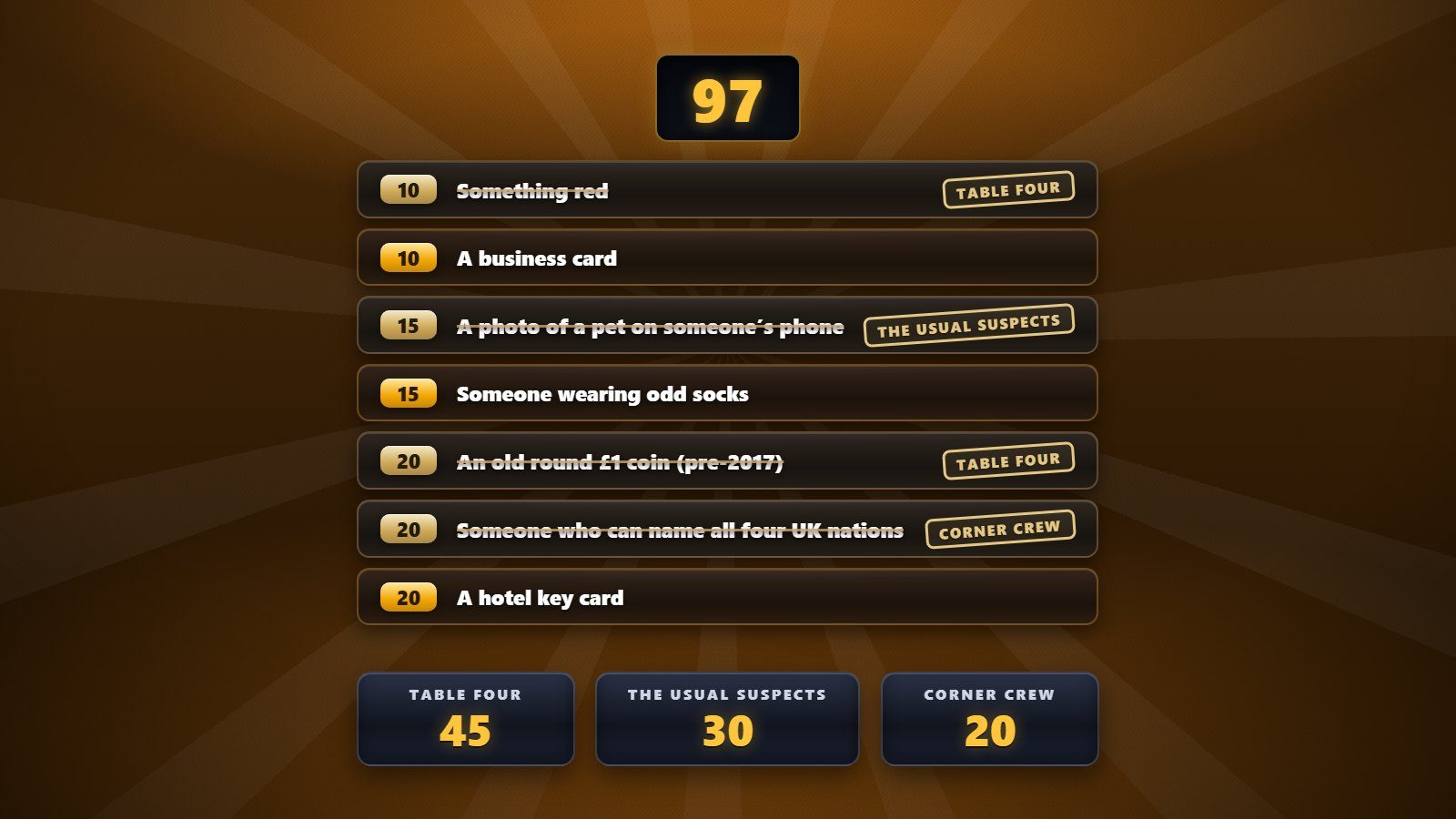
That is the whole idea behind whole-room game show formats, where every delegate plays on their own phone with nothing to download. A quiz, a “higher or lower”, a “guess the phrase” round: the screen holds the attention, the individual is never singled out, and a shy room becomes a loud one in about ninety seconds. A skilled host runs the room around it, which is what keeps it feeling sharp rather than like a gimmick.
You do not need software for a good game, though. A well-run quiz on paper, a quick team-vs-team round, or a simple ranking task all work. The rule is the same: make it a team effort, keep it short, and give people something to react to together. If you want more on this, see our conference games and audience engagement pages.
Group icebreaker activities that need no props
The most reliable group icebreaker activities need nothing but a room and clear instructions. Props go missing, screens fail, and rooms run late, so having a few zero-kit openers ready is simply good planning.
- Stand up if. Read out statements (“stand up if you travelled more than an hour”). It gets people moving and reveals the room to itself.
- The map. Ask people to stand in a rough map of where they grew up or where they work. Quick, physical, and a natural talking point.
- One question, one minute. Pose a single question to the room and have pairs answer it for one minute each. No kit, no setup, works at any size up to about forty.
- Ranked opinions. Read a mildly divisive statement and have people move to one side of the room for agree, the other for disagree. Instant energy, zero equipment.
When your room is bigger than 40
Once you pass roughly forty people, small-group openers start to strain and you need formats built for scale. Most icebreakers fail in a large room because they were designed for twelve people in a training room, not a hall.
If that is you, do not stretch these ideas thinner. Read our guide to icebreakers for large groups instead, which is written for exactly that problem. For the wider craft of opening well, our conference icebreakers page covers the professional, low-cringe approach in more depth.
How long should a group icebreaker run?
Keep a group icebreaker to about five minutes for a small group and no more than ten for a medium one. The point is to warm the room and hand momentum to the main session, not to become the session.
If you find an opener overrunning, it is usually because it has no clear finish line. Set the timer out loud, take a fixed number of answers, and move on while the energy is still high. Ending a beat early always beats ending a beat late.
For openers designed to fix a specific slump later in the day, our energisers guide covers the post-lunch dip and the pre-networking gap.
What makes an icebreaker fall flat?
An icebreaker falls flat when it feels like forced fun or puts a professional adult on the spot. Cringe is what kills participation, not reluctance. Give people a safe way in and they will take it.
The other common failures are simpler. The instructions are unclear, so nobody knows what to do. The format is built for a different size of room. Or there is no reason behind it, so it feels like a box being ticked.
Fix all three by being specific: pick the right opener for your numbers, explain it in one clear sentence, and tie it to what comes next. Do that and a group icebreaker stops being an awkward warm-up and becomes the moment the room starts working together. If you want a host to run that room for you, reach us at hello@conferencehost.uk or on 07596 851647.


17:00Close
Send me your agenda. I’ll show you where the room comes alive.
A fixed price, a free planning call, and a reply within one working day.