Kick Off Meeting: Agenda, Template and How to Open It Well
TL;DR
- A kick off meeting is the first meeting of a project team. Its job is to agree the goal, the roles, the dates and the risks before anyone starts work.
- Sixty minutes is enough for most projects. Ninety suits a bigger cross-team launch.
- Start on time, and get every person talking inside the first five minutes. A silent minute of writing beats a round of long introductions.
- Run a short premortem so the quiet worries come out in the room, not in week six.
- Send the actions, owners and dates within a day, or the meeting did not really happen.
A kick off meeting is where a project stops being a plan and starts being a team. Get it wrong and you have spent an hour reading slides to people who will not remember them. This guide gives you a kick off meeting agenda with timings, a template to copy, and the part most guides skip: how to open it so the room actually talks.
If you are planning a sales kickoff (the annual conference version), that is a different event with different goals, and the sales kickoff ideas guide covers it. This one is about project and team kick-offs.
What is a kick off meeting?
A kick off meeting is the first meeting with the project team, held with or without the client, once the basic planning is done. The phrase comes from sport: the kick-off starts the game. In a meeting it means the work starts.
A good one leaves everyone with the same answer to five questions:
- What are we trying to achieve, and what is out of scope?
- Who does what, and who decides?
- When are the key dates?
- What could go wrong?
- How will we keep each other updated?
A project kick off meeting is not a status update or a launch party. It sets how every later meeting will run.
What should a kick off meeting agenda include?
A kick off meeting agenda should cover introductions, the goal and scope, roles, the timeline, risks, how you will communicate, and next steps. That is close to the list PRINCE2’s kick-off guidance recommends, and it is the right order: people need to know why before they care about when.
Here it is with timings for a 60-minute meeting:
| Time | Item | Led by | What you leave with |
|---|---|---|---|
| 0:00 | Why this project matters | Sponsor | The reason, in two minutes |
| 0:05 | Opener: everyone speaks | Host or facilitator | Every voice heard once |
| 0:15 | Goal, scope, what is out | Project lead | One agreed sentence |
| 0:25 | Roles and decisions | Project lead | Who owns what |
| 0:35 | Timeline and milestones | Project lead | Key dates |
| 0:42 | Premortem | Facilitator | A risk list with owners |
| 0:52 | Ways of working | Whole team | Channels, cadence, reporting |
| 0:57 | Actions and close | Project lead | Owners and dates |
Atlassian’s project kickoff play runs for 90 minutes with 3 to 14 people, including a five-minute word from the sponsor and a ten-minute icebreaker. Stretch to 90 if several teams are meeting for the first time. Atlassian also makes a point worth stealing: not everyone needs to attend every part.
Send the agenda in advance, so people arrive prepared.
A kick off meeting template you can copy
Paste this into the invite and fill in the blanks. If a section is still empty the day before, that is your warning.
Project: [name] | Date and time: [start and finish] | Sponsor: [name]
- Why this matters: [one or two sentences, in plain words]
- Goal: [what done looks like, with a date]
- Out of scope: [the things people will assume are included]
- Roles: [name, role, what they decide]
- Milestones: [three to five dates]
- Known risks: [left blank, filled in during the premortem]
- How we communicate: [channel, meeting rhythm, who reports to whom]
- Actions: [action, owner, date]
For the roles line, a RACI matrix works well: who is Responsible, who is Accountable, who is Consulted and who is Informed. Some project management approaches insist on only one Accountable person per task. Push for that. When two people “own” a decision, nobody does.
If you are also running a timed event around the meeting, a run of show keeps the minutes honest.
How do you open a kick off meeting so people talk in the first five minutes?
Start exactly on time, give the sponsor two minutes on why the work matters, then get every person to say or write something before the first slide. If the first ten minutes are one person talking, the rest of the hour usually follows.
In one study of more than 300 meetings, 37 per cent started late, and the people who arrived on time reported feeling frustrated and disrespected. Close the door at the start time and get going.
Then pick one opener:
- Silent minute. Everyone writes their answer to “What would make this project a success for you?” Amazon starts meetings by silently reading a memo in a kind of study hall. A minute of silent writing does the same job: everyone thinks before the loudest person speaks.
- 1-2-4-All. Think alone for a minute, share in pairs for two, then fours for five, then the whole group. The full 1-2-4-All format takes about 15 minutes and gives everyone an equal chance to contribute.
- One-line introductions. Name, role, and one thing you are worried about on this project. One line each. A long round of introductions eats the opener and teaches nobody anything.
Why bother? MIT researchers found that groups where one person dominated were less intelligent than groups where turns were evenly spread. And Google’s research on teams found that how members interact matters much more than who is on the team.
Keep it professional. I have hosted 800+ events, and professional adults will happily take part if the format removes the risk of looking foolish. Cringe, not reluctance, is what kills participation. More low-risk ideas are in the team meeting icebreakers guide.
How do you get the real risks out at a kick off meeting?
Run a premortem. Ask everyone to imagine the project has already failed, then write down why. Gary Klein’s premortem is built on exactly that assumption, and its purpose is to make it safe for the knowledgeable doubters to speak up.
How to run it in ten minutes:
- “It is six months from now. The project has failed. Write down every reason why.” Three minutes, in silence.
- Go round the room, one reason per person per turn, until the list is exhausted.
- Pick the three biggest. Give each an owner.
Be careful with the claims made for it. The 1989 study behind the method found that imagining an outcome had already happened produced about 30 per cent more reasons, not better ones. More reasons is still the point at a kick-off.
Tone matters too. Google’s teams research quotes Amy Edmondson’s advice to say things like “I may miss something” or “I need to hear from you”. Say it before the premortem, and mean it.
Who should attend a project kick off meeting?
The sponsor, the project lead, the core team and anyone who will make or block a decision. Others can get the notes.
Bring the client in if the project is for one. The kickoff meeting is a chance to show them a clear path to the goal, which builds confidence early.
If nobody in the room has the answer to a question, PRINCE2’s advice is sensible: acknowledge it, take a note, and commit to following up.
Kick off meeting ideas for a bigger room
A department launch or a company-wide change can mean 80 or 300 people in a hall, not twelve round a table. At that size the 60-minute agenda above starts to creak. And the energy in a room is a curve: a 9am launch starts cold, so the opener has to work harder.
What changes:
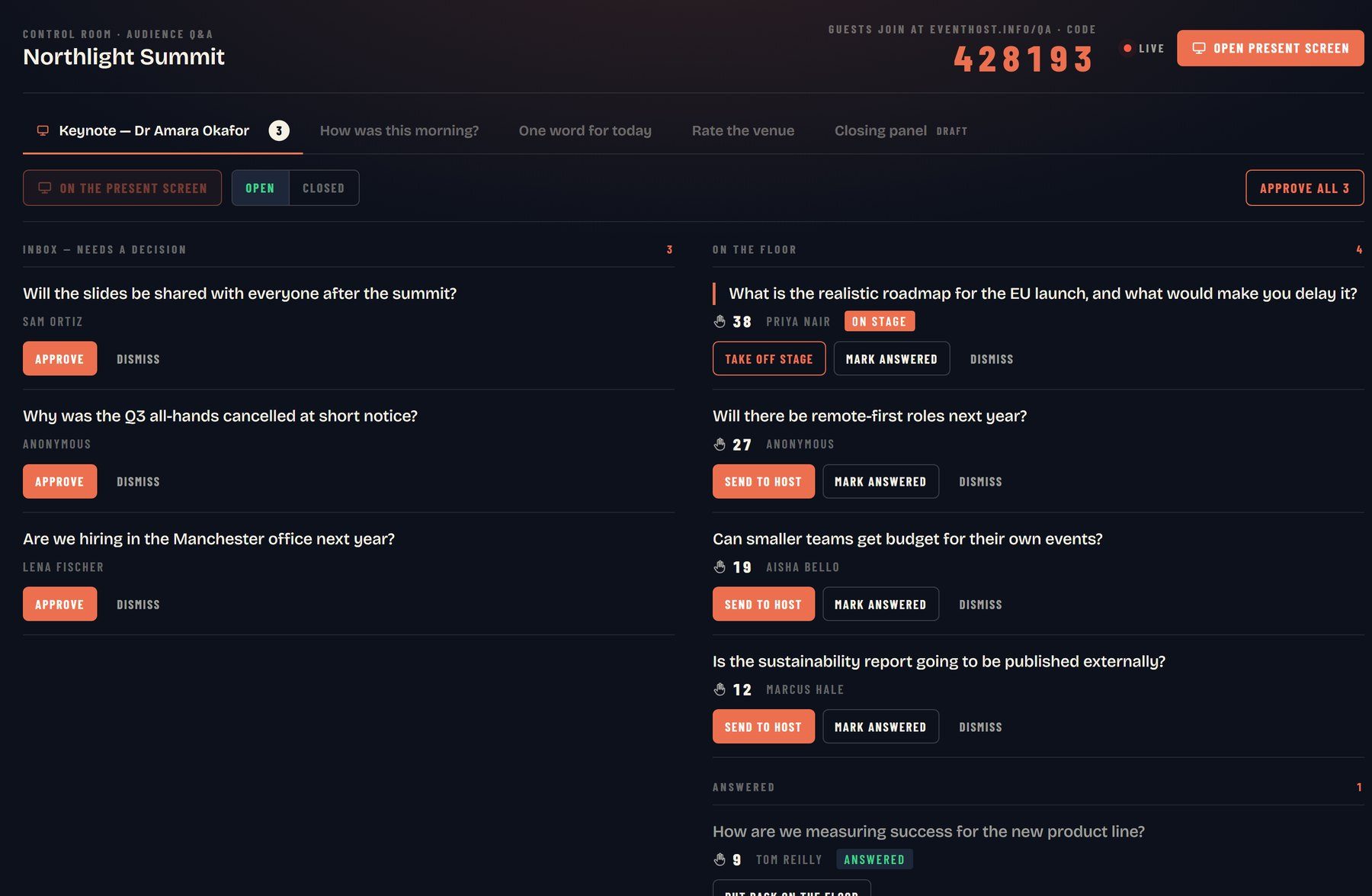
- Questions need a queue. A show of hands in a hall of 200 gets you the same five voices, and the room stays flat. I bring RoomReader, my own phone-based live Q&A, to every conference I host: delegates scan a code, ask in their own name or anonymously, and upvote the questions they want answered. Every question lands in a moderation queue first, so nothing appears on screen that should not.
- Polls only work with a reason. A poll is not a reason to look up from your phone. Ask something whose answer changes what the speaker says next. RoomReader also runs polls, word clouds, ratings and an ideas wall from the same screen.
- The premortem scales. Each table writes its reasons, then the whole room votes on the biggest.
- Someone has to run the room. Engagement is not a gimmick bolted on at the end. A conference facilitator runs the timings and transitions and keeps the whole room with you, so the project lead can concentrate on the content.
After the kick off meeting: the first 24 hours
The meeting is not finished until the notes are out. Send the completed template within a day, with every action carrying a name and a date.
Then book the first check-in before people forget the kick-off happened, and open it by revisiting the risk list. That turns the premortem into a working document rather than a one-off exercise.
If your kick-off is turning into a full event, with a hall, a stage and a few hundred people, send me the agenda or check availability at hello@conferencehost.uk.

17:00Close
Send me your agenda. I’ll show you where the room comes alive.
A fixed price, a free planning call, and a reply within one working day.