Conference Agenda Template: A Sample One-Day Programme
TL;DR
- A conference agenda template is the delegate-facing programme: times, titles, speakers and rooms. The crew’s minute-by-minute version is a separate document, the run of show.
- The sample below runs 08:30 to 18:00 with no seated block longer than 90 minutes, a proper lunch and two breaks.
- Put something interactive at the three predictable dips: the cold 9am open, the post-lunch slump around 1:30pm and the awkward gap before networking.
- Keep talks to 20 to 30 minutes, give Q&A its own time, and leave five-minute changeovers built into every session.
A conference agenda template tells delegates where to be, when, and why it is worth turning up. Most templates online are a grid with blank boxes. This one comes filled in, with a sample one-day programme and the reason each item sits where it does.
I have hosted more than 800 events. The energy in a room is a curve, and a good conference agenda is drawn around it, not around whoever asked for the 2pm slot first.
What is a conference agenda template?
A conference agenda template is the public programme for the day: session times, titles, speakers, rooms and breaks, in the order delegates will experience them. It goes in the joining email and the event app.
It is not the crew document. Cues, mic changes and lighting states belong in a run of show, which runs to the minute and stays backstage. Keep the two separate: delegates do not need the lapel mic order, and your AV team needs far more than “11:00 Panel”.
An event agenda template or a meeting agenda template follows the same logic at a smaller scale. A meeting agenda has three or four items and a decision. A conference agenda has fifteen, and the order matters as much as the content.
A sample one-day conference agenda template
Here is a filled-in programme for a single-stage conference of 100 to 400 delegates. Copy the structure and swap in your own sessions.
| Time | Session | Length | Why it sits here |
|---|---|---|---|
| 08:30 | Registration and coffee | 30 min | Gives late trains a margin before the start |
| 09:00 | Welcome, housekeeping and opening energiser | 15 min | The cold open: warm the room before the first speaker |
| 09:15 | Opening keynote with Q&A | 45 min | Strongest speaker while attention is fresh |
| 10:00 | Talk or case study | 30 min | Keeps the morning moving |
| 10:30 | Morning break | 30 min | First chance to network and refill |
| 11:00 | Panel discussion with audience questions | 45 min | Conversation after two talks changes the pace |
| 11:45 | Breakouts or two short talks | 45 min | Choice, or a change of voice |
| 12:30 | Lunch and networking | 60 min | A real hour, not a sandwich at the desk |
| 13:30 | Interactive session or game show | 20 min | Aimed squarely at the post-lunch slump |
| 13:50 | Afternoon keynote | 30 min | A strong speaker on a room that is now awake |
| 14:20 | Workshop or table discussion | 40 min | Delegates do the work, not just listen |
| 15:00 | Afternoon break | 20 min | A reset before the final stretch |
| 15:20 | Three short talks | 30 min | Variety when energy is lowest |
| 15:50 | Closing keynote or interview | 30 min | Ends the content on a high |
| 16:20 | Closing remarks and takeaways | 15 min | The host ties the day together |
| 16:35 | Networking drinks with a structured opener | to 18:00 | Bridges the awkward pre-networking gap |
Count the seated stretches. None runs longer than 90 minutes, and each one is broken up by a change of format: talk, panel, workshop, game, interview.
How long should conference sessions be?
Most conference talks should run 20 to 30 minutes, with keynotes at 30 to 45 including questions.
You will often read that attention collapses after ten minutes. The evidence is thinner than the claim. A review in Advances in Physiology Education found the primary data do not support a 10 to 15 minute attention limit. Its most consistent finding was that attention varied most between presenters, not between formats.
The same paper notes TED’s 18-minute rule: long enough to be serious, short enough to hold a room. That is a sensible ceiling for most business talks. A dull speaker loses a room well before 18 minutes. A good one can hold it far longer.
Meeting research agrees. Steven Rogelberg cites Parkinson’s law: work expands to fill the time you give it, so plan the shortest time that is reasonable.
Where should energisers go on a conference agenda?
Put them at the three points where energy predictably drops: the 9am open, straight after lunch at around 1:30pm, and the gap between the last session and networking.
I have watched that curve for twenty years. At 9am the room is cold and many delegates know nobody yet. A short opener before the first speaker fixes that, which is why the guide on opening a conference warms the room before any content.
The post-lunch slot is the one most agendas get wrong. A review of the post-lunch dip found mid-afternoon performance drops even when people have had no lunch, and a high-carbohydrate lunch makes it worse. So do not put your most technical speaker at 13:30. Put something the whole room does.
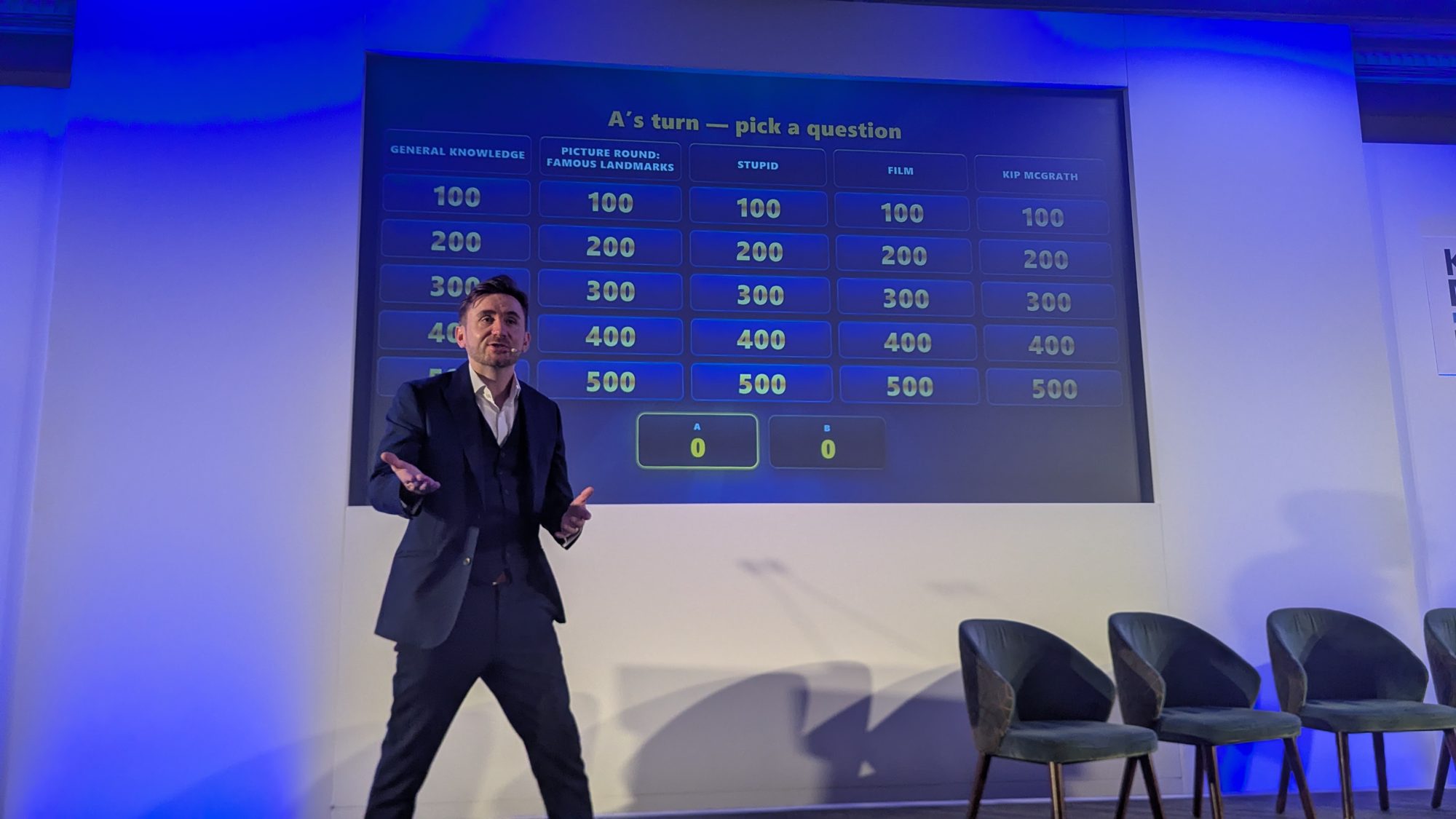
That is where a game show earns its place. I run eight whole-room conference games that every delegate plays on their phone, nothing to download, designed for a hall, not for twelve people in a training room. For lighter options, see the guide to conference energisers.

How much buffer time does a conference agenda need?
Build five minutes into every slot for changeovers. An agenda with no slack looks efficient on paper and runs late by lunch.
Microsoft’s brain research team found that back-to-back meetings caused stress to build, measured by beta wave activity. Ten-minute meditation breaks between meetings held stress steady, and the transitions themselves caused spikes. It was a small study of 14 people, but the lesson holds: changing between items costs energy.
In practice:
- Hide the buffer inside each slot. A “30 minute” talk is a 25-minute talk plus five minutes for the walk-on and mic swap.
- Make the morning break 30 minutes. Twenty minutes vanishes in the coffee queue.
- Put the movable item just before lunch, so an overrun eats breakout time, not lunch.
Remember the people working the event. Adult workers on more than six hours are entitled to one uninterrupted 20-minute rest break, and on a day like the sample above, your registration team can easily be on site for ten hours.
Filling in the agenda template, line by line
Every line on the agenda should answer one question: why would a delegate want to be in the room for this?
Rogelberg suggests framing a meeting agenda as questions wherever possible. The same trick works on a conference programme. “Q3 update” tells nobody anything. “Where are we losing customers, and what are we doing about it?” fills seats.
For each row, include:
- Start time (end times are for the run of show).
- A session title that says what delegates will get from it.
- Speaker name and role.
- Room, if there is more than one.
- How questions will be taken, such as live from the floor or by phone.
Share it early. An inclusive events toolkit from Oxford’s School of Geography recommends sharing programme details and speaker information early, so people can plan travel and care.
Where should Q&A and networking go?
Give Q&A a protected slot inside each session, and give networking real time in daylight hours, not only at the drinks.
The format shapes who asks. A study of 247 academic seminars found men were more than 2.5 times as likely as women to ask a question, and the gap narrowed when the first question came from a woman. The authors recommend active moderators who call on a wider range of people. That is a hosting job. It is also why I use RoomReader, my own live Q&A software, which comes with the booking: delegates who would never take a roving mic can type a question on their phone instead.
Networking is now the main draw. Freeman’s research found the share of attendees motivated by networking rose from 39% to 58% between 2021 and 2024. The Oxford toolkit also recommends at least one networking session in daytime hours, and avoiding networking that centres on alcohol.
How should a virtual conference agenda differ?
Make it shorter: half days, blocks of 60 to 90 minutes and longer breaks away from the screen.
Jeremy Bailenson at Stanford argues video calls cause fatigue through close-up eye gaze, extra cognitive load, constantly seeing your own face, and being stuck in one position. He calls these arguments rather than settled findings, but each gets worse across a full day. For hybrid, plan Q&A that works from the room and the screen.
Conference planning checklist for the agenda
Run the filled-in template against this checklist before it goes out. It doubles as a short guide on how to plan a conference programme.
- Proportion. HSE guidance says planning should be proportionate to scale and risk, with a risk assessment as the key tool. Agree with the venue who owns safety on the day.
- Breaks. Two breaks plus lunch on a full day. The Oxford toolkit recommends regular breaks to reduce fatigue.
- Timings. Later starts and earlier finishes help anyone with caring responsibilities. Let the drinks run on if you like, but not the content.
- Space. Name a quiet room on the agenda for anyone who needs a private break.
- Energy. 9am, 1:30pm, before networking.
- Ending. A planned close, not a speaker running over into the bar.
Delegates remember how the day ended, so script the final 15 minutes as carefully as the opening; the guide to closing remarks shows how.
If you have a draft programme and want a host who can run it and keep the whole room with you from 9am to the drinks, send the agenda or check availability at hello@conferencehost.uk.



17:00Close
Send me your agenda. I’ll show you where the room comes alive.
A fixed price, a free planning call, and a reply within one working day.