Would You Rather Questions for Work and Team Meetings

TL;DR
- Would you rather questions are dilemmas: two options, both tempting or both awful. People want to explain their choice, so they start conversations.
- For work, keep the trade-offs about working life, skills, meetings and harmless hypotheticals. Skip bodies, money, dating, alcohol and anything that ranks colleagues.
- In a big room, vote privately on phones, reveal the split, let each table argue for a minute, then re-vote.
- Hard questions suit the post-lunch slot, not a cold 9am open.
Would you rather questions get a room of professional adults arguing happily within about thirty seconds. Nobody shares anything personal or has to stand up. They just pick a side and defend it. Below are work-safe would you rather questions for work, team meetings and conferences, grouped by theme, with how to run them as a whole-room phone vote.
Why do would you rather questions work so well at work?
Because every question is a small dilemma, and people cannot resist explaining a dilemma. Unlike a quick-fire either/or, the choice starts the conversation rather than ending it.
In 1997, David Gomberg and Justin Heimberg put the game into a book: over 200 dilemmas where both options are equally desirable or equally grim. People take that kind of choice seriously, even when nothing rides on it. MIT’s Moral Machine, an online set of dilemmas about driverless cars, collected 40 million decisions from people in 233 countries and territories.
There is a second reason. Michael Kardas, Amit Kumar and Nicholas Epley found that deeper conversations with strangers were less awkward and more connecting than people predicted. We stay in small talk because we underestimate how interested others are. A good would you rather question is a safe step past the weather: it shows how someone thinks without asking them to reveal anything about their life.
The best would you rather questions for work
Every question here passes three tests: anyone can answer it, nobody discloses anything private, and there is no answer the boss is secretly hoping for.
Working life
- Would you rather have one brilliant idea a year or a decent idea every week?
- Would you rather be the person who starts every project or the one who finishes it?
- Would you rather work for a boss who is always right or one who always listens?
- Would you rather never do expenses again or never fill in another timesheet?
- Would you rather know every job in the company or be the only person who can do yours?
Meetings and office life
- Would you rather every meeting was capped at 15 minutes or every meeting came with proper biscuits?
- Would you rather sit next to someone who hums all day or someone who eats crisps on every call?
- Would you rather accidentally reply-all to the whole company or share your screen with 40 tabs open?
Skills and career
- Would you rather be brilliant at spreadsheets or brilliant at public speaking?
- Would you rather learn any new skill in a week or never forget anything you have already learned?
- Would you rather have your dream job with a two-hour commute or a decent job ten minutes from home?
Superpowers, work edition
- Would you rather be invisible in meetings or teleport to the office?
- Would you rather fly to every client visit or pause time before every deadline?
- Would you rather be able to mute anyone in real life or rewind the last ten seconds of anything you said?
The superpower round comes with real numbers to reveal after the vote. When YouGov asked Britons which superpower they would pick, in an April 2025 article, invisibility led on 19%, with flying on 15% and teleportation and time travel on 7% each.
For open-ended prompts that get one person talking for longer, use icebreaker questions instead.
What are some funny would you rather questions for work?
The funniest ones are absurd but harmless: they laugh at office life, never at a person in the room. A ridiculous choice that everyone recognises gets a bigger laugh than a clever one.
- Would you rather have a theme tune play every time you walk into a meeting or a laugh track after everything you say?
- Would you rather your camera switched on at random or your microphone unmuted at random?
- Would you rather communicate only in voice notes for a week or only in handwritten memos?
- Would you rather give your next presentation in a pirate voice or entirely in rhyme?
- Would you rather swap jobs with the chief executive for a day or with whoever runs the company’s social media?
Shared laughter is worth more than it looks. An Oxford team found that around 15 minutes of laughing together raised people’s pain thresholds by about 10%, and the researchers suggested laughter may play a crucial role in social bonding.
Keep it clean, though. Wharton research found that humour which lands makes people seem more confident and competent, but people who tell inappropriate jokes lose status.
What are good hard would you rather questions for adults at work?
The best hard ones are real trade-offs people face at work, with no obvious right answer. They should be hard because both sides are reasonable, not because the options are grim.
- Would you rather be told the blunt truth about your work every time, or never hear criticism again?
- Would you rather lead a team that likes you or a team that respects you?
- Would you rather be known as the most reliable person in the company or the most creative?
- Would you rather make a big decision quickly with half the facts or slowly with all of them?
- Would you rather fix one big problem for your customers or ten small ones for your colleagues?
- Would you rather take the credit for a team win you barely contributed to, or get none for a win that was mostly yours?
Steer clear of life-and-death hypotheticals. Trolley-style dilemmas like the Moral Machine’s are fascinating in a seminar and heavy at 2pm on a Thursday.
How do you run would you rather questions as a whole-room phone vote?
Put the question on the big screen, let every delegate vote on their phone, reveal the split, then let the tables argue. Run like that, it is designed for a hall, not for twelve people in a training room, and it works the same for 40 people or 400.
- Pick four to six questions. Short options fit a phone screen.
- Vote first, talk second. Skip the show of hands. Everyone commits privately before hearing anyone else, so nobody just follows the loudest person at the table.
- Reveal the split. The nearer 50/50, the better.
- Give the tables a minute. Each table defends its majority. Small clusters work best here: research on conversation found that about four people is the limit for one spontaneous conversation, so a table of ten naturally splits in two.
- Hear one defence. Invite a volunteer from the losing side to make their case. Invite, never pick.
- Re-vote. Run it again and show who changed their mind.
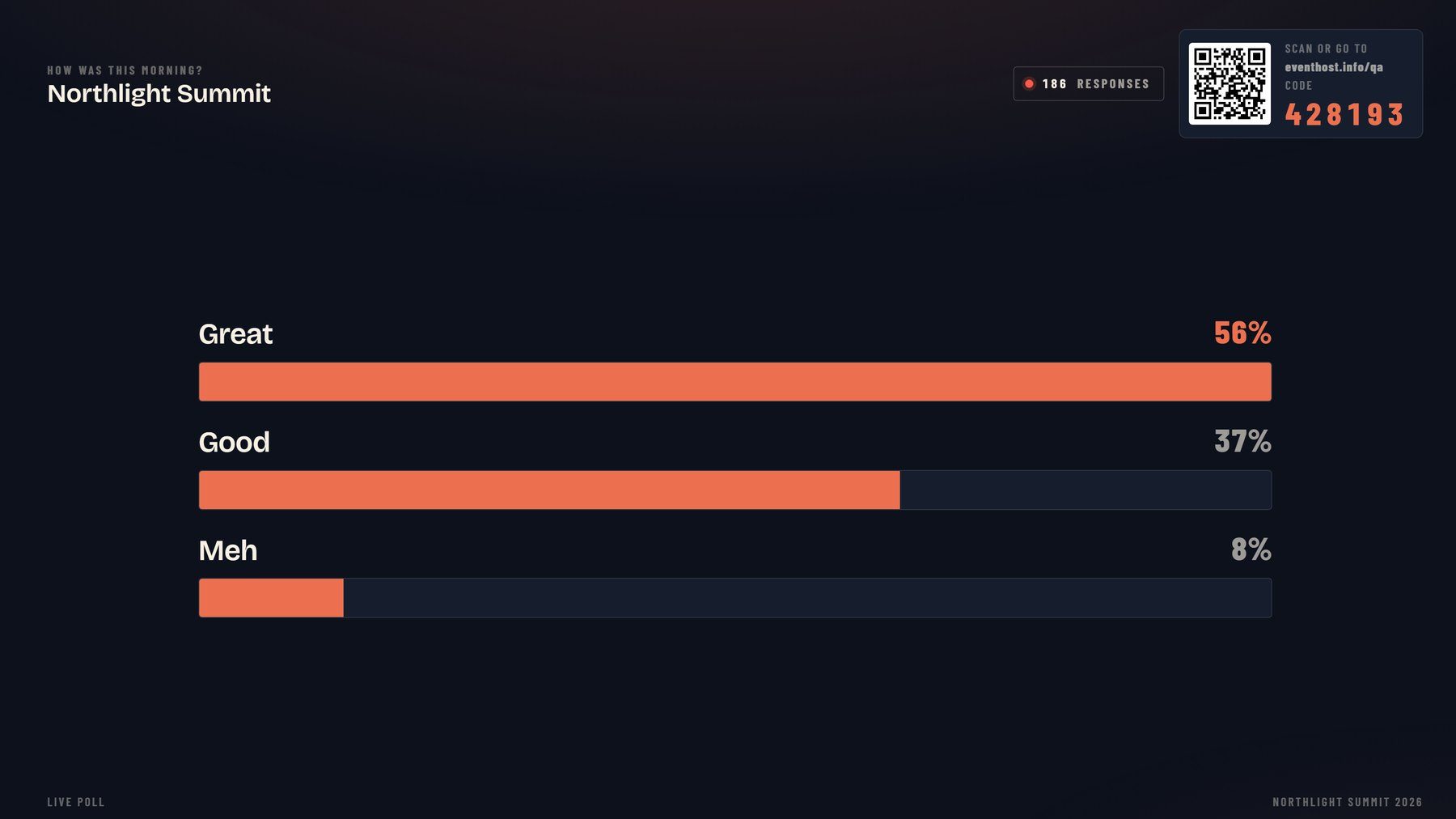
That re-vote is the part a plain poll misses. A poll is not a reason to look up from your phone; an argument with the people at your table is. RoomReader, the software I built, runs the vote and the reveal on the big screen. Every delegate votes on their phone, nothing to download, and it is included when I host.
Running would you rather in a team meeting
With six or eight people, skip the vote. Go round the table: each person gives their pick and one sentence of reasoning. Two questions take five minutes.
Two habits help. The manager goes first, ideally with something slightly unflattering. Harvard Business School’s Amy Edmondson argues that psychologically safe leaders are willing to be vulnerable, and that a simple question gives people a low-stakes way to speak up. And let people pass: nobody should have to perform.
For remote teams, Microsoft Teams has a built-in Polls feature that runs on Microsoft Forms, with up to 12 options per multiple-choice poll. Vote there, then come off mute to argue. More formats are in the guides to team meeting icebreakers and virtual icebreakers.
Which would you rather questions should you avoid at work?
Avoid any question where an answer could embarrass someone, exclude them, or read as a dig. If one person in the room might squirm at either option, cut it.
Acas lists jokes among the unwanted behaviour that can amount to harassment, and says it can count even if unintended. The protected characteristics include age, disability, race, religion or belief, sex, sexual orientation and gender reassignment. No question built around them is worth the risk.
- Bodies, health and diets. “Lose your hair or gain a stone” is not harmless in a room of 200.
- Ranking colleagues. “Would you rather be stuck in a lift with Dave or Priya?” puts real people on the spot.
- Money and job security. Pay cuts and redundancy are not hypothetical for everyone.
- Dating, drinking and anything you would not say in front of HR. Fine at a party. Wrong at work.
Where would you rather fits in a conference day
Use them when the room needs a reason to talk, and aim them at the dips. The energy in a room is a curve, and I have watched it for twenty years: the cold open at 9am, the slump after lunch, the awkward gap before networking.
At 9am, start lighter: a hard dilemma asks a lot of people who have just sat down. After lunch is where would you rather earns its place, because the table debate makes everyone talk. Before networking, end on a split vote and send people off to find someone who voted the other way.
I have hosted 800+ events, and my view is simple. Professional adults will happily take part if the format removes the risk of looking foolish. Cringe, not reluctance, is what kills participation. For more openers aimed at those exact moments, see the conference icebreakers page, or send the agenda and I will tell you where a would you rather round fits.

17:00Close
Send me your agenda. I’ll show you where the room comes alive.
A fixed price, a free planning call, and a reply within one working day.