Icebreakers for Team Meetings: Fast, No-Prep Ideas
TL;DR
- A good icebreaker for a team meeting is short, low-risk and needs no printing, props or setup.
- Match it to the clock: one quick question for a 2-minute standup, a round for 5 minutes, a light activity for 10.
- Match it to the meeting type too: a standup wants focus, a kickoff wants energy, an offsite wants people to mix.
- For remote and hybrid teams, use the chat box and round-robin turns so nobody talks over anyone.
- Skip anything that forces personal disclosure or puts one person on the spot. Cringe, not shyness, is what kills taking part.
A good icebreaker for a team meeting does one job: it gets people talking before the real work starts, without wasting time or making anyone cringe. The trick is picking one that fits the clock and the room, then running it without fuss. Below are fast, no-prep ideas sorted by how long you have and what kind of meeting you are opening.
What makes a good team meeting icebreaker?
A good team meeting icebreaker is short, inclusive and low-risk: one clear prompt everyone can answer in a sentence, with no wrong answers and nothing to prepare. It warms the room, signals that the meeting has started, and gives quieter people an easy first contribution.
The best openers share a few traits:
- Fast. It fits inside a few minutes and never becomes the meeting.
- No props. No printing, no slides, no kit. You can run it cold.
- Safe. Nobody has to reveal anything personal or perform.
- Relevant. It nudges people towards the mood you want next.
- One instruction. People understand the task in a single sentence.
Get those right and you rarely need anything clever. A plain question, asked well and answered by everyone, beats an elaborate game that half the room sits out.
How long should a team meeting icebreaker take?
Keep it under five minutes for most meetings, and no more than ten for a kickoff or offsite. A useful rule of thumb is roughly five to ten per cent of the meeting length, so a 15-minute standup gets a one-line check-in, not a party game.
Watch the clock honestly. The moment an opener overruns, it stops warming the room and starts eating the agenda, and people quietly resent it. Set a rough time in your head before you begin, and move on cleanly when it is up.
| Meeting length | Icebreaker time | What fits |
|---|---|---|
| 15 minutes (standup) | 1 to 2 minutes | One-word check-in |
| 30 to 60 minutes | 3 to 5 minutes | A quick round |
| Half or full day | 5 to 10 minutes | A light group activity |
Fast team icebreakers by time available
Pick by the time you actually have, not the one you like best. These team icebreaker activities all run cold, with no preparation and nothing to hand out.
You have 2 minutes
- One-word check-in. Everyone gives one word for how they are arriving today.
- Rose and thorn. One good thing, one annoyance, kept to a sentence each.
- Energy score. Each person calls a number from one to ten and, if they like, why.
You have 5 minutes
- Two truths and a lie. Each person offers three statements; the group guesses the lie.
- Would you rather. One playful either-or, answered round the room.
- Win of the week. A small work or personal highlight from the past few days.
You have 10 minutes
- Common ground. In pairs or threes, find three things everyone shares that are not about work.
- This or that, quickfire. Ten fast either-or prompts, hands up or thumbs for each.
- Desert island. One item, one song, one snack. Quick, revealing, harmless.
Keep a shortlist of five or six that you like. Rotating a small set stops the opener going stale and means you never scramble for an idea at the last minute.
Which icebreaker suits each meeting type?
Match the opener to the meeting’s purpose: standups want focus, kickoffs want energy, and offsites want people to mix. The same question can land well in one setting and fall flat in another, so start from what the meeting needs to feel like in its first minute.
| Meeting type | What it needs | Try |
|---|---|---|
| Weekly standup | Focus, speed | One-word check-in or energy score |
| Project kickoff | Shared purpose | One hope and one worry for the project |
| Sales kickoff | Energy, momentum | Win of the week, then a quickfire round |
| Offsite or away day | People mixing | Common ground in small groups |
| Retrospective | Honesty, safety | Rose and thorn on the sprint |
For a sales kickoff or an away day, resist the urge to open cold with numbers. A minute of energy first buys you a more awake room for everything that follows.
Quick team meeting icebreakers for remote teams
Remote and hybrid meetings need openers built for a screen, where dead air and people talking over each other are the real enemies. Use the chat box and a clear running order so everyone gets a turn without the awkward “no, you go” shuffle.
Ideas that work well on video:
- Chat-box one-liner. Everyone types their answer at once, then a few read theirs aloud. No waiting, no clashing.
- Round-robin order. Name who goes next so nobody guesses. It keeps things moving and includes remote people equally.
- Show and tell. One object within arm’s reach and why it is there. Quick, human, camera-optional.
- Drop an emoji. A single emoji for the mood of the week, posted in chat. Low effort, high signal.
For hybrid rooms, run the whole thing through the same channel the remote people use, so those dialling in are never second-class. If the in-room crowd answers out loud and the remote crowd types, the remote crowd disappears.
What should you avoid with team icebreaker games?
Avoid anything that forces personal disclosure, singles someone out, or drags on. The failures are predictable, and every one of them is easy to design out before you start.
- Forced sharing. Deep personal questions put people on the spot. Keep prompts light and optional.
- Winners and losers. Games that reward the loudest or quickest leave everyone else cold. Favour rounds where all contribute equally.
- Physical stunts. Anything involving standing, touching or moving excludes people and reads as childish to a professional group.
- Overrunning. The fastest way to sour a room is an opener that will not end. Time it and stop.
Professional adults take part happily when the format removes the risk of looking foolish. In my experience, cringe is what kills participation, not shyness, so the safest opener is usually the one that works.
How do you run one without any prep?
Keep a short list of go-to prompts you can use cold, and answer the first one yourself to model how long a reply should be. Going first sets the length and tone, so people copy you rather than deliver a monologue.
A few habits make no-prep openers reliable:
- Memorise three prompts. You will never be caught empty-handed.
- Set the order. Round-robin or “pick the next person” removes the awkward pause.
- Give a time. Say “one sentence each” out loud so nobody rambles.
- Model it. Answer first, briefly, then hand off.
That is genuinely all it takes for a small team. The moment you go first with a short, easy answer, the room understands the game and follows.
Taking team energy to a bigger room
The openers above are built for a team of ten around a table or a screen. Scale to a hall of two or three hundred and they stop working, because a question that flows round a small table dies in a big room where most people never get a turn.
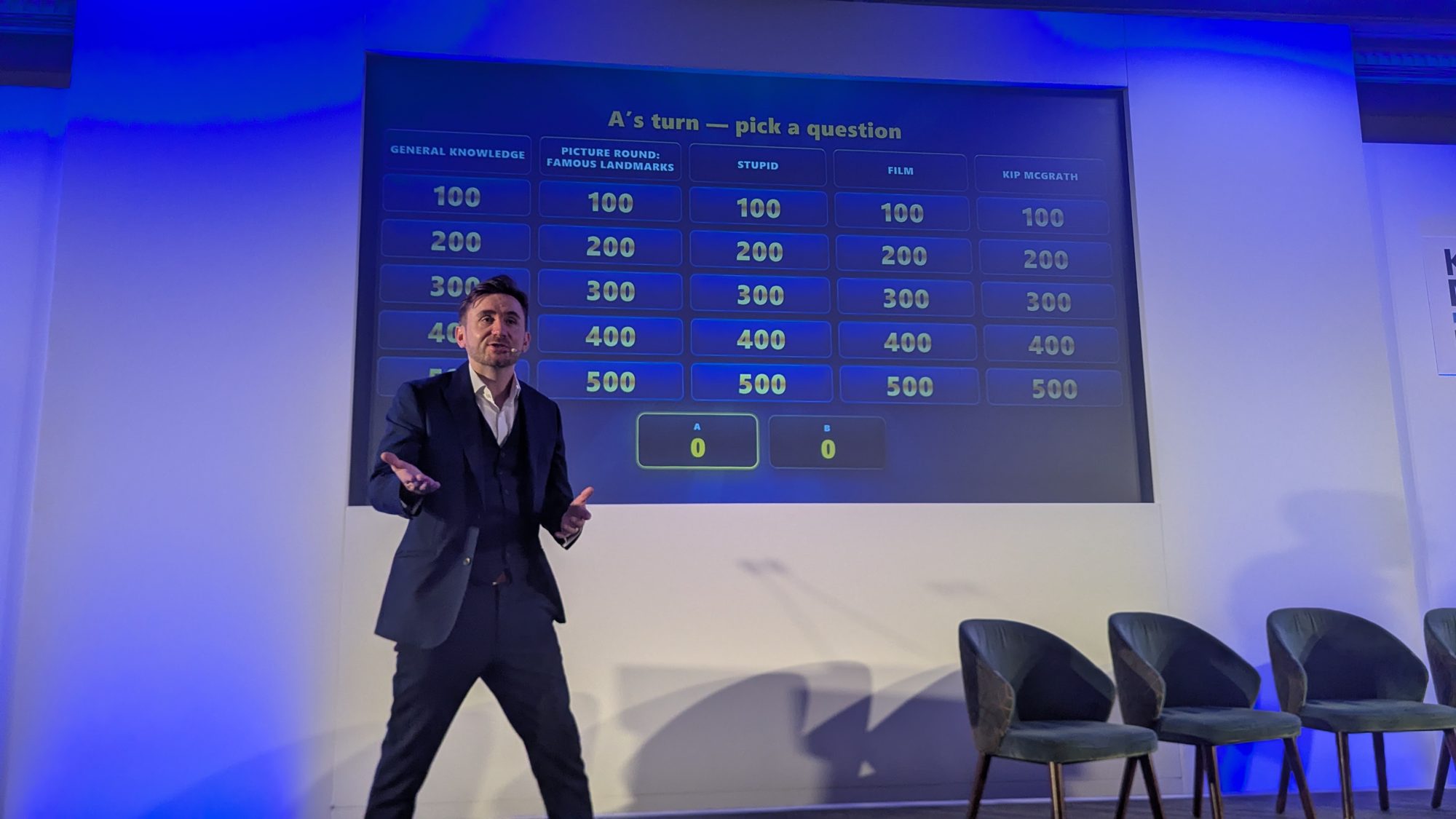
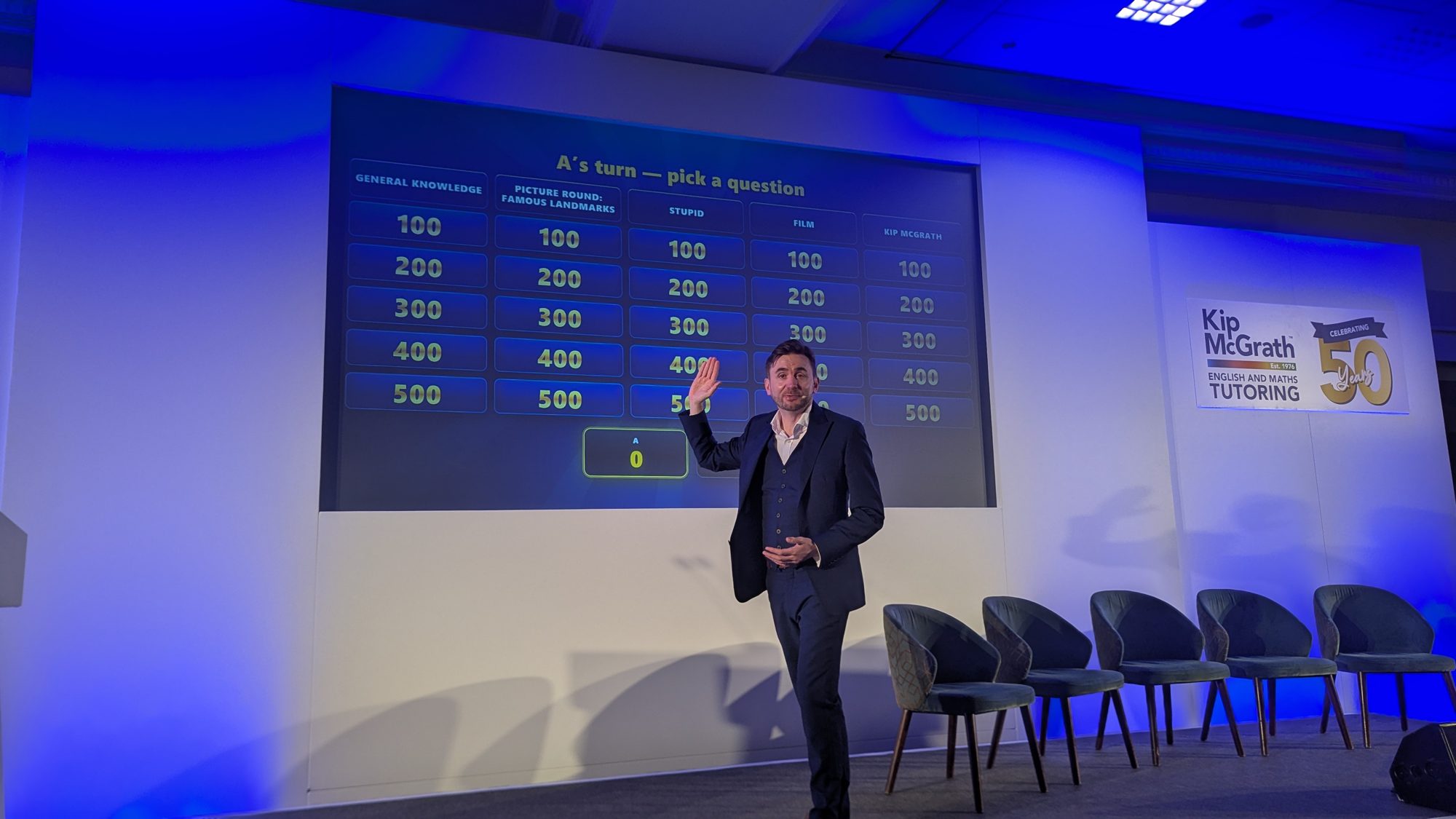
I have watched the energy in a room for twenty years, and the pattern holds: the cold open, the slump after lunch, the flat gap before networking. At that scale you need openers designed for a hall, not for twelve people in a training room, and formats that let every delegate take part at once rather than waiting for a microphone.
If you are planning a conference, kickoff or all-hands rather than a weekly meeting, that is where deliberate audience engagement earns its place. It is worth reading how conference icebreakers differ from the small-group kind, how whole-room game shows get everyone playing on their own phone, and what actually works with large groups. For a small team, though, a good question and a clear turn order will carry you most weeks.

17:00Close
Send me your agenda. I’ll show you where the room comes alive.
A fixed price, a free planning call, and a reply within one working day.