Murder Mystery Team Building as a Conference Evening
TL;DR
- A murder mystery is one of the few evening formats where delegates do something rather than watch something. That is why it survives a day of sessions.
- Tables of six to eight solve best. A host running the clues centrally keeps the same game working at 200 or more.
- Deduction is the game. Acting is the risk, so make performing optional.
- It falls flat when the solution cannot be reached from the clues, when the room is too noisy for dialogue, or when it runs past 90 minutes.
Murder mystery team building has a reputation problem. Half the organisers who ask about it picture a wig, a forced accent and a colleague doing a bad Poirot in front of 200 people who would rather be at the bar. The other half have watched a good one: tables bent over a casebook, arguing about a train timetable.
Both are real. Which one you get depends on the format, your table sizes and whether anyone is running the room.
What is murder mystery team building?
It is a scripted crime, broken into clues and released in stages, that delegates solve in teams against the clock. It usually runs across dinner, each course a chapter, ending with every table naming a suspect.
The form is older than corporate events. The V&A holds a 1950s Cluedo set and records that the game was invented in 1943 by Anthony E. Pratt, then first manufactured by Waddingtons in 1949. Agatha Christie’s The Mousetrap, the world’s longest-running play, opened in 1952 and has passed its 25,000th performance.
Appetite has not faded: asked in July 2024 which films they wanted more of, 54% of Britons picked crime and thrillers, in a poll of 1,000 adults. Nobody needs the rules explained.
Which murder mystery formats work for a conference evening?
Five formats turn up in UK corporate bookings. They are not interchangeable.
| Format | Group size | Runs for | Acting from delegates | Where it breaks |
|---|---|---|---|---|
| Casebook at tables, host-led reveals | 20 to 300 | 60 to 90 minutes | None | Needs a host between courses |
| Actor-led dinner theatre | 30 to 120 | 2 to 3 hours | Optional questioning | Cost per head, back tables cannot hear |
| Full character role-play in costume | 8 to 30 | About 2 hours | Required from everyone | Shuts out anyone who hates performing |
| Roaming investigation with clue stations | 20 to 150 | 45 to 75 minutes | Light | Standing, walking and noise |
| Phone-based whole-room deduction | 50 to 500 | 30 to 45 minutes | None | Needs wifi and a host driving it |
For a conference or away day, the casebook and phone-based versions travel best: they scale, they work seated, and nobody has to be in character.
In my view, full role-play is the one organisers regret: excellent with twelve people who chose it, miserable when it is sprung on a department.
What group size does murder mystery team building suit?
Tables of six to eight, as many tables as the room holds. With several clue threads running, that size lets everyone own a thread and still be heard.
Research on team size, summarised by Knowledge@Wharton, tends to land in the five to 12 range, with six recurring. Past about five people, effort per person falls away, and beyond eight or nine groups split into cliques. Jennifer Mueller’s study of 238 workers across 26 teams found individuals in larger teams performed worse, mostly because relationships inside a big team weaken.
Watch it happen on a dinner table: put twelve people on one casebook and three read while nine wait for a job.
How does the evening run, hour by hour?
A conference murder mystery is a timing job, not a theatre job. The kitchen sets the tempo and the host works to it:
- 19:00 seated, brief. Rules, how to submit an accusation, and permission not to act. Two minutes.
- 19:10 the crime. The scenario lands, with a clue pack per table.
- 19:25 starters. Tables work pack one while they eat.
- 19:55 second clue drop. New evidence contradicts something in pack one, and the arguing starts.
- 20:30 mains cleared, suspect interviews. Actors in character, or the host taking questions as each suspect.
- 21:00 accusations in. Every table writes a name, a motive and the clue that proves it.
- 21:15 the reveal. Walk the room through the chain of logic, then the prize.
Two details matter more than the plot. Someone must hold the room while plates are cleared, which is hosting, not acting. Every clue drop needs a hard stop too, or the quick tables wait in silence.
I have hosted 800+ events, and the energy in a room is a curve I have watched for twenty years. At 7pm, after a day of sessions, you start from a low point, and the first ten minutes decide the night.
What does murder mystery team building do for a group that has sat in sessions all day?
It flips them from listening to doing, which is what a tired room needs. Delegates have been taking information in since 9am; a puzzle asks them to produce something.
Doing beats watching, and the research backs it. A meta-analysis of 225 studies in PNAS found active learning raised exam scores by 0.47 standard deviations and cut failure rates from 33.8% to 21.8%.
On collaboration, a 2026 quasi-experimental study in the Journal of Criminal Justice Education put 79 students through a murder mystery escape room. Seven to eight weeks later, peers rated the 33 who took part higher on collaboration quality, contribution, interaction and keeping on track, with large effect sizes. Knowledge gains were minimal.
That is the fair claim here: it changes how a group works together, not what they know. Mix the tables by department and the introductions happen because a stranger holds the clue you need.
When does murder mystery team building fall flat?
When the puzzle cannot be solved, when the room cannot hear it, or when someone is made to perform.
- The unsolvable plot. In 1929 Ronald Knox set out his Ten Commandments for detective fiction so readers could reach the answer before the detective did. Ask your supplier to prove the solution is deducible from the clue packs. If the answer only arrives in the reveal, tables stop trying by course two.
- A room that cannot hear. University of Manchester analysis published in June 2024 put 18 million UK adults, roughly one in three, as having some hearing loss, and flagged listening difficulty in background noise. A dialogue-heavy format in a hard dining room needs radio mics, a proper PA and clues on paper.
- Forced acting. When Dwyer and Davidson asked 815 students about their fears, 60% checked public speaking. Professional adults will happily take part when the format removes the risk of looking foolish. Cringe, not reluctance, kills participation.
- An evening built on the bar. In 2017, ONS found 20.4% of adults in Great Britain drank no alcohol at all. A game that only makes sense three drinks in excludes a fifth of the room.
- Overrun. Past 90 minutes a puzzle starts to feel like homework.
- The runaway table. One table of crossword fiends solves it early and the rest give up. Hold a clue back.
Accessibility sits underneath all of it. Employers must make reasonable adjustments for disabled staff, and the government’s examples reach as far as recreation facilities. Design the evening to work seated, and for someone who lipreads.
Murder mystery, quiz or game show
A murder mystery is one long puzzle with one answer. A quiz or game show is many short rounds with constant scoring, so it recovers a flat room faster and suits a bigger hall.
Pick the mystery for a seated dinner, 60 to 90 clear minutes and tables that will talk. Pick rounds and a scoreboard for 200 people, a tight slot, or a crowd you do not know.
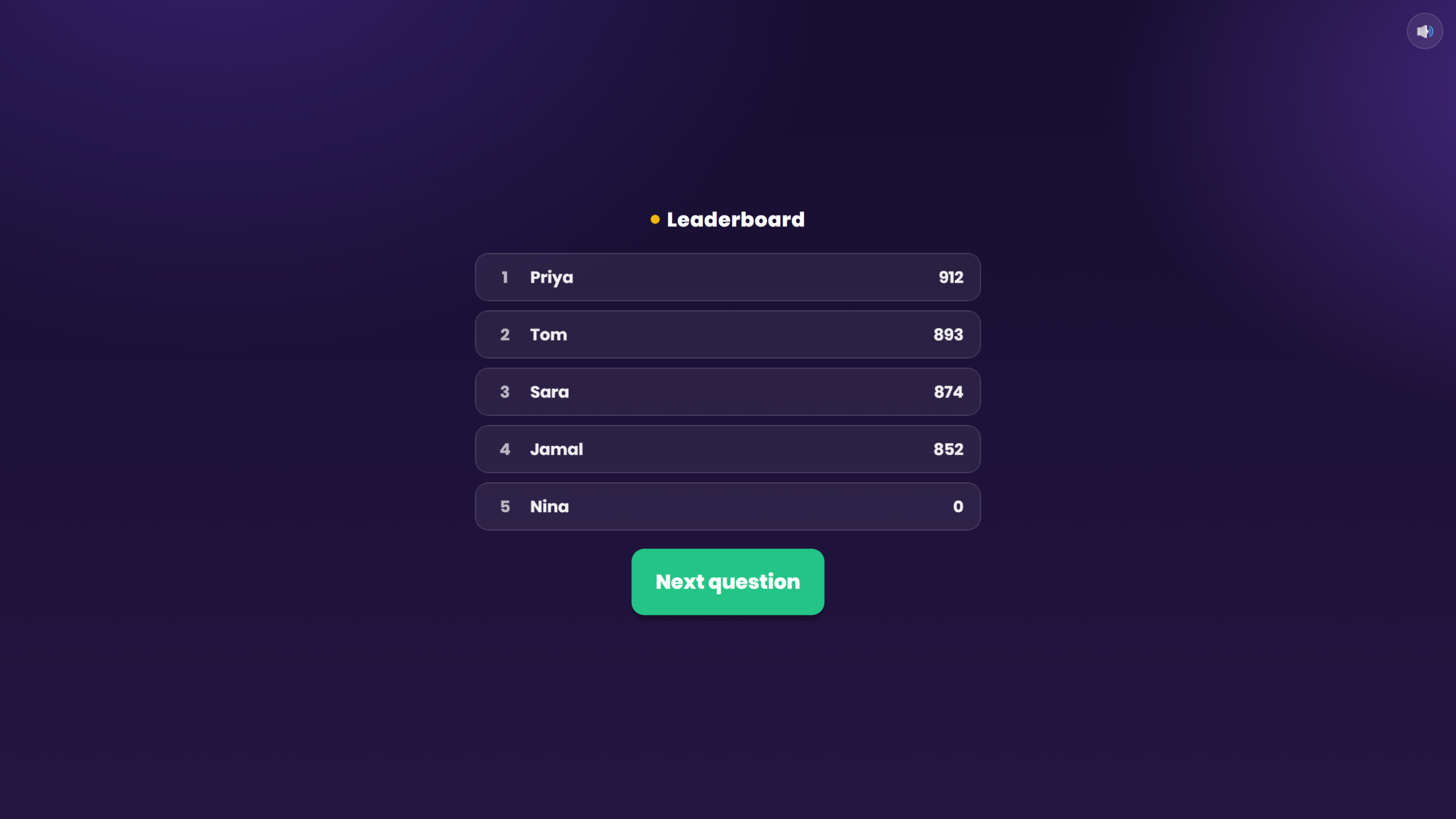
I run eight whole-room conference games that every delegate plays on their own phone, nothing to download. The decision is about the room, not the brand of game.
Daytime options sit in team building activities and away day ideas. For the rest of the programme, see corporate event ideas and Christmas party ideas.
What to ask before you book
Six questions separate a good supplier from a bought script.
- Can a table reach the solution using only the clues you hand out?
- What happens to a table that cracks it in 20 minutes?
- Who holds the room while plates are cleared?
- Is there a version where nobody has to act?
- What is the plan for the back tables and anyone who lipreads?
- How does the evening work for delegates who are not drinking?
Vague answers mean you are buying props, and the room is yours to rescue.
Brief it well, then let them play
The briefing is where these nights are won. Thirty seconds on the rules, a promise that nobody is put on the spot, then get out of the way.
Planning a conference evening or an away day and want someone to run the room rather than hand you a kit? Send the agenda or check availability at hello@conferencehost.uk.


17:00Close
Send me your agenda. I’ll show you where the room comes alive.
A fixed price, a free planning call, and a reply within one working day.