How to Facilitate a Large Group Workshop: Staffing for 200

In short
- A large group workshop for 200 needs one lead facilitator at the front and one table host per table, not one facilitator per table.
- Sources disagree on table size. Most work sits between 5 and 10 people, and 12 to 16 only works if professionals lead every group.
- At tables of eight, 200 delegates means 25 tables, 25 table hosts and about three floating co-facilitators. That is arithmetic from ranges, labelled as judgement.
- The lead holds the question, the clock and the room. A table host cannot do any of the three from inside a table.
- Phones replace flip-chart report-backs: each table sends one idea, the room spends its votes, and the lead reads out the top few.
How to facilitate a large group workshop is mostly a staffing question. A large group workshop is one agenda run for 100 or more people, who split into small tables that work at the same time while a lead facilitator runs the whole room. Staff it like a team meeting and a one-hour open discussion gives each of 200 people 18 seconds.
How many facilitators does a workshop for 200 need?
A workshop for 200 needs one lead facilitator, one table host for every table, and a few floating co-facilitators who check on tables. At tables of eight that is 25 hosts and about three floaters. No source gives one ratio, so the table below is arithmetic on the published ranges, as at November 2026.
| Table size | Tables for 200 | Table hosts | Who the source says can lead it |
|---|---|---|---|
| 5 | 40 | 40 | Dialogue works at this size per Glasgow, and the World Café says four, five at most |
| 8 | 25 | 25 | Leadership Strategies: a cap for unbriefed volunteer leaders |
| 10 | 20 | 20 | Same source: possible with leaders chosen and briefed beforehand |
| 12 to 16 | 13 to 17 | 13 to 17 | Same source: professional facilitators only |
The last row is the useful warning. Larger tables look cheaper until you notice they need a professional at every one. Roger Greenaway’s guide to large groups names ratios of 1:20 or 1:30 as the core problem, and says the answer is a team of facilitators, who can be group members prepared for the role.
The floaters are my planning assumption: one for every eight to ten tables, so three for 25. Their job is to walk the room, because a lead on stage cannot see inside a table. Stanford’s guidance makes the same point for online rooms: a host can only be in one room at a time.
Why do the sources disagree on group size?
They disagree because they are answering different questions: how big a group can be before talk goes wrong, and how big it can be before the person leading it loses it. The answer depends on the task and on who is hosting.
Researchers at Glasgow found five-person groups talked as dialogue, while in groups of ten the talk became serial monologue shaped by the dominant speaker. An MIT-led study published in 2010 found groups where one person dominated were less collectively intelligent than groups sharing turns.
Chris Corrigan’s 2012 post on ideal group sizes opens by saying there is no such thing, and calls eight and above too big for real conversation. The Activist Handbook says more than 12 people can show the traits of a big group.
The working rule: pick the table size from who will host it. Unbriefed volunteers, eight at most. Briefed hosts, up to ten. Anything bigger needs professionals, on that source’s view. The breakout session guide covers the return to plenary.
What does a table host do, and who briefs them?
A table host keeps one table on the question, on time and talking in turn, then sends the table’s result onward. They are not the facilitator. The World Café method treats the host as optional: one member who stays behind to brief the next group. The Activist Handbook adds distinct roles such as note-taker and timekeeper.
Table hosts are close to the table captains I set up at bigger events. Whoever organises the event arranges them, and the lead briefs them before delegates arrive. Give each a card with four lines: the question, the time, the output and the one rule (everyone speaks once before anyone speaks twice).
At a World Café for over 200 people in the University of Sydney’s Great Hall, each table chose a permanent host, with eight volunteers on laptops grouping the notes. The method itself is in the World Cafe guide.
How do you facilitate a large group workshop from the stage?
You facilitate a large group workshop from the stage by owning what only the front of the room can own: the question, the clock, the return and the summary. Lyn Carson designed and ran that Sydney café of 200-plus from the stage, with volunteers, which is the same split.

- The question. Put it on screen once and leave it there, so 25 hosts are not each paraphrasing it.
- The clock. Every table starts and stops together, and only the front can call that. Liberating Structures’ 1-2-4-All runs 16 minutes of timed steps, with no maximum group size, and the page warns hosts not to over-help. Its 1-3-All variant skips pairs when moving a big room is hard. More in the Liberating Structures guide.
- The return. One signal, repeated, brings 200 people back from 25 conversations.
- The summary. Someone has to say what the room decided. That is the lead.
How do you run a large group workshop without flip-chart report-backs?
You replace spoken report-backs with phones: each table sends one idea, delegates spend a few votes, and the lead reads out the winners. Twenty-five tables at two minutes each is 50 minutes of listening, on my assumption of two minutes a table. Greenaway notes that plenary feedback from every group is dull unless tightly controlled.
RoomReader, my own conference software, is included with hosting. Its ideas wall lets delegates add ideas from their phones and spread dot votes across them (three each by default), with the top ideas rising on the big screen, and nothing to download. Word clouds and live polls show the room’s mood in seconds. The software page lists what it does. It can also collect questions before the event, so the lead arrives knowing what the room cares about.
Spoken report-backs stay for a few tables only: pick three that surprised you. The rest of the output is on the screen already.
When is it worth hiring a lead facilitator for a workshop this size?
Hire a lead facilitator when nobody in your team has held 150 or more people to one clock, or when you cannot spare the one person who would otherwise stand at the front. Below about 40 people, a confident colleague with five tables and a stopwatch is usually enough. That threshold is my judgement.
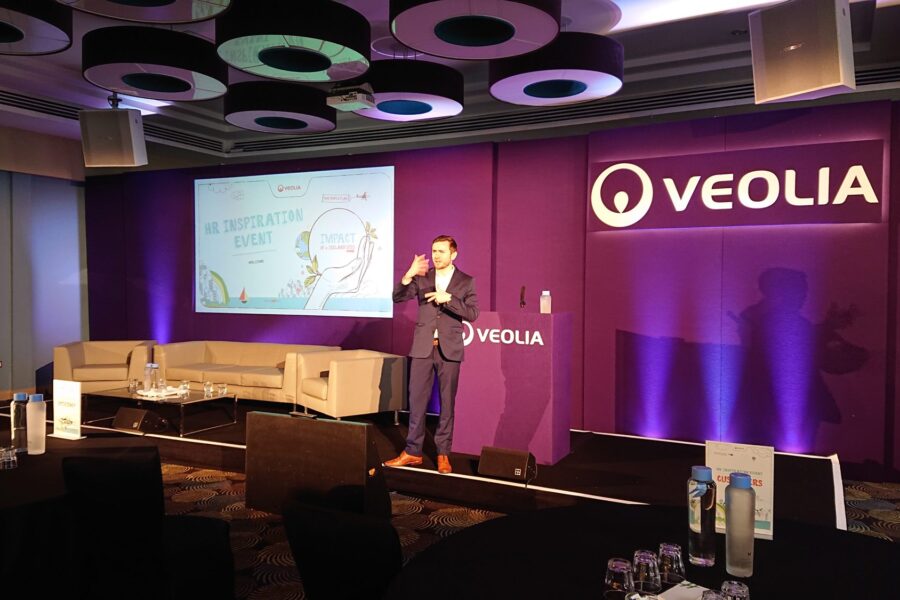
I have led only a handful of workshops of 100 or more. They run like the bigger events where I set up table captains, so I would not call it a specialism. The part I bring is the stage side: a broadcast-trained host who holds the question and the clock and brings the room back together at the end. A housing association client said of a whole conference I facilitated: “his energy, the structure behind it, his natural enthusiasm has just kept the whole thing rolling along.” The reviews page has the full quote.
See what a conference facilitator does day to day, or what facilitation means in the first place.
What to have ready when you get in touch
Have these to hand, even if half are guesses:
- Date, venue and headcount, and whether delegates sit at tables or in rows.
- The one question the workshop must answer.
- The agenda so far, and what went wrong last time.
- Who could be table hosts.
Send the agenda or check availability at hello@conferencehost.uk or on 07596 851647.

17:00Close
Send me your agenda. I’ll show you where the room comes alive.
A fixed price, a free planning call, and a reply within one working day.