How Does a Poster Session Work and How Long Should It Be

In short
- A poster session is a timed slot where each presenter stands by one board and delegates walk round and talk to them.
- Published slots run from 60 minutes to three hours. For a corporate day, 60 to 90 minutes is my working rule.
- Odd-numbered presenters stand for the first half, even-numbered for the second.
- It is a research-conference format. A corporate audience needs a smaller, shorter version.
How does a poster session work and how long should it be? A poster session is a timed slot in which presenters stand beside a board summarising their work while delegates walk round, read and ask questions. This guide gives the lengths and sums, and says where my own judgement as a conference host fills a gap.
What is a poster session and how does it work?
A poster session is a timed slot where each presenter stands beside one board summarising their work, while delegates circulate, read and question them. It swaps one talk to a seated room for many small conversations. Delegates choose where to go, so the room is the programme.
The format comes from research conferences, and nearly all the published guidance does too. The Biophysical Society’s 2026 instructions, read in November 2026, give boards six feet wide and four high, with text readable from four to five feet.
How long should a poster session run?
A poster session should run 60 to 90 minutes at a corporate event and 60 minutes to three hours at a research meeting. The 60 to 90 range is my rule of thumb for a day with other things in it. Published slots vary:
| Meeting | Slot | Detail |
|---|---|---|
| Biophysical Society, 2026 | 60 min a half | Odd 1:45 to 2:45pm, even 2:45 to 3:45pm |
| Iowa PGSRM, 2024 | 60 min a half | Odd 4:30 to 5:30pm, even 5:30 to 6:30pm |
| Aberdeen symposium, 2023 | 2 hours | Odd Wednesday, even Thursday, 13:30 to 15:30 |
| ACL organisers, 2015 | 3 hours | About 100 posters a session |
Here is the sum. The University of Illinois Chicago’s pharmacy research day, read in November 2026, asks presenters for a 3 to 5 minute overview before questions. A delegate who stays that long sees 12 to 20 boards in an hour (60 divided by 5, and by 3). That is my arithmetic, not a finding.
Boards and space: how much room does each poster need?
Give each presenter one board and leave open floor in front for the presenter and a small crowd. The sources disagree on how much floor, so tape the layout out in your real room first.
- Gaps. Ameen and colleagues, in the Indian Journal of Psychiatry in May 2025, suggest 1 to 2 metres between boards, well lit and not in corridors. The ACL wiki says to avoid closed aisles.
- Floor area. ACL 2015 planned about 16 square metres per poster. Better Posters, on 30 September 2010, asks for 15 square feet (about 1.4 square metres) as a minimum. That is a factor of ten.
- Numbers. Put the board number large on the board, with the slot time under it (my rule).
- Tubes. Colin Purrington notes tubes under boards are tripping hazards. Give them a rack.
How many posters can one delegate see?
One delegate can see 12 to 20 posters in a 60-minute slot, staying three to five minutes at each. The number you hang decides how much each person misses, so tell delegates to pick targets in advance.
To size the room, the ACL organisers saw one staffed poster per 10 to 13 delegates per session at ACL 2015 (about 200 posters, 1,100 to 1,400 attendees). That is one conference’s observation, not a standard. Applied to a hall:
| Delegates | Staffed boards | Total posters |
|---|---|---|
| 60 | 5 to 6 | 10 to 12 |
| 120 | 9 to 12 | 18 to 24 |
| 250 | 19 to 25 | 38 to 50 |
Walking is the cheap part. Two rows of 12 boards, 1.2 m wide with 1.5 m gaps, is 64 m, about a minute. The time goes in conversation, so count minutes at boards, not metres.
Odd and even: how does the two-slot rotation work?
In an odd and even rotation, presenters with odd-numbered boards stand by them for the first half and even-numbered presenters for the second. Every poster stays up throughout. Each presenter gets half the time to be questioned and half to read the others.
Biophysical and Iowa run two back-to-back hours; Aberdeen split it across two days. Numbers alternate along a row, so the staffed boards spread through the room (my reasoning). With 21 posters, 11 are odd and 10 even.
Keep a reserve list for no-shows, and confirm presenters 48 hours before, as the same editorial advises.
The host’s job: opening, five-minute warning, moving people
The host owns the clock, not the conversations. There are five moments.
- Before. Arrive early and count the boards. ESCAIDE 2019, a moderated poster session run by the European Centre for Disease Prevention and Control, had moderators arrive 10 minutes ahead to check authors were present.
- Opening, two minutes. Say which numbers present first, where the water is, and how the prize works. Then stop talking. Fold in the housekeeping announcements.
- Five minutes to go. Warn at the half. A visible timer helps, and Ameen and colleagues note it also manages crowd flow.
- The switch. Say it plainly: “Odd numbers, thank you. Even numbers, you are on. Odd presenters, go and see what you have been missing.”
- Close. ESCAIDE asked for one round of applause at the end, not after each poster.
ESCAIDE moderated tightly: eight minutes per e-poster, three presenting and five of questions, timed by stopwatch. Borrow that only if you want a structured session.
From my own work on the energy curve, a poster session on its feet suits the slump after lunch at about 1:30pm, or the awkward gap before networking.
How do you judge posters or award a prize?
Judge posters with two or more judges visiting each competing board during its staffed half, and publish the criteria in advance, as Purrington advises. Iowa’s 2024 session used one or two fellow attendees per poster. UIC’s research day used at least three judges for main prizes.
- Same judges throughout. The same authors say different judges for different groups make scores incomparable.
- Timing. They advise against judging at lunch and suggest 10:00 to 11:30 or 1:30 to 3:00.
- Spectators. Onlookers stand a metre back and hold questions until marks are in.
- A vote instead. ESCAIDE had delegates vote for a favourite, which needs no judges. Pick one method per half.
How do you keep a poster session from becoming wine and noise?
Keep a poster session from turning into wine and noise by staffing fewer boards at once, giving each board floor space, and putting drinks at the room’s edge. EuroSLA’s checklist, read in November 2026, says the space-to-noise ratio must be reasonable and you should hear one person without straining.
Drink is not the enemy. The ACL wiki serves beer during the session and adds food and drink to the floor sum, taking 1,600 square metres to 2,400. Crowding is the enemy.
- Water first. Better Posters wants water constantly available, with tables at the end of the row.
- Bar timing. My rule: open the bar at the switch or after judging, not before the first conversation.
- Trap the sound. ESCAIDE asked the audience to gather round the board under discussion.
Is a poster session right for a corporate audience, and should it be shorter?
A poster session suits a corporate audience when you have 8 to 20 projects to show and want people standing and talking. Keep it lighter than a research meeting: corporate delegates did not come to read.
My rules of thumb: one slot of 45 to 60 minutes, one-page boards, no abstracts, and a presenter who can say the point in a sentence. Place it in the gap before networking, using the conference agenda template to find the gap.
With more than 20 projects, or presenters who will not stand for an hour, choose Pecha Kucha or a breakout session instead.
When is it worth hiring a conference host for a poster session?
Hire a host when there are more than a dozen boards, a judged prize, or a hall where nobody at the back hears an announcement. For six boards in a foyer, a colleague with a timer will do.
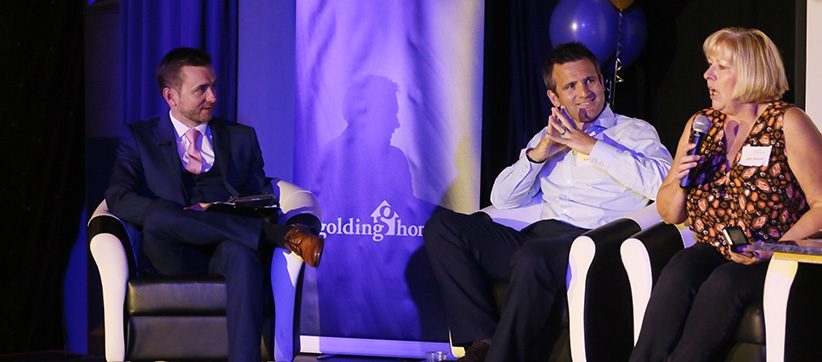
A conference MC runs the opening, the switch and the prize, and keeps the whole room with you. Golding Homes wrote on the reviews page: “Kevin hosted our staff conference event this year which was fantastic. He brought an energy and enthusiasm with him and played a really important part in getting people engaged in the day.”
I quote a fixed price per event, with no hidden extras. Have ready the date, venue, number of posters and delegates, a floor plan and who will judge.
Send the agenda or check availability at hello@conferencehost.uk, or call 07596 851647.

17:00Close
Send me your agenda. I’ll show you where the room comes alive.
A fixed price, a free planning call, and a reply within one working day.