Appreciative Inquiry: The 4D Model and How to Run It With a Group
TL;DR
- Appreciative inquiry is a change method that starts with what already works. It comes from a 1987 paper by David Cooperrider and Suresh Srivastva.
- The 4D model runs Discover, Dream, Design, Destiny. Most practitioners now add Define at the front.
- Paired interviews do the heavy lifting.
- A half-day session suits 20 to 60 people. A summit puts the whole system, up to thousands of people, in one room.
- In one review of 20 published cases, only seven showed transformational change. How you run the last phase matters most.
Appreciative inquiry asks a group to study its own best moments instead of its problems, then design the future around them. It is also one of the few facilitation methods with a version designed for a hall, not for twelve people in a training room. Below: the 4D model, a question bank, and running orders for a half-day session and a whole-hall summit.
One note on names. The method is usually shortened to “AI”, which now means something else to most delegates. I spell it out, and I would on your agenda too.
What is appreciative inquiry?
Appreciative inquiry is a strengths-based way of changing a group or organisation: inquire into the best of what is, imagine what could be, then design it together. Gervase Bushe’s encyclopedia entry sums up the central idea as groups evolving in the direction of the questions they keep asking.
It started as research. Cooperrider began the work during his doctoral study with the Cleveland Clinic from 1980, then published “Appreciative Inquiry in Organizational Life” with his mentor Suresh Srivastva in 1987 (he reissued it with commentary in 2017).
That paper set four principles: inquiry should begin with appreciation, and be applicable, provocative and collaborative. As Wikipedia summarises it, they argued that overusing problem solving held back social improvement. The UK charity Involve puts the origin neatly: organisations as organisms to appreciate, not machines to fix.
What are the five principles of appreciative inquiry?
The five principles cited today are constructionist, simultaneity, poetic, anticipatory and positive. Cooperrider and Diana Whitney published them later, and they became the widely cited set.
| Principle | In plain terms | For your session |
|---|---|---|
| Constructionist | People build their organisation through everyday conversation | Change the conversation first |
| Simultaneity | Asking a question already changes the system | Write your first question with care |
| Poetic | An organisation is a story that keeps being co-written | The words in your topic matter |
| Anticipatory | Today’s actions follow our image of the future | A vivid shared picture pulls behaviour towards it |
| Positive | Lasting change needs positive feeling and social bonds | Hope is a working condition, not decoration |
Bushe puts simultaneity bluntly: questions are never neutral. His example of the poetic principle is a good test for your topic. “Increased customer satisfaction” becomes “inspiring fanatically loyal customers”.
The appreciative inquiry 4D model, phase by phase
The 4D model emerged in the late 1990s. Bushe notes that Cooperrider resisted writing a how-to book for about 15 years, so there is no single correct way to run it. Most versions add a fifth D: the 5-D process at the Center for Appreciative Inquiry starts with Define.
| Phase | The question underneath | What the group produces |
|---|---|---|
| Define | What do we want more of? | An affirmative topic, phrased to inspire |
| Discover | When have we been at our best? | Stories, and the conditions behind them |
| Dream | What could we become? | A shared picture of the future, often visual |
| Design | What would it take? | Possibility statements (Cooperrider’s “provocative propositions”) |
| Destiny | What will each of us do? | Self-chosen commitments |
Destiny used to be called Delivery. Cooperrider renamed it because Delivery sounded like traditional change management, which is why guides variously say Destiny, Deliver or Deploy.
Discover is the heart of it. The key innovation, Bushe says, is that members interview each other about their own “best of” stories, so the people affected run the inquiry.
What questions do you ask in appreciative inquiry?
Appreciative inquiry questions ask about real experience first, then the future, then action, and all of them are open. The classic interview covers a best experience, what people value and their wishes: the standard shape the Center describes. Here is a bank for a work setting; swap in your own topic.
Define (sponsor and design team)
– What do we want more of around here?
– If this went brilliantly, what would people say in a year?
Discover (paired interviews)
– Tell me about a time you worked on a challenge with others and were proud of the result. What made that possible?
– When have you seen this team at its best with a customer? What was different?
– What do you value most here, and what must we never lose?
Dream
– It is three years on and this has gone better than anyone hoped. What has changed?
– What would a new starter notice in their first week?
Design
– Which strengths from the stories could carry the dream?
– Write it as if it is already true: “We…”
Destiny
– What one step can you take this fortnight without asking permission?
– Who will you do it with?
The first Discover question is close to the Liberating Structures Appreciative Interviews invitation, a 55 to 75 minute structure that works as a taster. For more prompts by phase, see Health Education England’s supervisor module.
How do you run appreciative inquiry as a half-day session?
Run all five Ds in one morning and give the interviews the biggest slice. This running order is my suggestion for 20 to 60 people at tables of six to eight. It is compressed: Involve notes the questions are usually developed and tested over two to four half or full-day workshops.
| Time | Phase | What happens |
|---|---|---|
| 09:30 | Define | Sponsor names the topic and why it matters (15 min) |
| 09:45 | Discover | Paired interviews, 20 minutes each way (40 min) |
| 10:25 | Discover | Tables pool stories and name the conditions behind them (25 min) |
| 10:50 | Break | 15 min |
| 11:05 | Dream | Tables picture the future and show the room (35 min) |
| 11:40 | Design | Tables draft two or three possibility statements (40 min) |
| 12:20 | Destiny | Individual commitments, offers and requests (30 min) |
| 12:50 | Close | Sponsor responds (10 min) |
Put it in the morning. The energy in a room is a curve, and paired storytelling at 1:30pm is a hard sell. The agenda template shows where a working session sits in a full day.
Do not cut the interviews. They are why professional adults join in: nobody is on the spot, they are telling one colleague about a good day at work. Cringe, not reluctance, is what kills participation.
How does an appreciative inquiry summit work in one hall?
An appreciative inquiry summit puts the whole system in one room for all four Ds. The AI Practitioner journal describes summits of one to four days with anywhere from 50 to 3,000 people. Cooperrider’s summit briefing describes 300 to 2,000 or more stakeholders over two and a half to three days.
Plan the lead time. A design team spends one or two days on the stakeholder mix, task and agenda, and the summit usually follows six to eight months later.
With only one day and a hall of 300, a compressed version at round tables of eight could run like this:
| Time | Phase | Whole-hall format |
|---|---|---|
| 09:00 | Define | Sponsor sets the task from the stage (20 min) |
| 09:20 | Discover | Pairs interview their neighbour (45 min), then tables pool themes (30 min) |
| 10:35 | Break | 20 min |
| 10:55 | Dream | Tables create a picture of the future; six show the hall (60 min) |
| 11:55 | Lunch | 60 min |
| 12:55 | Design | Delegates move to new tables by topic and draft statements (75 min) |
| 14:10 | Break | 20 min |
| 14:30 | Destiny | Personal commitments, then offers and requests (45 min) |
| 15:15 | Close | Leadership responds to the themes (30 min) |
Moving tables for Design is deliberate. It mixes the room and gets people out of their seats just as the post-lunch slump arrives.
Running the room at a summit
In a hall, the method is rarely the hard part. Logistics are: starting 150 interviews at once, bringing 38 tables back on time, and hearing from all of them without 38 report-backs.

Phones solve the last one. With RoomReader, the live Q&A software I built and include with hosting, each table sends its strongest theme and the host reads out patterns on screen. Any decent audience response tool can do it, and these participation techniques cover other ways to put a whole audience to work.
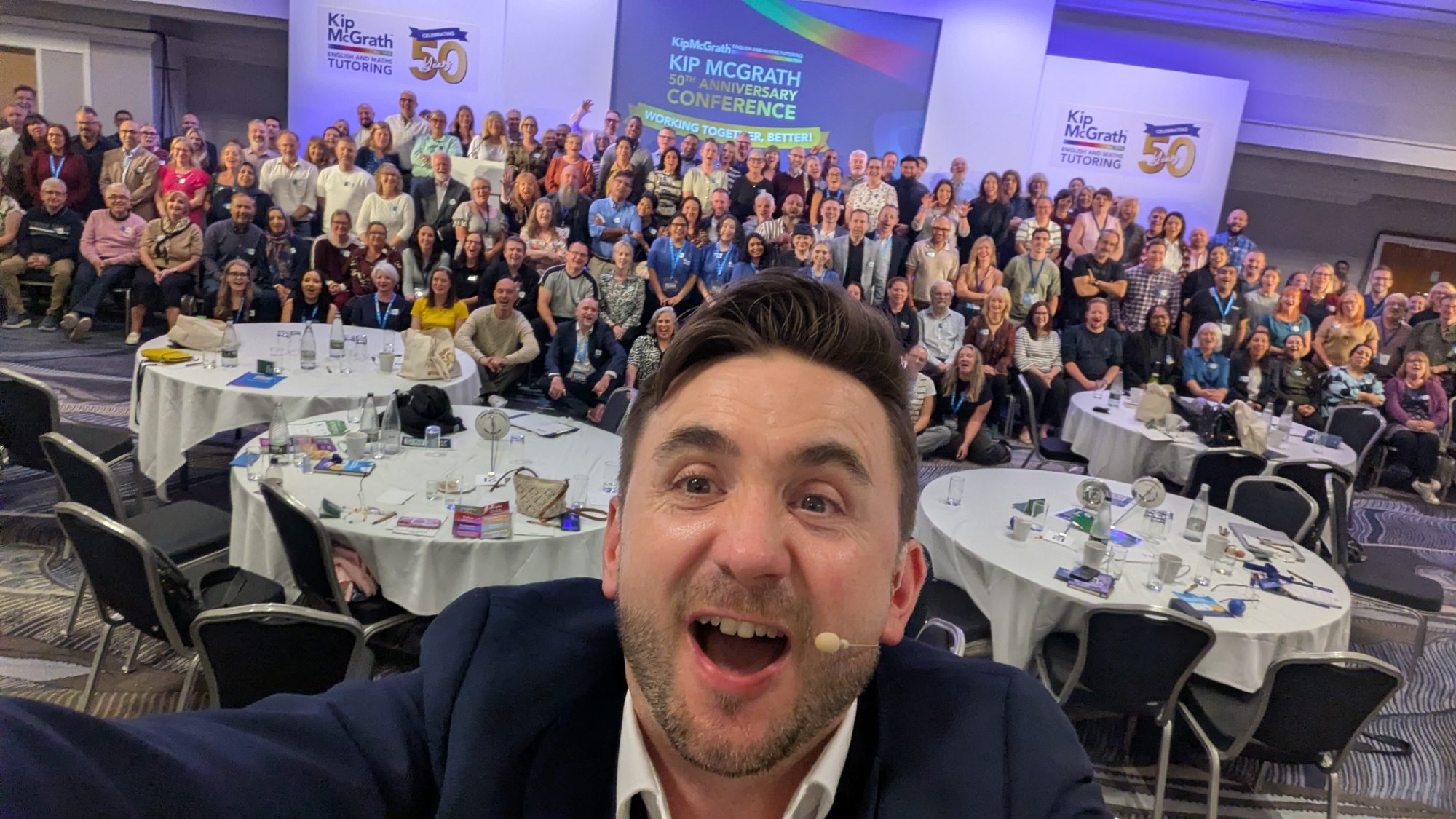
I am a conference host and facilitator, not an appreciative inquiry consultant. I have hosted 800+ events, and one thing holds: even a format built for a hall needs someone at the front holding the structure and keeping the whole room with you. That is conference facilitation.
Does appreciative inquiry actually work?
Sometimes, and the evidence points to the last phase. Bushe and Kassam’s meta-case analysis examined 20 published cases. All collected positive stories and nearly all followed the 4D model, yet only seven (35%) showed transformational change.
Those seven changed how people thought, not just what they did, and backed self-organising action. In five of the six where Destiny could be traced, it was improvisational, against two of the other 12. In practice: leaders invite people to act on the designs instead of forming committees.
Bushe is also clear that the method does not replace good leadership and skilled facilitation. Good questions will not rescue a weak sponsor.
What goes wrong with appreciative inquiry?
It fails in predictable ways. Nearly all of them start with treating it as a positivity exercise instead of an inquiry.
- Banning the problems. Bushe argues mainstream practice leans too hard on the positive. Someone with a real grievance who is told to stay positive switches off. Acknowledge it, then use the Liberating Structures redirect: when have we succeeded, even in a modest way?
- A vague topic. Skip Define and Discover wanders.
- Destiny as a committee. A steering group and a Gantt chart throw away the part that works.
- The same few voices. Involve flags the small numbers in a core group as a way to exclude people. A summit answers that.
- A one-off day. Some practitioners, Bushe reports, would rather run it as a long process punctuated by events.
Appreciative inquiry alongside your other methods
Appreciative inquiry is not meant to replace problem solving. Research in Practice, which supports social care in England, describes it as a way to complement other enquiry, and suggests making good practice a standing agenda item.
So borrow from it. Use Appreciative Interviews as a one-hour opener at an away day, or run Discover alone at a team meeting. For lighter options, see these team building ideas.
If you are planning an appreciative inquiry session or summit and want someone to run the room on the day, send the agenda or check availability at hello@conferencehost.uk.


17:00Close
Send me your agenda. I’ll show you where the room comes alive.
A fixed price, a free planning call, and a reply within one working day.