What Is a Hackathon? How to Run a Corporate Hackathon People Finish
TL;DR
- A hackathon is a short, time-boxed event where small teams build a working prototype against a brief, then pitch it. The name joins “hack” and “marathon”.
- A corporate hackathon is run for a company’s own staff, usually over 24 to 48 hours, on problems the business actually has.
- They are not only for coders. Atlassian, Microsoft and others open them to every department, and AI tools have lowered the bar further.
- Whether it was worth doing comes down to the brief and what happens the following week. Not the pizza.
- The host’s job is the kickoff, the check-ins and a pitch finale that runs to time.
What is a hackathon, and why would a company run one for staff who have never written a line of code? The short version: it is a deadline with a brief attached. Teams get a day or two to build something that works well enough to show, and the event ends with every team pitching what it made.
The meaning and history take two minutes. The rest of this guide is about the corporate hackathon: who takes part, how to write the brief, how to judge it, and what the person on the microphone has to get right.
What is a hackathon?
A hackathon is an event where people do rapid, collaborative building over a short, fixed period, aiming to have something that works by the end. That is close to the standard definition, which describes the goal as functioning software or hardware.
Length varies. Devpost, a platform that has hosted hackathons since 2009, says in-person events typically run 24 to 48 hours, while virtual ones can stretch to six to eight weeks. Most corporate versions sit at the short end: one or two working days.
The shape barely changes. A brief at the start, teams forming around ideas, a long stretch of building, then demos or pitches to judges at the end.
Where does the word hackathon come from?
The word is a blend of “hack” and “marathon”. The “hack” here means exploratory programming, not breaking into systems.
The earliest recorded uses are both from June 1999. OpenBSD developers held a cryptography coding event in Calgary on 4 June 1999, and later that month Sun Microsystems used the term at its JavaOne conference, where attendees were challenged to write a Java program for the new Palm V.
So the hackathon meaning has always been the same: a sprint, not a lecture. You come out with something you built.
What is a hackathon in business?
In business, a hackathon is an internal event where employees step away from their day jobs to prototype answers to the company’s own problems. Devpost describes internal hackathons as events organisations run for their own staff, with aims that include solving business problems, cross-team collaboration and engagement.
Some well-known products started this way. Atlassian runs ShipIt, a 24-hour innovation sprint, and says Jira Service Management began as a ShipIt project. A 2012 CIO report on Facebook listed Timeline, Video, Chat and the Like button among features that came out of its hackathons.
Scale varies hugely. Microsoft says its first company-wide hackathon ran in July 2014, and that 18,304 people took part in 2017. Most corporate hackathons are far smaller: a few dozen people in one building for a day, which is closer to a team building day with a product at the end.
Are hackathons only for coders?
No. The format works for anyone who can solve a problem in a team, and the larger corporate events say so openly.
Atlassian invites people from every department, from Legal and Finance to engineering, and says projects can be technical or non-technical. Microsoft’s own write-up is blunter: hackers don’t have to be engineers. Coursera notes that beginners are welcome at many events.
Mix the teams on purpose. The best hackathons, one innovation guide argues, bring together a mix of designers, marketers, strategists and developers. A non-coder hackathon might produce a redesigned onboarding process, a customer journey map or a policy prototype rather than an app.
Hackathon ideas that make a good brief
The brief decides whether the event is useful. A good one names a real problem, a real user and a real constraint, and leaves the answer open. Some corporate hackathon ideas that work for mixed teams:
- Fix one annoying internal process. Expenses, onboarding, booking a meeting room. Everyone has an opinion.
- Rebuild a customer journey. Pick one journey, walk it as the customer, and prototype the better version.
- Use your own data. Give teams a cleaned dataset and ask what it tells you that nobody has looked at.
- Prototype a feature customers keep asking for. Sales and support teams usually know exactly which one.
- Cut waste. Pick one named part of the business and take out time, paper or cost.
Two traps: a brief so open that teams burn half the day choosing a topic, and one so narrow there is only one answer.
What is an AI hackathon?
An AI hackathon is one where teams use artificial intelligence tools, usually generative AI, to build their prototypes. Devpost calls them its fastest-growing category, and says AI has lowered the barrier for non-engineers to build working prototypes.
The UK government has used the format too. During the AI Safety Summit in November 2023, the Central Digital and Data Office co-ran a 48-hour event, the Generative AI Government Hackathon, with PwC and Microsoft. For a company, an AI hackathon is a practical way to let staff try the tools on real work, with guard rails on what data they can use.
How to run a hackathon: team sizes, timings and the brief
Keep teams small. Joshua Tauberer’s hackathon guide suggests groups of about two to five, and plans for one subject matter expert for roughly every four non-experts. That ratio matters in a corporate event: put one person who knows the system in each team.
A workable shape for a one-day internal hackathon:
| Time | What happens |
|---|---|
| 9:00 | Kickoff: the brief, the rules, the judging criteria, the deadline |
| 9:30 | Idea pitches, then teams form |
| 10:00 to 15:30 | Build, with short check-ins mid-morning and after lunch |
| 15:30 | Hard stop. Demos ready |
| 16:00 | Pitch finale, judging, the reveal |
Prepare before the day. Research by Alexander Nolte at the University of Tartu found that corporate hackathon projects were more likely to continue when teams arrived already prepared, knew where their idea fitted the company’s products, and stuck to what each member already does well.
How should you judge a corporate hackathon?
Judge against three or four criteria announced at the kickoff, never ones invented in the judging room. A sensible set for a company event:
- Impact. Does it solve the problem in the brief, and for whom?
- Feasibility. Could the business actually build it?
- Fit. Does it plug into something the company already runs, or would it need a new team, a budget and three sign-offs before anyone could touch it?
- The demo. Does it work, or at least show clearly how it would?
Mix the panel. One senior sponsor, one person who owns the problem, one person who would have to deliver it. Atlassian’s mix of awards, including a People’s Choice and a non-technical prize, means more than one kind of team can win. Not everyone agrees with winners at all: the hackathon guide argues against them for civic events. For a company, a few categories usually beats a single trophy.
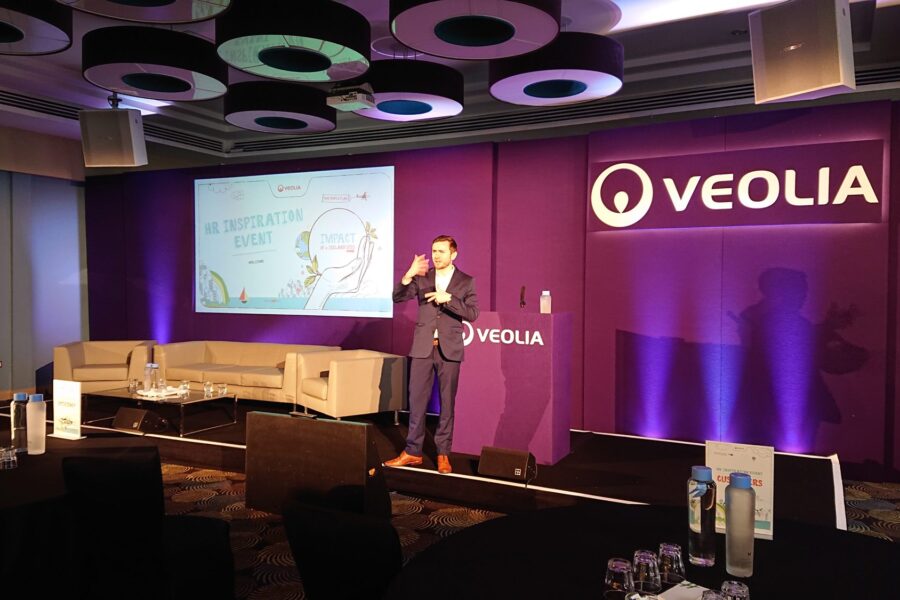
The host’s job: kickoff, check-ins and the pitch finale
A hackathon needs a host at three moments. They are the same moments that make or break any conference day.

The kickoff. Set the purpose, the brief, the rules and the deadline in plain language, and say how judging will work. Then run the idea pitches. The hackathon guide caps them at one minute each: the problem, the idea, the help needed. Someone has to hold that line, or the morning disappears.
The check-ins. I have hosted more than 800 events, and the energy in a room is a curve. A build day dips just like a conference does, hardest after lunch. Short, scheduled check-ins (each team gives one line on progress) keep the pace up and tell organisers who is stuck. The guide to conference energisers covers that post-lunch slot.
The pitch finale. This is the part everyone remembers, and the part most likely to overrun. Facebook gave teams three minutes to get the demo working and explain it; Atlassian asks for a demo video of two minutes or less. Whatever limit you pick, enforce it kindly and every time. Run the order so the next laptop is plugged in before each team is called, and keep the judges’ questions short.
Then the reveal. Build it like an awards moment: categories first, the main prize last, a short reason for every winner. If you want a People’s Choice vote, run it on the audience’s phones. RoomReader, the live Q&A and audience response software I built, is included when I host, so every delegate votes on their own phone, nothing to download. Cringe, not reluctance, kills participation, so nobody is asked to stand up and perform who did not volunteer.

What happens after a hackathon?
The best projects get a sponsor and a next step. Decide who that sponsor is before the day, not after. At Facebook, according to the 2012 CIO report, executives picked a few projects to look at further and gave feedback, which showed staff their work was taken seriously.
Nolte’s research found taking part also helped employees show project management and leadership skills, and grew their internal networks. That is worth saying out loud at the close.
If your hackathon sits inside a bigger event, such as a sales kickoff or an internal conference, the same rules apply: a clear open, a paced middle and a close that keeps the whole room with you. I work as a conference facilitator and host, and the guide on hosting a conference shows how the whole day fits together. Send the agenda or check availability at hello@conferencehost.uk.

17:00Close
Send me your agenda. I’ll show you where the room comes alive.
A fixed price, a free planning call, and a reply within one working day.