What Is a Town Hall Meeting in Business? A Host’s Guide
TL;DR
- In business, a town hall meeting is a company-wide session where leaders give a short update, then answer questions from staff in the open.
- The name is borrowed from New England town meetings of the 1630s, with one big difference: nobody votes at a corporate town hall.
- It is a communication exercise, not a decision-making forum, and never a substitute for the consultation the law requires on redundancies.
- Quarterly is the sensible default, plus an extra one whenever something big breaks.
- The hard part is not the slides. It is the awkward question asked in front of 400 colleagues.
So what is a town hall meeting in business? It is the one hour in the corporate calendar where the whole organisation gets to ask leadership anything, out loud, in front of everyone. Easy to schedule, surprisingly easy to ruin.
What is a town hall meeting in business?
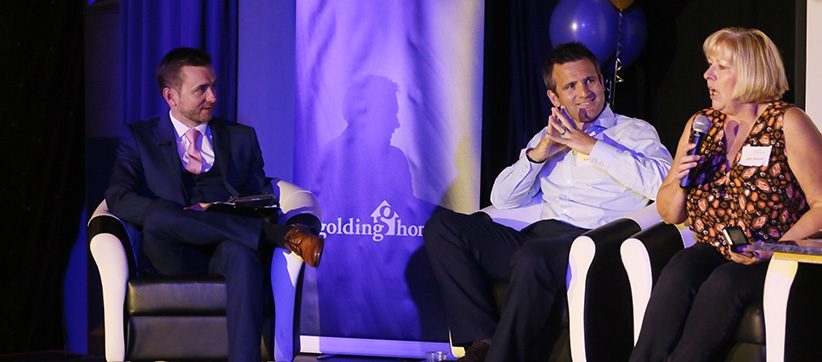
A business town hall meeting is a company-wide gathering, in person or online, where senior leaders share news and then take open questions from employees. The questions are not a courtesy at the end. They are the reason the format exists.
Three things separate it from a staff briefing. It is open to everyone, not just a layer of management. Leaders answer live, not in writing. And the agenda is only half theirs.
For the running order and Q&A mechanics, my town hall agenda guide sets out a 60-minute version you can lift. This post is what sits underneath: the purpose, the cadence, and what happens when it turns uncomfortable.
Where does the town hall meeting name come from?
From colonial New England, roughly four centuries ago. Town records from 8 October 1633 in Dorchester, Massachusetts set up weekly gatherings of inhabitants to settle local business: the first recorded American town meeting. Those inhabitants also chose twelve men to run things between general meetings.
The format reached national politics much later. Jimmy Carter held one in Clinton, Massachusetts in March 1977, and Bill Clinton made the televised version a campaign standard from 1992. Corporate internal comms borrowed it from there.
One inherited difference matters more than the etymology. The original meetings were direct democracy: people turned up and voted. Campaign town halls were not, and neither is yours. Say so from the stage. An audience that thinks it is voting, then finds out it was only commenting, does not come back.
What is a business town hall meeting actually for?
It closes the gap between what leaders think they have explained and what the organisation has actually understood. That gap is wider than most boards believe.
In research from The Grossman Group with The Harris Poll, reported in October 2025, 99% of business leaders thought they had communicated change well, against 25% of employees who agreed. Seventy-eight per cent of employees wanted it done better next time.
The payoff is measurable. Gallup, surveying 18,665 employees in 2023, found that among staff reporting significant disruption, those who strongly agreed their leaders communicate effectively were 4.3 times as likely to be engaged, and 65% less likely to feel frequently burned out.
So the purpose is narrow and worth doing: explain the why, let people test it, let everyone watch leaders answer. It is not a decision-making body, nor a morale event with a quiz bolted on.
A town hall is not formal consultation
Worth saying plainly: organisations confuse the two, and it gets expensive.
In the UK, an employer planning 20 or more redundancies at one establishment within 90 days must hold collective consultation with union or elected representatives. The minimum is 30 days before the first dismissal for 20 to 99 roles, 45 days for 100 or more. Separately, staff at organisations with 50 or more employees may request a formal ICE agreement on being informed and consulted. Even then, Acas is clear the employer keeps the right not to change what it plans to do.
A town hall sits alongside that, as communication. Announce a restructure at one by all means. Just never let the room believe the announcement was the consultation.
How often should you hold a town hall meeting?
Quarterly, plus an extra whenever something significant breaks. Monthly works in fast-moving companies with genuinely new things to say. Annual is not a town hall, it is a tradition.
The test is content, not calendar. Over half the leaders in the Grossman research expected more than three major changes within two years, so most organisations have plenty to explain. If you have nothing new, cancel and send a note. A thin town hall teaches people the format is theatre.
| Cadence | Works when | Risk |
|---|---|---|
| Monthly | Rapid growth, restructure, integration | Becomes a status report nobody attends |
| Quarterly | Most organisations, results-led rhythm | Big news waits too long |
| Event-driven only | Very small or very stable companies | Leaders only appear with bad news |
Publish the dates a year ahead either way. Calling one at short notice tells the organisation something is wrong before anyone speaks.
Getting real questions instead of planted ones
Open the question queue a week before, keep it open during the update, let people post anonymously, and let the room upvote. Then answer the top-voted questions first, in order, read out by someone other than the chief executive.
Each choice removes a specific risk. CIPD defines employee silence as choosing not to speak up when you have something to say, and notes people stay quiet when the risks seem to outweigh the benefits. Its own research found a quarter of employees report high levels of silence. The walk to a roving mic in front of 400 colleagues is that calculation, made in public.

I have hosted 800-plus events and the pattern is consistent: professional adults take part readily when the format removes the risk of looking foolish. Cringe, not reluctance, kills participation. Delegates use my own live Q&A software, RoomReader, in their phone browser with nothing to download.
If the queue genuinely is thin, use two or three real questions gathered in advance and say so. Planted questions dressed as spontaneous ones get spotted, and then the whole queue looks staged.
How do you handle a hostile question in front of everyone?
Slowly, and without matching the temperature. Rick Schell of Rice Business advises staying calm and listening carefully, because matching the questioner’s emotion escalates it while everyone else watches how you respond. They are the real audience, and they are keeping score. You will not always win the questioner round, and you do not need to.
A sequence that holds up under pressure:
- Pause, then thank them. Two seconds of silence reads as composure, not weakness.
- Ask before you answer. A diagnostic question such as “can you tell me more about the concern?” buys information and lowers the heat. Throughline Group warns against rushing in with platitudes: “I completely understand” arrives as dismissal.
- Refuse the false premise. Hostile questions often smuggle in an assumption. Schell’s advice is to reframe rather than accept it, then answer the real issue.
- Answer the part you can, name the part you cannot. “I don’t know yet, and you will hear by the end of November” is a real answer. The room can tell that from a non-answer instantly.
- Move on once, cleanly. If the questioner keeps going, offer a conversation straight after the session and take the next question. Say it once, respectfully, then do it.
Rehearse it. Have internal comms write down the ten questions nobody wants asked, and make leaders answer them out loud first. The hostile question is not the risk. An unrehearsed leader is.
This is where a neutral chair earns their fee: pressing the follow-up when an answer drifts, keeping the whole room with you while the hard ones land. My conference facilitator page sets out that job.
How do you run a town hall meeting for a hybrid workforce?
One queue, one set of rules, wherever people are sitting. The moment the room gets a microphone and remote staff get a chat box, the people at home learn this is not for them.
That group is not a fringe. The ONS found 28% of working adults in Great Britain were hybrid workers between January and March 2025, rising to 56% among managers and directors earning £50,000 or more. Your senior audience is disproportionately on a screen.
Rules that cost nothing:
- Say where each question came from, including “from someone at home”, so remote questions are visibly in the mix.
- Alternate between the room and the online queue rather than clearing the room first.
- Give the online audience its own co-host, with authority to interrupt.
My hybrid engagement guide goes further on keeping both rooms with you.
The follow-up that makes the next one worth attending
Within a week, publish written answers to every upvoted question you did not reach, where everyone can see them. Not a summary. The questions as asked, with answers and names against them.
Then track the numbers: questions submitted, upvotes cast, the share you answered. If submissions fall quarter on quarter, people have decided the questions do not matter. That is the metric that tells you whether the format is alive. My audience engagement page covers the wider craft.
Want someone neutral running the questions? Send the agenda or check availability at hello@conferencehost.uk.



17:00Close
Send me your agenda. I’ll show you where the room comes alive.
A fixed price, a free planning call, and a reply within one working day.