Town Hall Meeting: What It Is and How to Run One at Work

TL;DR
- A town hall meeting is a company-wide meeting where leaders give a short update and then take open questions from staff. The questions are the point.
- An all hands meeting leans towards information going out. A town hall leans towards questions coming in, so give the Q&A at least a third of the time.
- People stay quiet when speaking up feels risky. Collect questions in advance and live, allow anonymous posts, and let the room upvote.
- Have someone other than the CEO run the questions, and publish answers to anything you did not reach within a week.
A town hall meeting at work is the one session in the corporate calendar where staff are invited to ask leaders anything. Most of them fail in the same place: the Q&A. Here is what a company town hall meeting is, how it differs from an all hands, a running order you can lift, and how to run the questions so people actually ask them.
What is a town hall meeting?
A town hall meeting is a company-wide gathering where senior leaders share news and then answer questions from employees, in person, online or both. The defining feature is the open Q&A: anyone can ask, and leaders answer in front of everyone.
The name is borrowed. Corporate town halls are modelled on the New England meeting of the 17th century, where local people gathered to settle local business. One difference matters: nobody votes at a town hall. In business the term now covers informal corporate gatherings held to share results or personnel changes.
So the town hall meeting meaning at work is simple: leaders explain what is happening and why, then stand there while the organisation asks them about it.
Is a town hall meeting the same as an all hands meeting?
Not quite, though plenty of companies use the names interchangeably. The difference is direction.
| All hands meeting | Town hall meeting | |
|---|---|---|
| Main purpose | Share information, align everyone | Answer questions, hear concerns |
| Who talks most | Leaders and presenters | Employees, then leaders replying |
| Q&A | Often ten minutes at the end | A third to a half of the time |
| Typical rhythm | Monthly or quarterly | Quarterly, or after big news |
| Success looks like | Everyone knows the plan | Hard questions asked and answered |
If your all hands keeps running out of time for questions, you have an all hands. Call it a town hall only if the questions get real time.
Why do company town hall meetings fall flat?
Because the questions dry up, and the questions are the whole point. A town hall with no questions is a briefing with a nicer name.
In an exploratory study of employee silence, most of the 40 employees interviewed had been concerned about an issue at work and not raised it with a supervisor. The reason they gave most often was fear of being viewed or labelled negatively. Now picture asking that question into a microphone, in front of 400 colleagues and the CEO.
Trust is thin, too. Gallup found that in May 2026 only 20% of US employees strongly agreed they trust their organisation’s leadership. A policy paper published by Acas warns that staff can see requests for their views as a cosmetic exercise with no consequence.
I have hosted 800+ events and the pattern is familiar. The roving mic goes out, someone asks for a show of hands, and a big room stays flat. Professional adults will happily take part if the format removes the risk of looking foolish. Cringe, not reluctance, is what kills participation.
A town hall meeting agenda that leaves room for questions
Here is a 60-minute running order. Stretch or squeeze it, but protect the Q&A block first.
| Time | Segment | Notes |
|---|---|---|
| 0 to 5 min | Host welcome | How questions work, what anonymous means, the finish time |
| 5 to 20 min | Leadership update | Three headlines, not thirty slides |
| 20 to 30 min | One focus topic | The thing people are actually talking about |
| 30 to 55 min | Live Q&A | Top-voted questions first, read out by the host |
| 55 to 60 min | Close | What happens to unanswered questions, and by when |
Open the question queue when the invitation goes out, a week before. People ask better questions with time to think, and leaders see the themes coming. Keep the queue open during the update, so the Q&A starts with a full list rather than a nervous pause.
If the town hall sits inside a bigger internal day, the sales kickoff guide covers the wider running order.
How do you run the Q&A at a town hall meeting?
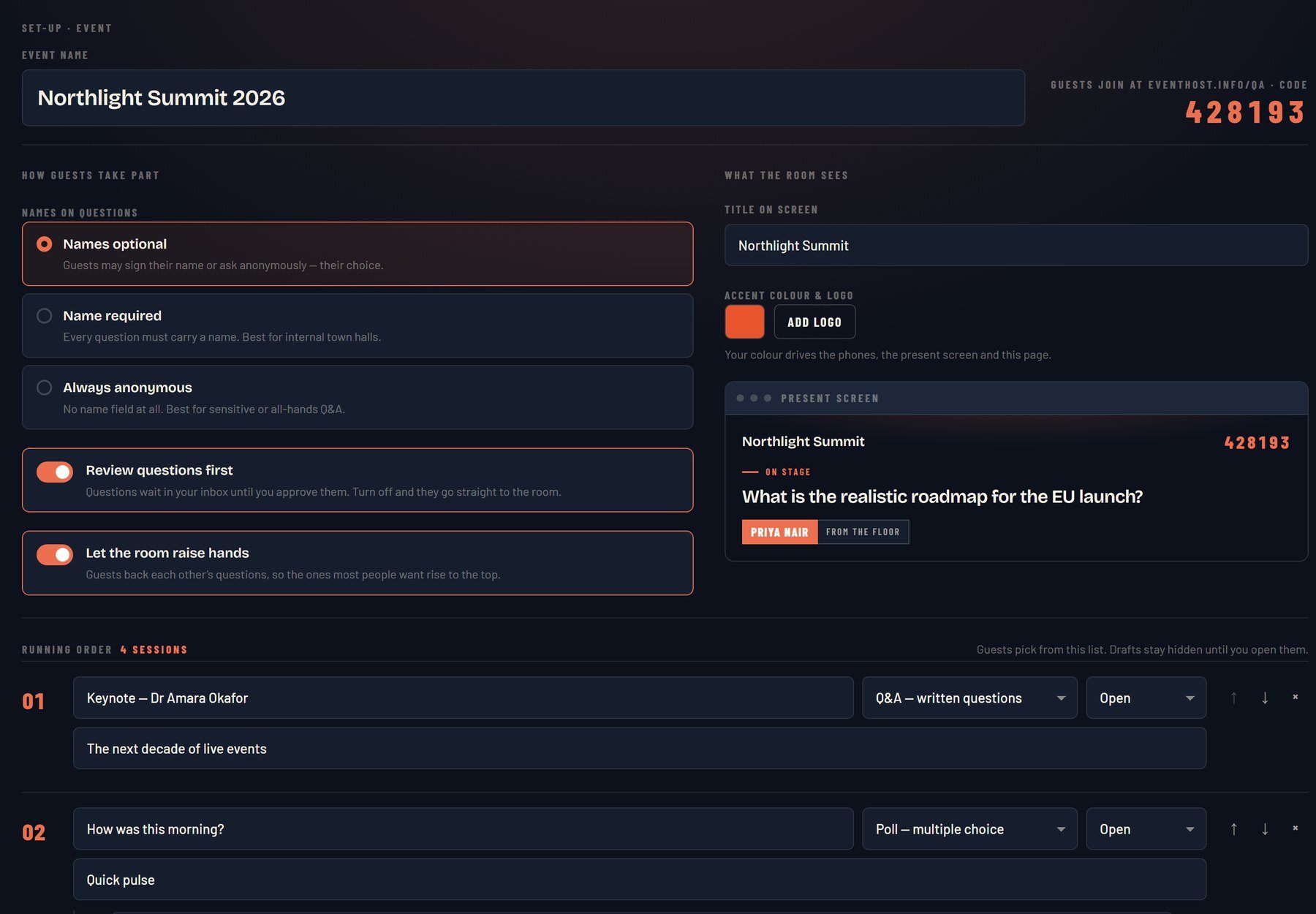
Collect questions on people’s phones, let colleagues upvote them, and have a host read them out, most popular first. That removes the walk to the microphone, shows leaders what the room really wants to know, and stops the loudest voice setting the agenda. A roving mic is fine for twelve people in a training room. In a hall of 400 it is a long walk with everyone watching.
Anonymous or named?
Offer anonymous posting. Fear of being labelled is the main reason people stay quiet, so take it away. Be precise about what anonymous means: in Microsoft Teams Q&A, anonymous posts cannot be tracked by the organisation, but replies and reactions to them are not anonymous. Tell people that before they type.
Upvoting
Upvoting turns a pile of questions into a ranking. Teams lets each attendee upvote each question once and sort by most upvoted. The rule that makes it work: leaders answer the top questions, not the comfortable ones lower down.
Moderation without softening
Moderate for abuse, duplicates and anything naming an individual. Do not moderate for discomfort. At Google, staff used a tool called Dory to post and upvote questions for leaders. In 2024 Google replaced it with an AI tool that groups and summarises questions, and some employees complained it produced softball questions. Google said the summaries did not soften anything. But once staff believe their question has been rewritten, they stop trusting the format.
The first question
Choose the first question deliberately. In a study of almost 250 academic seminars, when a man asked the first question, women went on to ask proportionally fewer. The researchers could not show cause, but the lesson costs nothing: the first question signals whose floor it is.
Adding a polling app rarely fixes this, because a poll is not a reason to look up from your phone. That is why I built my own live Q&A software, RoomReader. It is included with my hosting, and delegates use it in their phone browser, nothing to download.
What questions get asked at a company town hall meeting?
Expect the questions people already ask each other at their desks. Most fall into six groups:
- Pay and reward: “When will we hear about the pay review?”
- Change: “Is the restructure finished, or is there another phase?”
- Ways of working: “Is the office policy changing again?”
- Strategy: “Why are we pulling out of that market?”
- Workload: “We were told to do more with less. Which of the ‘more’ can we drop?”
- The rumour: whatever the leak or the gossip is this month.
Prepare your leaders for the hard ones. Have someone in internal comms write down the ten questions nobody wants asked, and rehearse answers. “I don’t know yet, and here is when I will” is a good answer. A non-answer is not.
If the queue is thin, seed it with two or three real questions gathered in advance, and say so. Planted questions dressed up as spontaneous ones get spotted.
How do you run a hybrid or virtual town hall meeting?
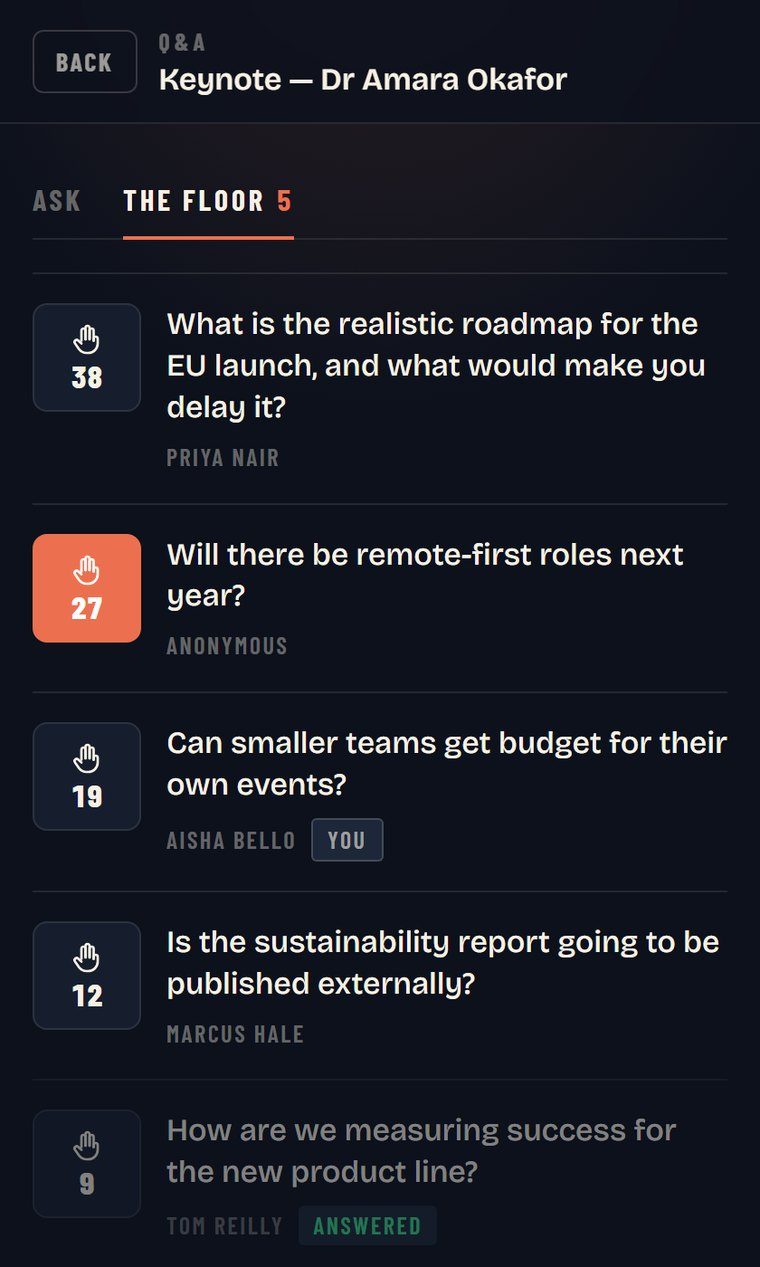
Use one question queue for everyone, wherever they are sitting. If the room gets the microphone and the people online get a chat box, remote staff learn quickly that the town hall is not for them.
That remote group is big. The ONS found that 28% of working adults in Great Britain were hybrid working in autumn 2024. Platforms can carry the numbers: as of October 2026, Microsoft says a Teams town hall can host up to 10,000 attendees, or 100,000 with Teams Premium. So capacity is rarely the issue. The hard part is making online staff feel heard.
A few practical rules:
- Say where each question comes from (“from the Leeds office”, “from someone online”) so remote questions are visibly in the mix.
- Alternate between the room and the online queue.
- Give the online audience its own co-host watching their feed.
The hybrid engagement guide covers keeping both rooms with you.
The host’s job at a town hall meeting
The CEO should not chair their own Q&A. When the person being questioned also picks the questions, the room assumes the hard ones will be skipped, and it is usually right.
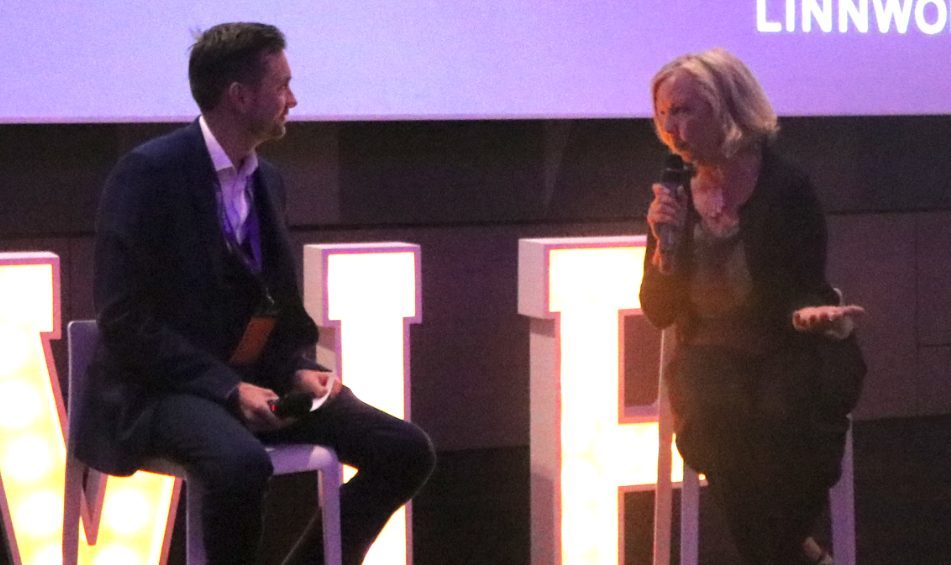
A neutral host reads the questions out, keeps answers to time, and asks the follow-up when an answer drifts: “That covered the timing. The question was whether jobs are affected.” That is facilitation, not entertainment: my conference facilitator page sets out what a chair does.
Amy Edmondson defines psychological safety as a shared belief that a team is safe for interpersonal risk taking. Questioning the CEO in front of the whole company is exactly that kind of risk. The host’s job is to make it feel less risky, every time, and to keep the whole room with you while the hard questions land.
After the town hall: answer what you did not reach
The town hall does not end when the call does. Within a week, publish written answers to every top-voted question you did not reach, where everyone can see them.
Google’s own TGIF shows how a format withers. In November 2019 Google moved its TGIF meetings to a monthly format focused on product launches and business strategy, citing leaks and viewing that had fallen from 80% of staff to 25% over a decade.
Track questions submitted, upvotes cast and the share answered. If they fall quarter on quarter, people have stopped believing the questions matter. My audience engagement page covers keeping a big room involved.
If you are planning a town hall meeting and want someone neutral to run the questions, send the agenda or check availability at hello@conferencehost.uk.

17:00Close
Send me your agenda. I’ll show you where the room comes alive.
A fixed price, a free planning call, and a reply within one working day.