Leadership Conference: How to Plan One Senior People Take Seriously
TL;DR
- A leadership conference is not a smaller all-staff day. The room in front of you is the relay the workforce actually trusts, so the day has to leave people able to act and explain.
- Build the agenda around three or four decisions instead of eight presentations, and put the hardest conversation before lunch.
- Candour is a design problem, not a personality problem. Name the confidentiality rules, collect questions on phones, and protect whoever speaks first.
- Agree before the day what should be different six weeks later, then measure that rather than the applause.
A leadership conference is the one event where the audience is also the delivery mechanism. Everyone in that room goes back to a team on Monday and either carries the message or quietly drops it. That changes almost every planning decision, and it is why a scaled-down all-staff day produces a nice lunch and nothing else.
What makes a leadership conference different from an all-staff conference?
The difference is what the room is for. An all-staff conference informs. A leadership conference has to send people out able to decide and defend a position to their own teams.
That matters because of who gets believed. The IoIC’s IC Index 2024, based on 4,000 UK workers surveyed in March 2024, found 75% of employees trust their direct manager, against 58% for the leadership team and 55% for the CEO. Trust falls the further up you look. Gallup’s US research puts managers at 70% of variance in engagement scores.
So the people in your leadership conference are the channel, and most have not been equipped for it: the same report found only 11% of managers said they had been trained in communicating change effectively.
There is a second difference organisers underestimate. At an all-staff event, disagreement is handled offstage. At a leadership conference, disagreement is the content. If nobody disagrees in the room, you have run a broadcast with better biscuits. The general craft of hosting a conference still applies, but the brief is different.
What shape should a leadership conference agenda take?
Build it around three or four decisions, and schedule the hardest one before lunch. Everything else is either input to a decision or the cascade that follows.
Two reasons for the morning: people are freshest, and the awkward topic then has the day to settle. Most people also hit a measurable drop in alertness in the post-lunch dip between 14:00 and 16:00, so that slot should carry activity, not the strategy reveal.
The energy in a room is a curve. I have watched it for twenty years across 800+ events: the cold open, the slump after lunch, the awkward gap before networking. Aim the lively parts of the day at those exact moments.
A one-day leadership conference agenda, block by block
Think in proportions before you think in timings. A split that works:
| Block | Purpose | Rough share of the day |
|---|---|---|
| Context from the CEO | Where we are, what has changed, what is not up for debate | 10% |
| The hard conversation | One topic nobody wants to raise, facilitated properly | 20% |
| Decision sessions | Small groups, real options, named owners | 30% |
| Cascade build | What each leader says to their team, drafted in the room | 15% |
| Re-energise and connect | Post-lunch activity, networking with a purpose | 15% |
| Open and close | Framing at the start, commitments at the end | 10% |
For the hour-by-hour version, start from a conference agenda and build the technical timings into a run of show, so the AV team and the host work from the same page.
How do you get candour from a room of senior people?
Lower the cost of being the first person to say the difficult thing. Senior people are not less honest, they just have more to lose by going first.
The research is consistent about what suppresses it. Amy Edmondson’s study of 51 work teams defined psychological safety as a shared belief that the team is safe for interpersonal risk taking, and found that where leaders behave in authoritarian or punitive ways, people become reluctant to take that risk. A 2022 study found a leader’s negative emotional expression pushes people towards silence by reducing psychological safety.
It gets worse the more power is in the room. A 2025 qualitative study found reluctance to speak up is sharpest when the issue involves people holding organisational power, and that many stay quiet because they expect nothing to change. Another 2025 study found that punitive or unpredictable leaders create climates of fear, amplified where deference to authority is the norm.
What actually works on the day:
- Say out loud what is not up for debate. Fake consultation kills the afternoon.
- Run the sensitive session under the Chatham House Rule: participants may use what they hear, but may not reveal who said it or their affiliation. Say it at the top of the session, not in the pack.
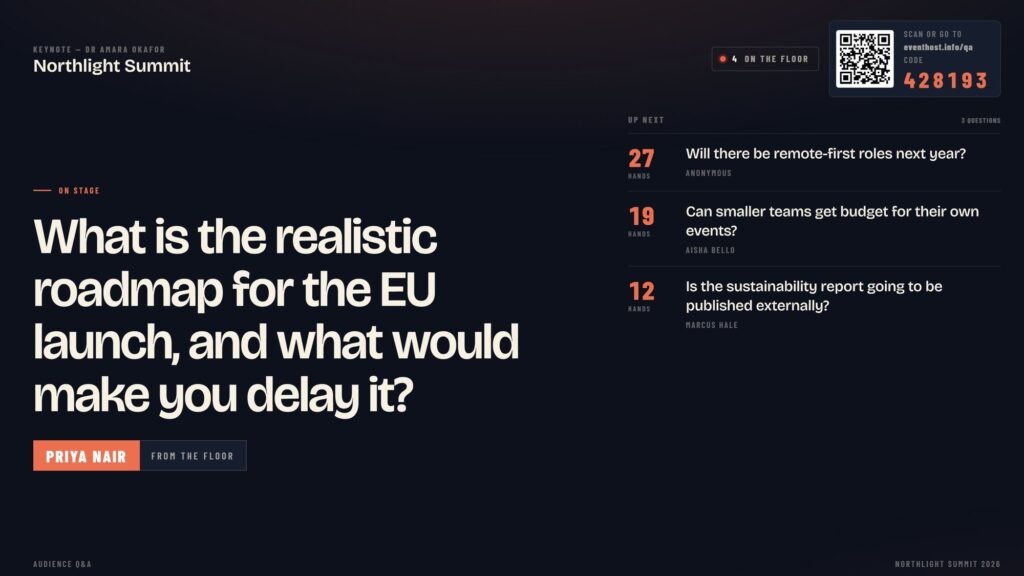
- Take questions on phones rather than hands. I use RoomReader, my own live Q&A software, so questions arrive without anyone standing up first and the room’s upvotes tell you the real agenda. Nothing to download.
- Protect whoever says the uncomfortable thing first. One defensive answer from the top table and the rest of the day goes polite, which is the expensive kind of quiet.
Professional adults will take part when the format removes the risk of looking foolish. Cringe, not reluctance, is what kills participation.
What should the host do, and what should the CEO do?
My rule is simple. The host owns the clock, the room and the questions, and keeps the whole room with you. The CEO owns the message and the answers. Blur the two and you get a day that runs late and says less.
| The host | The CEO |
|---|---|
| Opens, sets the rules, holds the time | Gives the context and the direction |
| Pulls out the question nobody is asking | Answers it straight, including “I do not know yet” |
| Keeps the quiet half of the room in it | Stays in the room after speaking |
| Summarises what was actually decided | Confirms the commitments publicly |
| Protects the energy across the day | Lets the host interrupt |
An internal chair usually cannot do the host half, not through lack of skill, but because they have a stake in every decision and a line manager in the room. Hence an outside conference facilitator on the days that matter.
How do you handle the awkward question from the floor?
Take it. A leadership audience smells deflection instantly, and dodging costs more than answering badly.
Acknowledge it as fair before answering: that tells the room questions are welcome. Keep it in the room rather than offering a one-to-one later, unless it concerns an individual. Route it to whoever owns the answer, not the most senior person present. Then close the loop, with a date.
Two phrases worth rehearsing beforehand: “that is a fair question and the answer is not settled yet”, and “here is what we do know”. Both buy honesty without bluffing. The same preparation applies to your panel questions.
How do you measure whether a leadership conference worked?
Decide what should be different six weeks later, before you book the venue. Satisfaction scores on the day tell you about the catering.
The Kirkpatrick model is the useful frame: reaction, learning, behaviour and results, and its own guidance is to start with Level 4 results and work backwards. HM Treasury makes the same point in the Magenta Book, its guidance on designing an evaluation, which assumes the design happens before delivery.
Collect four things:
- The share of leaders who can state the top three priorities without notes, in the room and again at six weeks.
- Decisions logged with a named owner and a date, counted at the close.
- The share of those decisions closed or on track at six weeks.
- Whether the team conversation happened: ask the teams, not the leaders.
Five ways a leadership conference goes wrong
- Everything is a presentation. Eight decks, no decisions, a room reading email behind their laptops.
- The CEO leaves after their slot. The signal that lands is that the rest of the day is optional.
- No consequence. Nothing from the day reaches anyone’s objectives. Next year starts in the same place.
- The cascade is left to goodwill. If leaders do not draft what they will tell their teams in the room, most never will.
- An entertainment bolt-on. Energy has to come from something the room already cares about, not from an act wheeled in at 4pm.
Booking a host for a leadership conference
I host, MC and facilitate leadership conferences and internal kickoffs across the UK, in person and virtually. The live Q&A software and whole-room formats come with me, not as a separate act. Pricing is quoted per event on length, preparation and travel, as a fixed price with no hidden extras.
Check availability or send the agenda to hello@conferencehost.uk. I will tell you where the day is likely to sag and what I would change.

17:00Close
Send me your agenda. I’ll show you where the room comes alive.
A fixed price, a free planning call, and a reply within one working day.