Fireside Chat: What It Is, the Format, and How to Host One
TL;DR
- A fireside chat is an interview on stage: one host, one guest, no slides, in front of an audience.
- The usual format is 30 to 45 minutes, two chairs, a prepared arc of questions and 10 minutes of audience questions at the end.
- Choose it over a panel when you want depth from one person. Choose a panel when you want disagreement between several.
- The format does not carry the session. The interviewer does, so pick someone who can listen, follow up and interrupt.
“Fireside chat” appears on almost every conference agenda, and too often it is the slot for a senior leader who did not want to prepare slides. That undersells it. Run properly, it is the most watchable session of the day. People lean in to a real conversation in a way they never do for slide 14.
Here is what the term means, how the format works, when to pick it over a panel, and how to host one so your guest says something worth hearing.
What is a fireside chat?
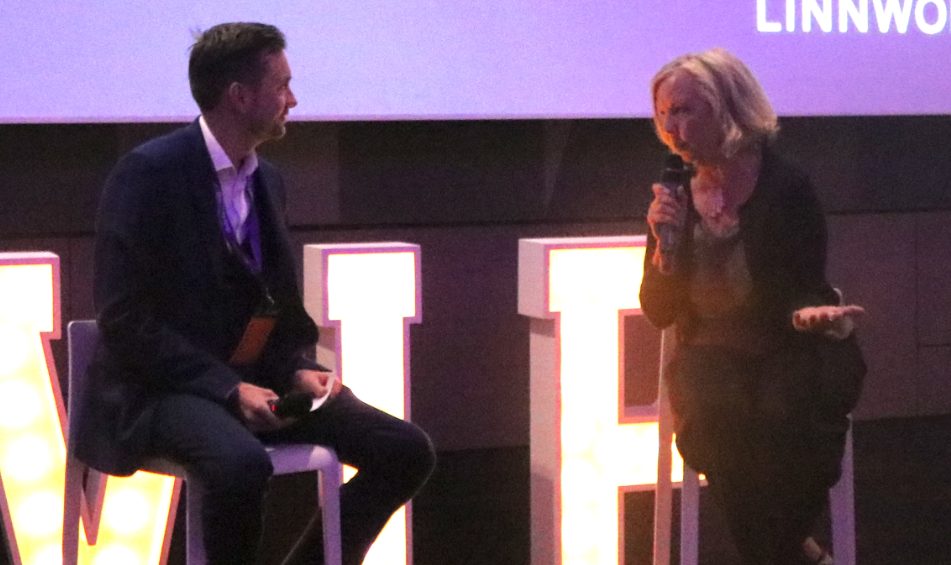
A fireside chat is an informal, structured interview between a host and a guest, held in front of an audience and without slides. The host asks the questions, the guest answers from experience, and the audience usually gets to put questions of their own before the end.
In business, the meaning holds whether the room is a conference hall or an all-staff meeting. A leader or expert sits down with an interviewer instead of standing behind a lectern. The aim is candour: what they think, what went wrong, what they would do differently.
Some organisers stretch the term. One medical association’s moderator guide describes its fireside chats as a moderator with two or three experts on stage. That is closer to a small panel, but the principle holds: seated, conversational and free of slides.
You will also see it billed as “in conversation with”, an on-stage interview or a keynote conversation. Same idea, different label.
Why is it called a fireside chat?
It is named after Franklin D. Roosevelt’s radio addresses, which ran from 12 March 1933 to June 1944 and got their nickname from a CBS press release.
The lesson that survives is the one in the name. Speak to a few people, not to a crowd, and a room of any size will listen.
What is the fireside chat format?
The fireside chat format is two people in chairs, a set of prepared questions, no slides, and a block of audience questions at the end. Everything else is a variation on that.
| Element | What works |
|---|---|
| Length | 30 to 45 minutes in total |
| On stage | One host and one guest |
| Seating | Two chairs angled towards each other and the room, with a low table |
| Slides | None. A holding slide with names and the session title is enough |
| Microphones | One each, handheld or lapel, so nobody leans across |
| Audience questions | The last 10 minutes, collected throughout |
Events publishers use the format themselves. In August 2024, Skift described candid interviews with chief executives, run by its editors on a single stage, as the core of its own live events.
Where it sits in the day matters. The energy in a room is a curve, and I have watched it for twenty years: the cold open at 9am, the slump after lunch, the awkward gap before networking. A fireside chat with a guest people want to hear is a strong way to open, and a strong way to close. Straight after lunch it is a risk, because the post-lunch dip in alertness is real, and two people talking quietly in armchairs will not fight it unless the guest is exceptional.
Fireside chat vs panel: which should you programme?
Programme a fireside chat when you want depth from one person, and a panel when you want several viewpoints to rub against each other. The mistake is choosing by habit.
| Fireside chat | Panel | Keynote | |
|---|---|---|---|
| Voices on stage | Host plus one guest | Moderator plus three or four | One speaker |
| Best for | Depth, candour, personal story | Contrast and debate | A single prepared argument |
| Main risk | A guarded guest or a soft interviewer | Everyone agreeing politely | Slides nobody remembers |
| Preparation | One briefing call | A call with every panellist | The speaker’s own |
If your guest has one big story to tell, a panel discussion will dilute it. If the subject is contested, one guest gives you one side. And if you do go with several voices, the craft of moderating a panel is a different job from interviewing one person.
How to host a fireside chat
Brief the guest, but do not script them
Speak to your guest before the day. Agree the three or four areas you will cover, find out what they are tired of being asked, and ask what they have never been asked. Share themes, not a word-for-word list. Send the list and you get rehearsed answers.
Coaches who prepare speakers for these sessions give the same advice from the other chair: bring an index card, not a script, and keep each answer to about 60 seconds before handing back.
Build an arc, not a list
Twelve unrelated questions make an interrogation. Three chapters make a conversation. A simple arc works in almost any room: where the guest came from, the hard decision or the thing that went wrong, and what they would tell the people in the audience to do on Monday.
Start easy and specific. Save the question the room actually wants answered for the middle, once the guest has warmed up.
Listen and follow up
The best question of the session is rarely on your card. It is the follow-up to something the guest has just said. A 2017 study by Harvard researchers found that people who ask more questions, and follow-up questions in particular, are better liked, because they come across as more responsive. That study looked at one-to-one conversations, not stages, but the mechanism is the one an audience notices: a host who is plainly listening.
Use question types on purpose. Open questions get stories. Closed questions pin down a position. Few executives treat questioning as a learnable skill at all, so a host who does stands out quickly.
Bring the room in
Do not leave audience questions to a roving microphone and a long silence. Professional adults will happily take part if the format removes the risk of looking foolish. Cringe, not reluctance, is what kills participation.
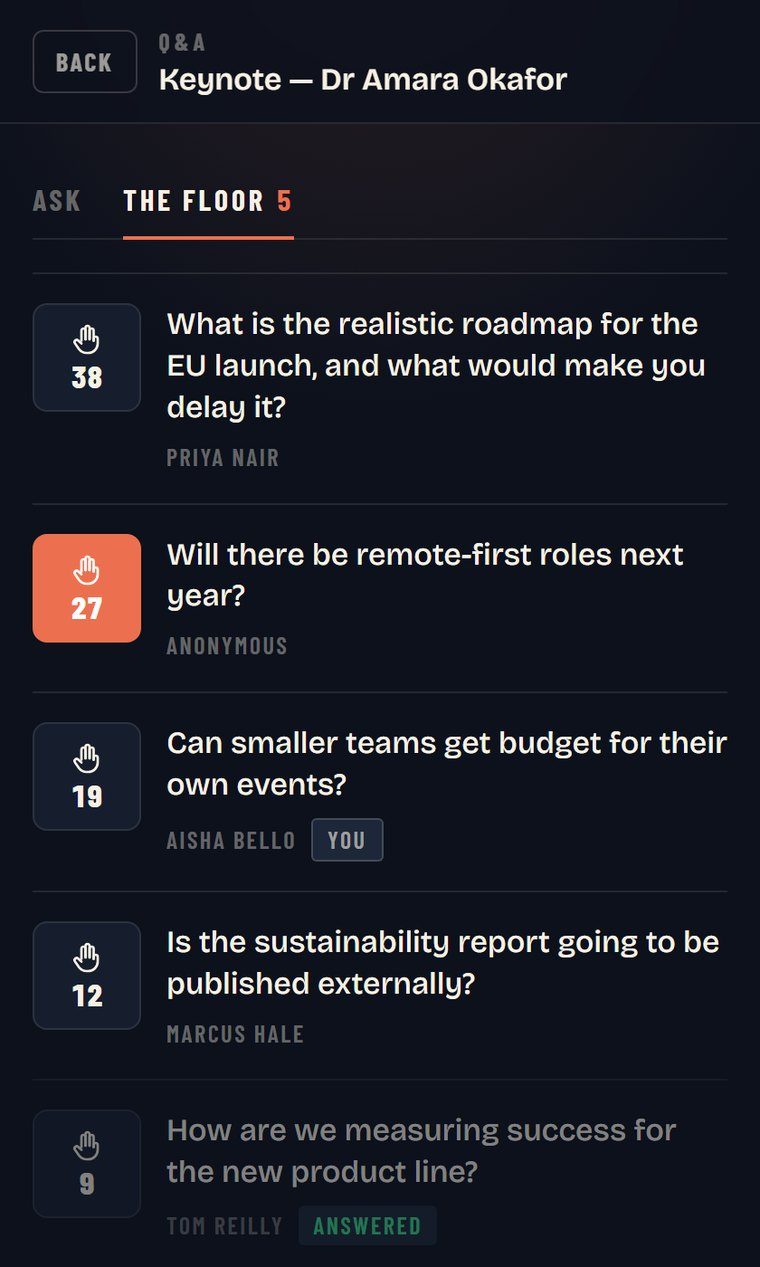
Collect questions from the first minute and choose the best ones. It keeps the whole room with you, even the people who would never put a hand up. When I host, I use RoomReader, my own live Q&A software, which is included with hosting: delegates send questions from the phone browser, with nothing to download. Whatever you use for live Q&A, the point is the same. Curated questions beat the first hand in the air.
Land it on time
Keep one or two final audience questions in hand, then close with a single line the guest wants people to remember.
Thank them and get off. A fireside chat that overruns takes its minutes from the coffee break, and the room knows it.
Fireside chat questions worth stealing
Adapt these to the guest. They are grouped by the job they do.
Openers (easy, specific, quick to answer)
- What were you doing the week before you took this job?
- What does a normal Tuesday look like for you now?
- What did you believe about this industry five years ago that you no longer believe?
Story questions (the middle of the session)
- Take us back to the moment you realised the plan was not working. What happened next?
- What is the decision you came closest to getting wrong?
- Who changed your mind about something important, and how?
- What did that cost you, personally or commercially?
Challenge questions (asked warmly, but asked)
- Your critics would say the opposite. What do they get right?
- What are you still not good at?
- If you were starting again today, what would you not do?
- What is the question you hoped I would not ask?
Closers
- What should everyone in this room do differently on Monday?
- What are you most uncertain about for the year ahead?
- What is one thing you have read, heard or seen recently that you keep thinking about?
For sessions with several guests, there is a separate bank of panel questions built for getting people to disagree.
What goes wrong with a fireside chat?
Almost always, the interviewer. Two chairs and no slides do not make a session engaging on their own.
The attention research points the same way. The often-quoted idea that audiences switch off after ten minutes is not supported by the data, and a 2016 review of the lecture research found that attention varies far more between teachers than between formats. A relaxed format in the wrong hands is still a dull half hour.
The failures are predictable:
- Reading the list. The host asks question four because it is next, not because it follows.
- The monologue. Six minutes, one answer, nobody steps in.
- Soft questions. Every question is an invitation to say how well things are going.
- The overrun. Audience questions get squeezed into the last two minutes or dropped altogether, and the one question the room really wanted never gets asked.
Who should ask the questions?
Someone independent of the guest. A colleague, or anyone more junior, will struggle to interrupt their own chief executive or press a point the guest would rather avoid, and the audience can tell within a minute.
Bring in an outside interviewer and that changes. They can ask what the room is thinking, cut a long answer short without consequences, and keep to time. That is the job of an event moderator, and it is the job I have done as a host and moderator for 20+ years and 800+ events.
If you have a fireside chat on your agenda and want it to be the session people talk about afterwards, send the agenda or check availability at hello@conferencehost.uk.
17:00Close
Send me your agenda. I’ll show you where the room comes alive.
A fixed price, a free planning call, and a reply within one working day.