Check-In Questions for Meetings That Get a Real Answer
TL;DR
- A check-in is not an icebreaker. It tells you what state the people in front of you arrived in.
- Budget by head: 20 to 30 seconds a person. A spoken round works up to about twelve people.
- “How is everyone?” gets a round of “fine”. A question with a shape, one word, one number, one specific thing, gets an answer.
- Skip it under fifteen minutes, or when the group checked in two hours ago, and say why.
- Make passing cheap. Never go back for a second attempt.
Good check-in questions do a job that has nothing to do with breaking the ice. They tell you, inside ninety seconds, whether the agenda you wrote on Friday still fits the people who turned up on Monday. Most advice on check in questions for meetings is 150 prompts with no judgement about which ones work.
What is a check-in, and how is it different from an icebreaker?
A check-in is a short round at the start of a meeting where every person says something about the state they are in. An icebreaker is an activity designed to get people comfortable with each other.
The icebreaker’s problem is social: these people do not know each other and will not speak freely until they do. The check-in’s problem is informational: they know each other perfectly well, and you have no idea which of them is still mentally in the meeting they just left.
That changes the question. A check-in asks about now, where a round of icebreaker questions can be playful and irrelevant. Microsoft’s telemetry puts the average knowledge worker at an interruption every two minutes, with half of all meetings landing between 9 and 11am or 1 and 3pm. Nobody arrives fresh.
What makes good check-in questions for meetings?
A good check-in question is answerable in one breath, has a visible shape, and asks about the present rather than the person.
- One breath. If the honest answer takes a paragraph, the round overruns and the last three people shorten theirs to nothing.
- A visible shape. One word, one number out of ten, one thing. The shape tells people how long an answer should be, so you never police it.
- About now, not about them. “What is on your mind this morning” is answerable. “How are you feeling” is a question about identity, and most people decline it politely.
- Equal cost. As easy for the quietest person as the loudest.
That last one is not a nicety. MIT’s work on collective intelligence found groups where one person dominated performed worse, and evenness of speaking turns beat individual ability as a predictor.
How long should a check-in take?
Budget 20 to 30 seconds per person and multiply, not a flat five minutes. A round that works with eight people is an eighteen-minute ordeal with forty.
| Group size | Mechanism | Realistic time |
|---|---|---|
| 2 to 6 | Full spoken round | 1 to 3 minutes |
| 7 to 12 | Spoken round, one word or one number only | 3 to 5 minutes |
| 13 to 25 | Chat box, sticky notes or pairs | 3 to 4 minutes |
| 26 to 60 | Pairs, then a handful shared aloud | 5 minutes |
| 60+ | Phone vote or poll, results on screen | 2 minutes |
The jump at around a dozen is the one I watch organisers miss. Above it you stop running a round and start running a structure. Pairs scale where rounds do not, which is why facilitators reach for impromptu networking or 1-2-4-All. Keep the proportion honest: a standup has a 15-minute timebox in the Scrum Guide, and a two-minute round eats an eighth of it.
Check-in questions that get a real answer instead of “fine”
“How is everyone?” returns “fine” because it is a greeting, not a question. Nobody hears it as a request for information. Give it a shape and the answers change immediately.
| Gets “fine” | Gets an answer |
|---|---|
| How is everyone? | One word for how you have arrived today. |
| Everyone good to go? | Out of ten, how much of you is in this meeting? |
| Anything to flag? | What will distract you in the next hour? |
| Any concerns? | What would make this hour worth your time? |
Each question on the right names its own format. “One word” and “out of ten” are instructions as much as questions.
Two habits help. Go first, briefly, in the shape you asked for. And never follow an answer with a solution: Acas advises managers to regularly ask workers how they are doing, and the fastest way to kill that is to treat every answer as a ticket to be fixed in public.
Three sets of check-in questions you can use tomorrow
The ninety-second team meeting. Pick one and move on.
- One word for how you have arrived today.
- Out of ten, how much of you is in the room?
- What is one thing you finished since we last met?
- What do you need that is not on the agenda?
A workshop or away day, where the day depends on engagement.
- What made you say yes to today?
- What would make this a waste of your time?
- What do you know about this problem that the rest of us do not?
- What assumption do you want us to challenge?
A project or decision meeting, where the work matters more than the mood.
- One sentence: where is your piece?
- What is your biggest unknown right now?
- What decision are you waiting on?
- What have you stopped doing to make room for this?
Keep five or six and rotate them, or “fine” creeps back.
When should you skip the check-in?
Skip it when the meeting is shorter than fifteen minutes, when the same group checked in earlier that day, or when the first agenda item is genuinely urgent. Two more cases where I leave it out:
- A room that has just had bad news. A chirpy prompt reads as tone-deaf.
- When you will not act on the answers. If somebody says three out of ten and nothing changes, you have taught the room the question is decoration.
Say out loud that you are skipping it, and why. “Straight in: twenty minutes, one decision” costs four seconds and stops it reading as carelessness.
What do you do about the person who will not play?
Make passing cheap, visible and permanent: offer “pass” as a legitimate answer before the round starts, and never return to anybody who uses it. Most refusal is a reasonable guess that the exercise is pointless.
I have hosted more than 800 events, and the pattern holds in boardrooms and in halls. Professional adults take part willingly when the format removes the risk of looking foolish. Cringe is what kills participation, not reluctance.
Harvard Business School research on new hires found willingness to speak up declines across the first year, and that how the room reacts shapes whether more follow. One sarcastic response to an honest “four out of ten” closes the round for everybody. Where somebody sits out every week, that is a signal about the meeting, and a one to one is the place to raise it: Gallup found employees whose managers hold regular meetings are markedly more likely to be engaged.
Running a check-in on a video call
On a call the question has to carry its own turn order, because dead air and people talking over each other are the real enemies.
- Everyone types at once. One line in the chat box, then two or three read theirs out.
- Name the next person. “Priya, then Tom, then me.” It removes the “no, you go” shuffle.
- Let people look away. Stanford’s research on nonverbal overload put close-up eye contact and watching yourself on camera among the causes of video fatigue.
Run it all through the channel the remote people use, or the remote half disappears. I have written up the connection side of this separately, in virtual icebreakers.
What changes when the room has 300 people in it?
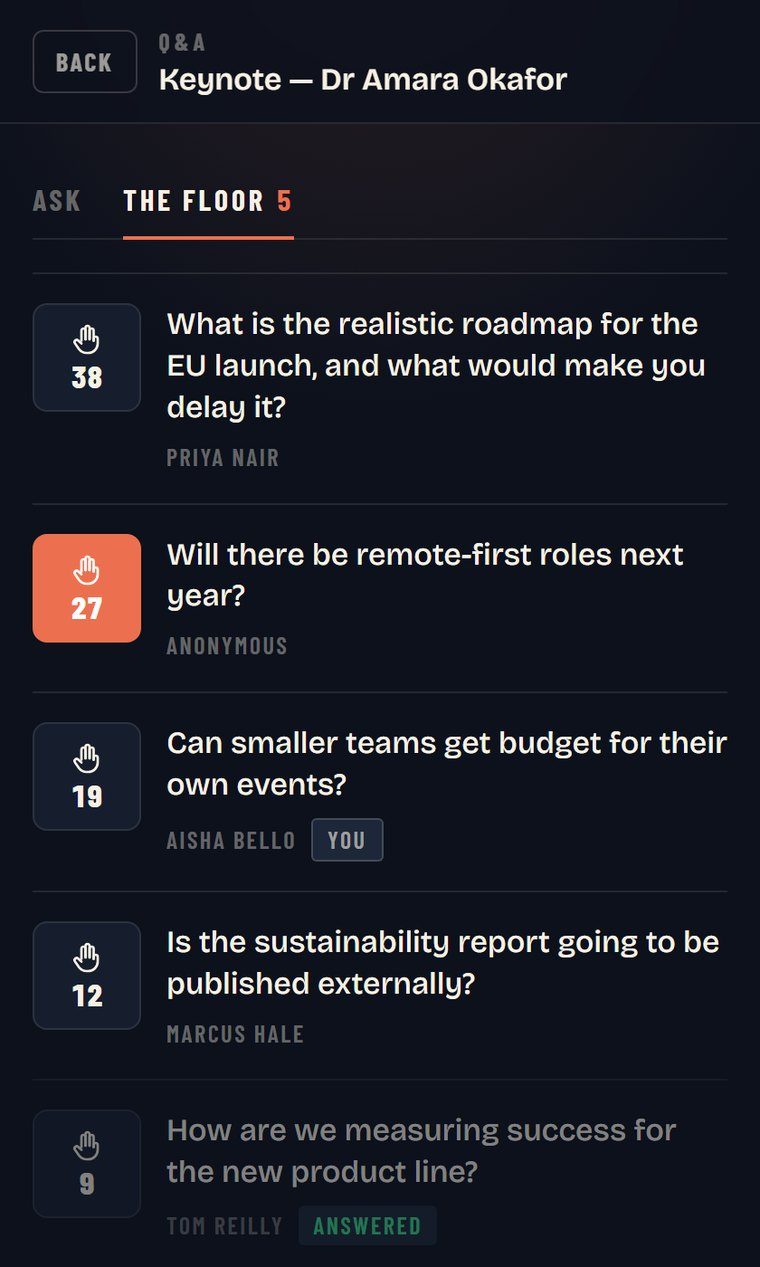
At conference scale a check-in becomes a measurement rather than a round, and the mechanism has to let everybody answer at once. A question asked round a table dies in a hall, because most people will never get a microphone.
I have watched the energy in a room for twenty years and the curve is reliable: the cold open at 9am, the slump around 1:30pm, the flat gap before networking. A whole-room check-in tells you where on that curve you actually are, rather than where the agenda says you should be. The HSE’s management standards on job demands expect systems that respond to individual concerns, and a room telling you it is at four out of ten after lunch is a concern with a timestamp.
Planning a conference rather than a weekly meeting? Openers that scale are a different craft: start with conference icebreakers and how deliberate audience engagement works in a big room. For a team around a table, a shaped question and a clear turn order carry you most weeks, and the no-prep openers for team meetings cover the other half.

17:00Close
Send me your agenda. I’ll show you where the room comes alive.
A fixed price, a free planning call, and a reply within one working day.