Hire a Panel Moderator: What One Session Gets You, and What to Ask
TL;DR
- To hire a panel moderator is to pay for the preparation as much as the hour on stage: a pre-brief, a question plan, timekeeping and the audience Q&A.
- One UK agency puts moderator and facilitator fees at £2,000 to £6,000 (read November 2026). That is one vendor’s range, not a survey, and it is not my fee.
- Ask five things: how they prepare the panellists, what is off limits, what they will do about an overrun, who chooses the audience questions, and what you get in writing.
- A colleague can chair a friendly product panel. A sponsored, senior or contested panel needs a neutral outsider.
Kevin Durham moderates panels, fireside chats and audience Q&A at UK conferences. If you have a strong line-up and nobody to chair it, this is how to hire a panel moderator well: what one session actually gets you, what to ask before you book, and when you do not need one.
What do you get when you hire a panel moderator for one session?
A professional panel moderator gives you four things for one session: a pre-brief with the panellists, a question plan, timekeeping on the day and a managed audience Q&A. Most of that work happens before anyone steps on stage.
The Speakers Agency, in its moderator guide, says even a strong line-up can struggle without someone guiding the discussion. Celebrity Speakers lists the core tasks: setting the scene, managing time, fielding audience questions and handling the unexpected. Here is what that should look like in a booking.
| Stage | What you should receive |
|---|---|
| Before | A call on the aim, audience and line-up; calls with panellists or their teams; a question plan |
| Running order | Timings your production team can hold the moderator to |
| On the day | The opening, the questions, quiet voices brought in, a close on time |
| Audience Q&A | Questions collected, filtered and chosen by the moderator |
| Afterwards | The audience questions exported, if they were collected digitally |
Two of my own jobs sit in that first row. First, I get clear on whether any audience questions need filtering. A sensitive topic, such as two companies merging, can mean some questions should not go through, so I gauge which types I can let through and which I must stop. Second, names: I go through the script with the client on a call, again the day before, and break each name down phonetically.
One client said of me: “Incredibly well prepared, including double checking pronunciations.” (Matt Gilby, GCPA Ltd, on the reviews page.)
How much does it cost to hire a panel moderator in the UK?
The Speakers Agency says UK facilitator and moderator fees typically run between £2,000 and £6,000, depending on experience, profile, format and preparation (read November 2026). It is a speaker agency’s own range, so treat it as indicative, not as a market survey.
Speakers’ Corner publishes fee bands beside its TV presenter facilitators, from £2k to £5k up to £25k and over. A known broadcaster is priced for the name as well as the skill.
Preparation is the lever you can see. A one-hour panel with a pre-brief and a question plan is not a one-hour fee. For the full list of what moves a price and what a quote should include, read the conference host cost guide instead.
My own fee is quoted per event, as a fixed price with no hidden extras, and I state no figure in a blog post. Whoever you ask, find out whether the number includes VAT: GOV.UK gives the standard rate as 20%.
Booking one session instead of a day
Some moderators take only a half day or a full day, and others will do one session. I am happy to take a single panel or a half day, though those requests are rare: I am normally booked to moderate a whole day. With any moderator, ask whether a single session is bookable and what changes in the price if it is.
Expect the pre-brief and question plan to stay in the booking even for one panel, because that work does not shrink with the session. If you have two or three panels across a day, one moderator for all of them gives panellists a single briefing process and a consistent chair. The craft on stage is covered in how to moderate a panel, so I will not repeat it.
What should you ask before you hire a panel moderator?
Ask five moderation-specific questions: how they prepare panellists, how they find what is off limits, what they will tell the panel about interrupting, who chooses audience questions, and what you will see in writing. The answers tell you whether you are buying preparation or just a person with a microphone.
- How will you prepare, and will you speak to my panellists? In a 2014 survey of 539 people, 72% had issues with the moderator, and poor preparation is on the list of mistakes. Hannah Storm, a moderator writing for Journalism.co.uk in May 2024, likes to meet panellists beforehand.
- How do you find out what is off limits? Storm suggests asking speakers which questions they would rather not answer, and what company policy puts out of bounds. A moderator who has never asked is guessing.
- What will you tell the panel about interrupting? Failing to intervene in time is another of those mistakes, and the cure is a pre-brief that says the moderator will step in. Overrunning also costs other sessions: Storm notes it disrespects other people’s breaks and talks.
- Who decides which audience questions get asked? Storm warns against promising Q&A and not delivering it. My answer: I do, having agreed with the client beforehand what can go through, and I hold the microphone throughout. While I have not handed it to an audience member, I keep control.
- What will I see before the day? A question plan, a timed running order, and a clear statement of what the fee covers, including travel, overrun and VAT.
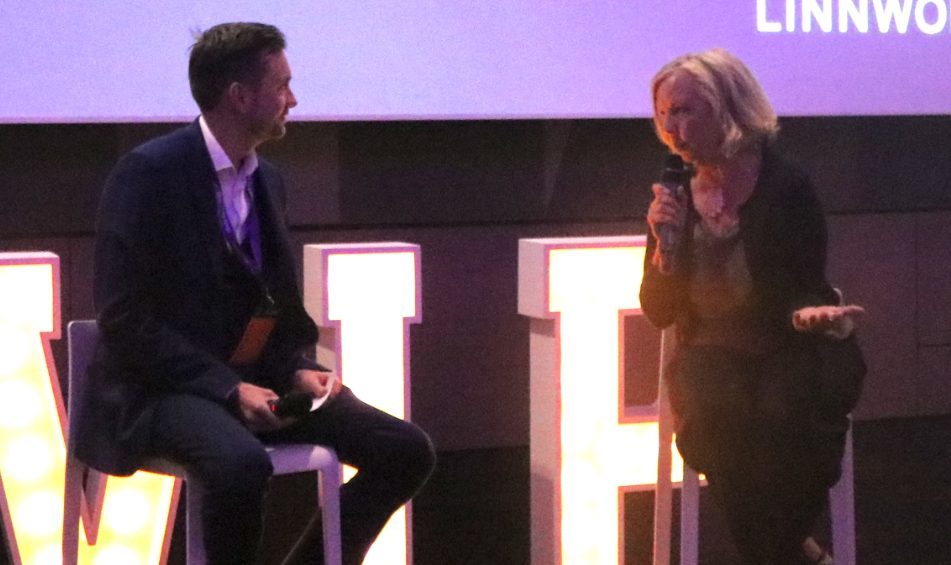
On question four, I use RoomReader, my own live Q&A software, which is included when I host. Every question lands in a queue for me to approve, hold or drop before it reaches the screen. If you are still writing the questions themselves, panel questions has a method.
When is a colleague enough, and when do you need a panel moderator?
Use a colleague when the panel is a product or team session, the audience knows the people and little is at stake. Hire a panel moderator when the panel is sponsored, senior, contested or on the main stage, because the chair has to be neutral and willing to push.
Great British Speakers makes the neutrality point: using a staff member may introduce bias, where an outsider has no side. A sponsor who has paid for the slot and a senior panellist who must not be embarrassed both need someone fair to everyone and still able to ask the question the audience came for. A colleague of the panellists cannot do both.
The 2024 Panels Report from Powerful Panels, which drew on over 100 executives and meeting organisers, found panels worth having when done well and not when done poorly. Whether you need a professional for the whole day is a separate test, set out in in-house or professional.
What to send when you get in touch
Send the line-up, the theme, the session length, the audience size and format (in the room, hybrid or online), whether there is Q&A and for how long, any topic that is sensitive, and what went wrong last time. That is enough for a moderator to say whether the session needs one.
I would rather tell you straight than sell you a booking. Send me the line-up and the theme, and if you do not need me, I will say so. The event moderator page has the formats I chair, and the conference host site covers the full day.
Send the agenda to hello@conferencehost.uk or call 07596 851647 to check availability.


17:00Close
Send me your agenda. I’ll show you where the room comes alive.
A fixed price, a free planning call, and a reply within one working day.