Lightning Talks: How to Run a Session That Does Not Eat Your Afternoon

TL;DR
- Cap a lightning talk at five minutes and run six to eight of them in a 30 to 90 minute block.
- Pick the discipline first: a free five minutes, Ignite’s 20 slides at 15 seconds, pecha kucha’s 20×20, or one slide in two minutes.
- One laptop, every deck in PDF, collected 48 hours ahead in running order.
- Say from the stage that you will stop people at time, then do it without apologising.
Lightning talks are the cheapest way to get eight voices on your stage inside an hour, and the easiest session in the day to lose. The talks are rarely the problem. The ninety seconds between them is, and so is the speaker who has brought a 40-minute deck and intends to use all of it. This is the operational side, from the host’s chair.
What is a lightning talk, and how long should it be?
A lightning talk is a very short talk, usually capped at five minutes, with several speakers running one after another in one session. Make five minutes your default and move off it only for a reason.
The range is wider than people expect. It runs five to ten minutes but is usually capped at five, and the block is typically 30 to 90 minutes. It dates from the Python Conference in 1997, and Mark Jason Dominus coined the name in June 2000.
Shorter works. At CW23 in May 2023 the Software Sustainability Institute gave speakers two minutes and one slide. Longer works too, but stops being lightning: the Alan Turing Institute runs internal ten-minute slots and says plainly that it is strict with time.
Which lightning talks format should you pick?
Pick by how much you trust your speakers to rehearse. The looser the format, the more rehearsal it quietly demands.
| Format | Shape | Length | What it asks of the speaker |
|---|---|---|---|
| Free lightning talk | Any slides, or none | 5 minutes | Self-discipline, nothing stops them but you |
| Ignite | 20 slides, auto-advancing | 5 minutes | Three rehearsals, no room to drift |
| Pecha kucha | 20 slides at 20 seconds | 6 min 40 sec | Visual thinking, one idea per image |
| One-slider | 1 static slide | 2 to 3 minutes | Ruthless editing, nothing to hide behind |
Ignite talks run 20 slides advancing every 15 seconds, five minutes exactly, from one Seattle event in 2006 to 350 cities. PechaKucha began in Tokyo in February 2003 with 20 images at 20 seconds each, landing every talk at 6 minutes 40 seconds. The pecha kucha guide covers those rules in detail.
The one-slider deserves more love. The Three Minute Thesis, developed at Queensland in 2008, allows one static slide with no transitions, so nobody can bury a thin idea in build effects.
How many lightning talks fit in a session?
Six to eight. Past ten, the room stops telling one speaker from the next, however good they are.
BSDCan’s June 2025 session is a tidy model: 40 minutes split between a maximum of eight speakers, so at least five minutes each.
Do the arithmetic with the gaps in it. Eight five-minute talks is 40 minutes of content, plus a 20-second handover each and two minutes to open and close, so you need 45. Book 50 and you finish early, which no delegate has ever complained about.
One laptop, or does everyone plug in their own?
One laptop, always, with every deck already on it. That decision removes most of what goes wrong.
BSDCan spells out the policy: slides by email before a stated deadline, PDF only, one laptop for everything, no live demos. Harsh on paper, and the session runs like a train. useR! 2017 wanted the PDF file by a named date too.
Who holds the clicker depends on the format. In an auto-advancing block, nobody: AV starts the deck and the speaker only has to talk. In a free block, pass it across while the current speaker is still going, and make sure the next one has held it at the tech check. Someone meeting a clicker on stage loses fifteen seconds and their composure.
How do you collect the slides in advance?
Set a deadline 48 hours ahead, ask for PDF, and merge every deck into one file in running order.
The parts people skip:
- A file naming rule. Surname-firstname.pdf. Ten files called Presentation.pdf is how the wrong deck goes up.
- A tech check with a time on it. Write the Docs holds one fifteen minutes before the session and confirms the running order there.
- A stated consequence. BSDCan’s is blunt and effective: miss the deadline, you get no slides.
- A merged master deck in run of show order, with a holding slide between talks.
Then there is the person who turns up five minutes before the block with their deck on a memory stick. Decide that answer before they ask, not in front of them.
What works: they go last, the file is copied at the desk rather than plugged into the show laptop mid-session, and if there is no time they speak without slides. PyCon US tells speakers slides are not required, so that is the normal version of the format, not a punishment. Say it warmly: “You are on last, and we will run it off the desk machine if it loads in time.”
The clock, the handover, and what you say at zero
A visible countdown helps, and it can also make a nervous speaker gabble. The difference is whether they knew it was coming.
Write the Docs runs a countdown timer for every talk, signals at one minute and stops speakers at five. The clock puts the decision to wrap up with the speaker, not with you. Put it on a monitor they can see rather than the screen behind them, and show them the one-minute cue at the tech check.
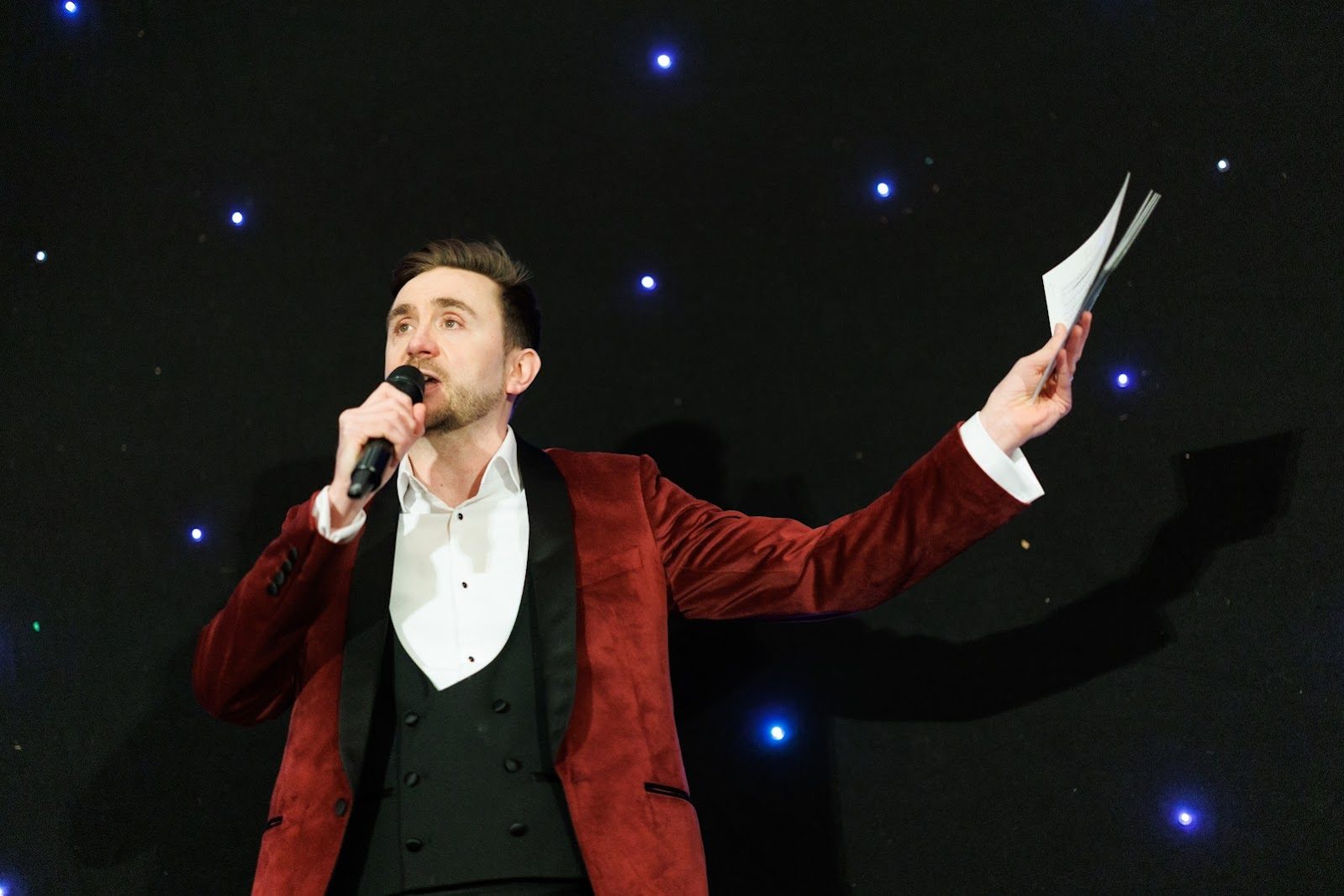
Handovers are where sessions bleed. Eight talks means eight gaps, and ninety seconds each is twelve minutes spent watching people walk.
- Speakers sit in the front row in running order, and the next one stands as the applause starts.
- Your introduction is one line: name, team, title. The speaker introduction guide covers what to leave out.
- The holding slide goes up the second a talk ends, so AV never shows a desktop.
- Lead the applause and cut it at four seconds. It is a transition, not an interval.
Cutting someone off is the bit hosts dread, and this format licenses it in advance. Say so before the first talk: “Everyone gets five minutes. I will stop people at five minutes, including the chief executive, and nobody should take it personally.”
At zero: “That is time. Give us the one line you want us to leave with.” If they keep going, warmth and a full stop: “We will leave it there, because I want you all to go and find Priya in the break.” Then straight into the next name, and the room reads it as the format working.
Should lightning talks take questions?
Not between the talks. Questions after every speaker double the length of the block and kill the rhythm that makes it worth doing.
Small internal sessions can afford them, which is why the Turing handbook allows a few minutes per slot. In a hall of 200, where a microphone has to walk to each raised hand, collect questions during the block and run one short Q&A at the end. I use RoomReader, my own live Q&A software, so delegates send questions from their phones with nothing to download and the host picks three good ones instead of taking whoever reaches the microphone first.
Briefing a first-time lightning talks speaker
The failure mode is always the same. Someone compresses their 40-minute talk into five, and you get a trailer for a talk nobody will see.
Give them a different instruction. One idea, one example, one thing you want the room to do next. Write the last sentence first, then build the three slides that earn it. Ignite makes the same case for its own constraint: the work is drilling down to the essence of an idea.
The 3MT guide tells competitors to read it aloud and ask whether the point landed, which catches an overrun before the day. Write the Docs also keeps a separate first-time speaker category, and telling a nervous colleague the slot is built for first-timers does more than any amount of coaching.
Where lightning talks belong in the day
The hardest slot on any programme I have hosted is the one straight after lunch. A block with a new face every five minutes is built for it.
Straight after a keynote is the worst slot, because five-minute talks sound thin next to 45 minutes of polish. The slot before networking is the sleeper hit: the room leaves with eight things to open a conversation with. There is more on pacing in the guide to hold attention.
If you want the clock, the handovers and the cut-offs handled by a conference MC who has hosted more than 800 events, send the agenda to hello@conferencehost.uk.
17:00Close
Send me your agenda. I’ll show you where the room comes alive.
A fixed price, a free planning call, and a reply within one working day.