Anonymous Questions at Conference Q&A: How to Run Them Well
TL;DR
- Anonymous questions are typed on delegates’ phones and reach the host without a name attached, so people ask what they would never say into a microphone.
- Research on speaking up at work finds people stay quiet out of fear that is rarely based on anything that has happened to them.
- The risk is real. A question with no face behind it is more likely to be rude, or aimed at one colleague.
- Pre-moderation fixes most of that. Every question lands in a queue, and the host approves, holds or drops it before the room sees it.
- Named or anonymous is the organiser’s choice. Decide it in the brief and say it out loud in the welcome.
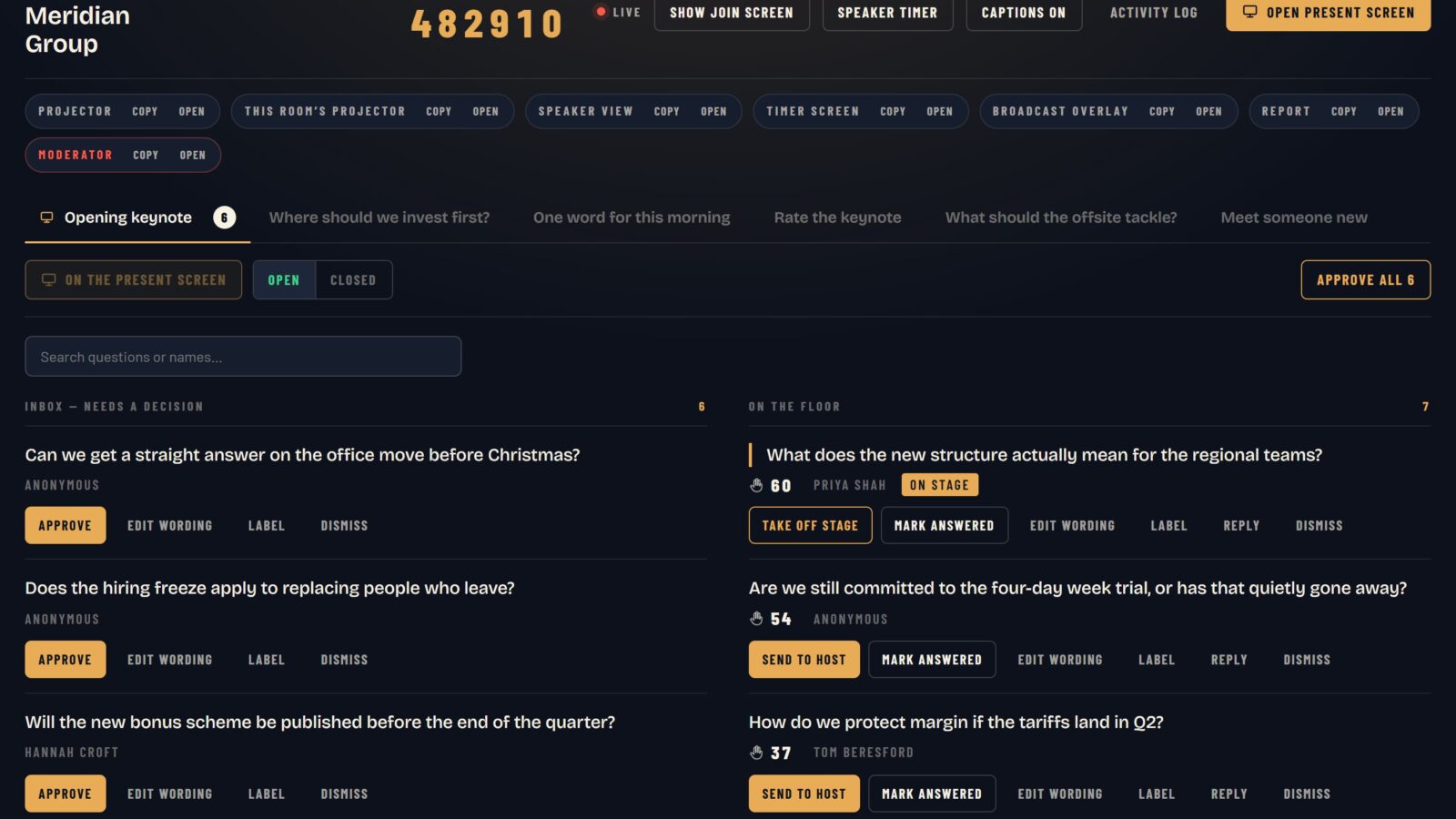
Anonymous questions at a conference are questions delegates send from their phones without their name on the screen. This post, written from my side of the stage as a conference host, covers how to let delegates ask anonymous questions at a conference without letting the session go sideways: why anonymity works, and how a moderation queue catches what goes wrong.
Why do anonymous questions at conference Q&A get the real questions asked?
Anonymous questions at conference Q&A get asked because they remove the social risk of asking. A delegate who would never stand up in front of 300 colleagues will type the same question from their seat, because nobody can see who sent it and nobody can judge them for it.
The research on why people stay quiet points one way. Amy Edmondson’s 1999 paper defined psychological safety as a shared belief that a team is safe for interpersonal risk taking. A conference hall with the chief executive on stage is rarely that.
Her 2011 work with James Detert went further. Their four studies found implicit voice theories, taken-for-granted rules about when speaking up is risky, which suppress questions even where it is objectively safe. Steven Kelman’s April 2012 summary of the paper adds the striking part: people’s fears were seldom based on anything they had experienced. Detert and Ethan Burris made the same point in Harvard Business Review in January 2016: however open the manager, many staff are more likely to keep mum than question an initiative.
Classroom studies show what changes when the name goes. In a 2010 study of 128 students answering 50 controversial questions, anonymous keypads produced more varied answers than a show of hands, which suggests less conformity, and shy students strongly preferred them. At the University of Michigan, reported by EdSurge in October 2019, an anonymous backchannel dramatically increased questions in large lectures.
That matches what I see from the stage. People who would never put a hand up in front of their peers will type a question without a second thought, especially when their name is not on it.
What can go wrong with anonymous questions at conference Q&A?
Anonymous questions at conference Q&A can go wrong in three ways: a question is rude, it is off-topic, or it names and targets a colleague. Remove the name and you remove some of the restraint that comes with it, so a host should expect a few questions that must never reach the big screen.
The eye-contact research explains why. Noam Lapidot-Lefler and Azy Barak tested 142 people chatting online in March 2012 and found that lack of eye contact drove hostile messages more than anonymity did. Scientific American’s September 2012 write-up put it plainly: with their eyes hidden, participants were twice as likely to be hostile. A delegate typing on a phone in row 30 has no eye contact with anyone on stage.
The quieter failures are more common than the rude ones:
- Six versions of the same question about the restructure.
- A complaint about the coffee posted during a keynote on strategy.
- A loaded question written to embarrass one speaker, not to get an answer.
- A question that would be fine at the break and wrong in front of 300 people.
None of these is a reason to switch anonymity off. They are a reason to put someone between the phones and the screen.
How does pre-moderation handle rude or off-topic questions?
Pre-moderation means every question goes into a private queue before the room sees anything. The host reads each one and approves it for the screen, holds it for later or drops it. A rude question is read by one person and goes no further, so the room never knows it was sent.
RoomReader, the live Q&A software I built and bring to every conference I host, has pre-moderation on by default. Delegates join by QR code or six digits, with no app to download, and each question waits in my queue until I decide.
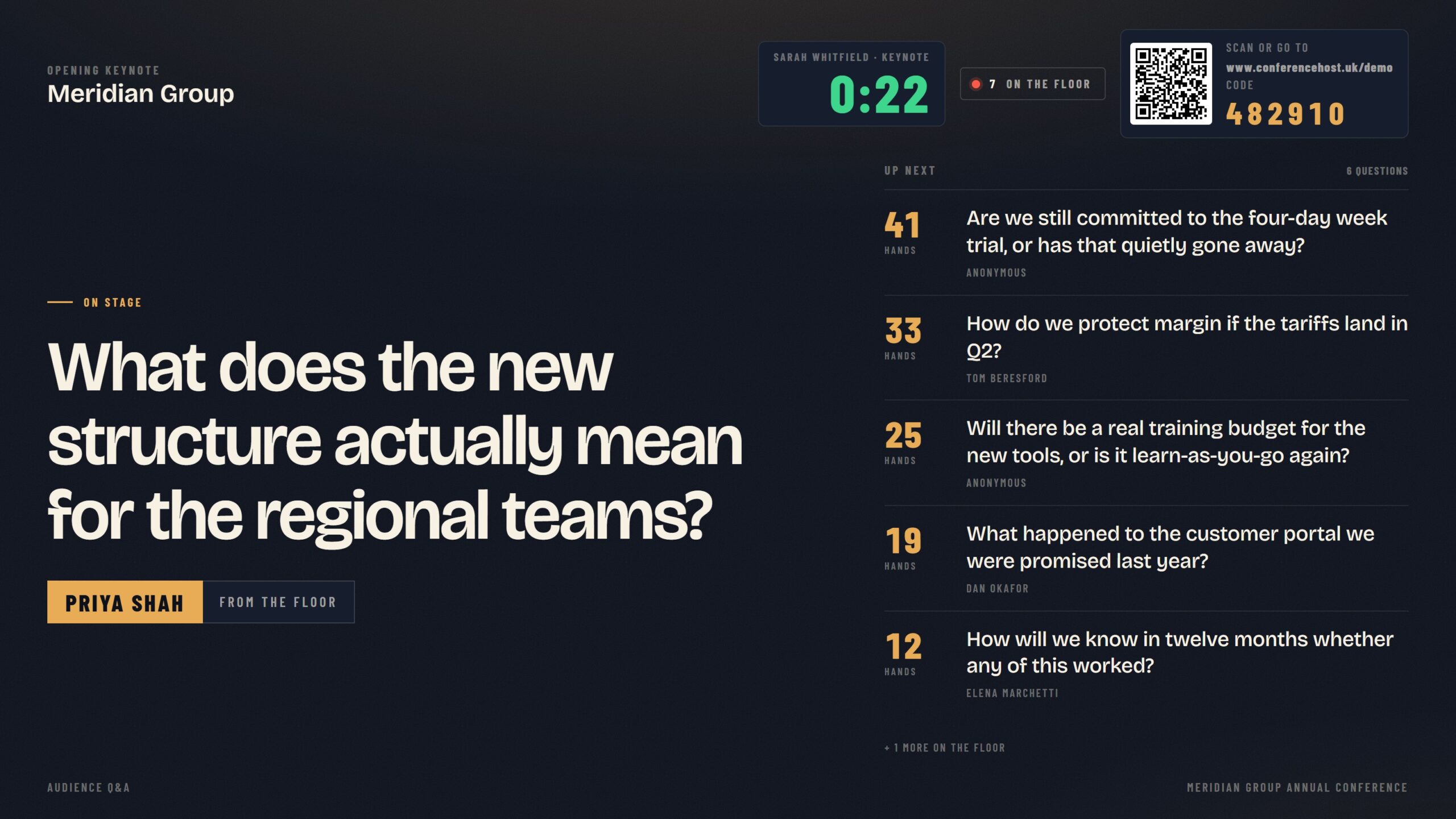
These are my own rules for the queue, not a research finding:
| What arrives | What I do | Why |
|---|---|---|
| A hard question the leadership would rather not hear | Approve | Dropping it teaches the room the queue is for show |
| A good question at the wrong moment | Hold | Bring it back in the session it belongs to |
| Five versions of one question | Approve the clearest, drop the rest | One answer covers all of them |
| A personal attack or a named colleague | Drop | It never reaches the screen |
| A complaint about the venue or the coffee | Drop, then pass it to the organiser | Real feedback, wrong audience |
The first row matters most. Pre-moderation is for rudeness, not for difficulty. Morrison’s 2014 review argues that people speak up when they believe it is both safe and worth it. Anonymity makes it safe. A host who answers the awkward question in front of everyone makes it worth it.
Named or anonymous: the organiser’s choice
Named or anonymous is the organiser’s call, made before the day. RoomReader lets delegates ask in their own name or anonymously, as the organiser allows, so the setting matches the event.
My rule of thumb:
- Leaders answering their own staff: allow anonymous. This is where hierarchy silences people most, which is why the town hall guide recommends it.
- An external expert panel or a customer conference: names optional. Many people like the credit for a sharp question.
- A small technical workshop: named is usually fine, because the speaker may want to follow up.
Then tell the room exactly what anonymous means. The Michigan backchannel hid names from classmates but not from the professor. Delegates deserve to know which kind they are using. In RoomReader the data is deleted 30 days after the event, and saying so in the welcome costs ten seconds.
Setting it up on the day
- Agree the name setting in the brief, session by session. RoomReader runs multiple sessions per event, so a keynote and a closing panel each get their own queue.
- Put the QR code and the six digits on the holding slide.
- Say in the welcome how questions work, who reads them and what anonymous means.
- Read each approved question out on the microphone, so the whole room hears it.
- Let the room upvote, so the questions most people want answered rise to the top. That is a subject of its own.
- Export the unanswered ones by CSV afterwards, so the speaker can reply by email.
When is it worth bringing in a host to moderate anonymous questions?
A host is worth bringing in once the questions are aimed at senior leaders in a room of hundreds, or the subject is sensitive enough that one bad question on the big screen would be the thing people remember. A colleague with a laptop can moderate a team meeting of 30. Running a live queue while chairing the stage, keeping time and keeping the whole room with you is a full job, and it is the one I do.
As a panel moderator I handle the queue and the stage together. Nicola Briscoe of the Electrical Industries Charity is quoted on my reviews page: “He’s really professional, engaged the room and took control where we needed it.” Kind words. The delegates asking the questions are the ones doing the brave part.
Each event gets one fixed quote, nothing extra afterwards, and RoomReader comes included when I host. Have ready the date, the delegate numbers, who will be answering, and whether questions should be named or anonymous. Send the agenda or check availability at hello@conferencehost.uk, or call 07596 851647.


17:00Close
Send me your agenda. I’ll show you where the room comes alive.
A fixed price, a free planning call, and a reply within one working day.